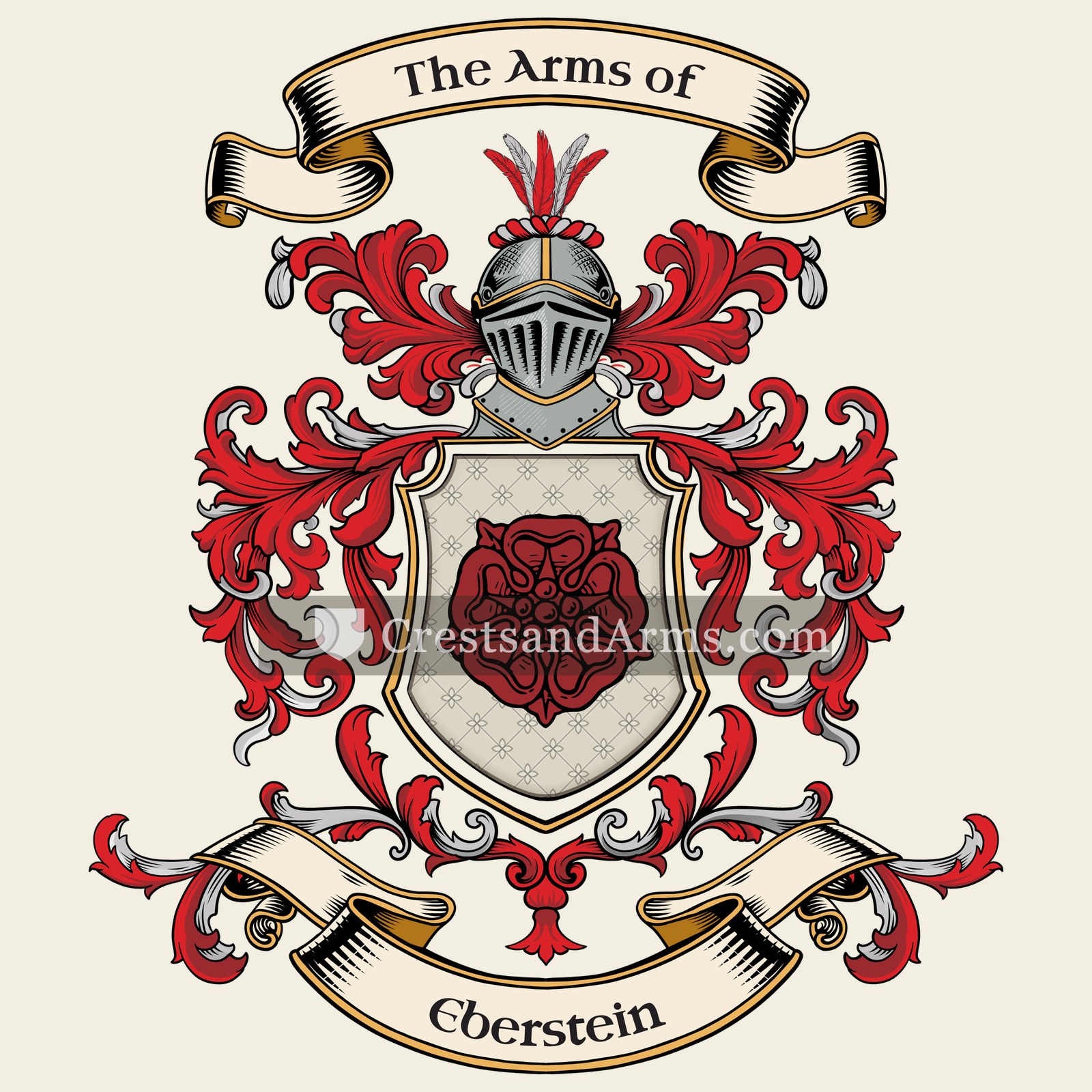
A record of documented arms, meaning and origin, researched for the Eberstein family of Germany.
Reg. 4384 · German, D–F
Coat of Arms & Family Crest Details
Symbols on this shield
roseThe seventh son, and beauty with grace
Colours
Silver (Argent)Means: Peace and sincerity
Red (Gules)Means: Military strength
Historical info
Source
J. B. Rietstap, Armorial Général, Gouda: G. B. van Goor Zonen, 1884–87
Blazon (the actual original written record)
“D'arg. à une rose de gu., bout. d'azur, barbée de sin. C.: la rose, entre deux prob. d'arg., ayant chacune à l'ext. quatre verges horizontales d'or, ornées de feuilles de tilleul du même. - Plus tard ces armes étaient éc. d'or à un sanglier de sa., pass. sur un tertre de sin., et augmentées d'un second cimier, savoir un buste d'homme, hab. d'or, coiffé d'un mitre épiscopal et ch. sur la poitrine de la rose de l'écu.”
WestphaliaWestphalia, c. 1660
Digital archive packCoat of arms PNG, gold border print PDF, vector SVG and the certificate of authenticity. Sent to your email in minutes.
Map of Germany showing where the Eberstein arms are recorded
The Eberstein arms were recorded in Westphalia, c. 1660.
Westphalia was a land of small estates and fortified farmhouses in western Germany. Its families were numerous and not especially rich, but each held its own ground, and holding ground was what brought arms.
This is where the arms were entered in the register. Families often moved to other parts of the country, so the same name can turn up in more than one region.
The body that granted and recorded arms in Germany in this period.
Leopold I, Holy Roman Emperor
Sovereign of the period
Leopold I, Holy Roman Emperor
1658–1705
Reigning in Germany when the Eberstein arms are first recorded.
How Arms Worked in Germany
In the Holy Roman Empire, coats of arms were often granted to individuals by the Emperor or his representatives. These arms were then passed down through the generations to all legitimate descendants of the original holder. Younger branches of a family usually kept the same shield design without needing to change it, as the arms belonged to the entire lineage.
Granting authority
The Holy Roman Emperor held the sole power to grant new coats of arms throughout his vast imperial territories.
How they got arms
Families typically obtained their coats of arms through a formal imperial grant or by proving their noble status to the authorities.
Where arms were recorded
These grants were officially recorded in the Imperial Chancery registers, which began keeping formal records of such honors during the Middle Ages.
The family's standing
Recorded among the armigerous families of Westphalia.
Origin & History of the Eberstein Family in Germany
The name Eberstein is rooted in the German language and translates literally to boar stone. This name likely originated as a topographical identifier for families living near a prominent rock formation or a landmark associated with wild boars. By the year 1660, historical records confirm that members of the Eberstein family were well established in the Westphalia region of Germany. During this period, the family lived in a landscape defined by dense forests and rural farming communities. Life in Westphalia during the mid-seventeenth century was shaped by the aftermath of the Thirty Years' War, which forced many families to focus on rebuilding their local agricultural ties and strengthening their community presence. As the family grew, they became part of the social fabric of the region, contributing to the local economy and the development of Westphalian village life.
Eberstein Meaning & Related Branches
Root word
Eber and Stein
Eber means wild boar and Stein means stone or rock.
This name
EbersteinRefers to a location or castle associated with a wild boar, likely indicating a fortified rocky site.
also spelled
Ebersteine
Ebersteinn
Ebersteinh
Eberstine
Documented Sources
J. B. Rietstap, Armorial Général, Gouda: G. B. van Goor Zonen, 1884–87


 roseThe seventh son, and beauty with grace
 roseThe seventh son, and beauty with grace