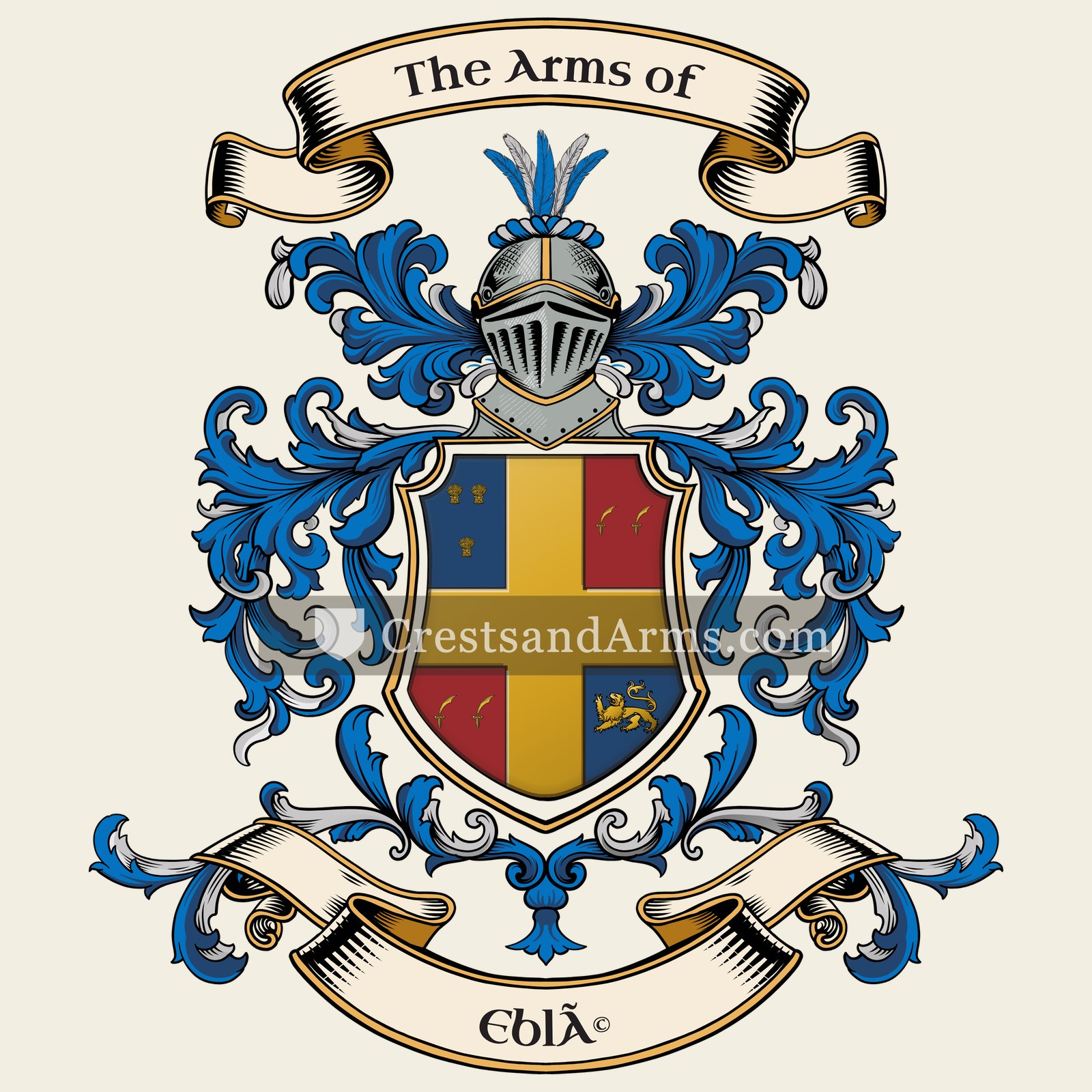
A record of documented arms, meaning and origin, researched for the Eblé family of France.
Reg. 7142 · French, D–F
Coat of Arms & Family Crest Details
Symbols on this shield
cross symbolChristian faith and service
wheatsheafPlenty, and the harvest of one's own labour
swordJustice, and military honour
lionCourage, strength and royalty
Colours
Blue (Azure)Means: Loyalty and truth
Red (Gules)Means: Military strength
Gold (Or)Means: Generosity
Historical info
Source
J. B. Rietstap, Armorial Général, Gouda: G. B. van Goor Zonen, 1884–87
Blazon (the actual original written record)
“Ec.: au 1 d'azur à trois épis d'or, liés du même; aux 2 et 3 de gu. à deux épées garnies d'or, passées en saut.; au 4 d'azur au lion cont. d'or. A la croix d'or, br. sur les écartelures.”
FranceParis, c. 1809
Digital archive packCoat of arms PNG, gold border print PDF, vector SVG and the certificate of authenticity. Sent to your email in minutes.
Map of France showing where the Eblé arms are recorded
The Eblé arms were recorded in Paris, c. 1809.
This is where the arms were entered in the register. Families often moved to other parts of the country, so the same name can turn up in more than one region.
The body that granted and recorded arms in France in this period.
Napoleon
Sovereign of the period
Napoleon
1804–1814
Reigning in France when the Eblé arms are first recorded.
How Arms Worked in France
In France, a coat of arms was a mark of honor that passed down through the male line to all legitimate descendants. Families often used the same shield without changes to show their shared heritage. If a branch wanted to stand out, they could add a small mark to their shield to show their specific place in the family tree.
Granting authority
The Juge d'armes de France acted as the official authority that regulated and verified coats of arms across the country.
How they got arms
Families typically inherited their arms from ancestors, though they could also receive them through royal grants or by proving their noble status.
Where arms were recorded
Coats of arms were officially recorded in the Armorial Général de France, which began its main collection in the year 1696.
The family's standing
Recorded among the armigerous families of France.
Origin & History of the Eblé Family in France
The Eblé family name is most famously linked to the military history of France during the early nineteenth century. The family rose to prominence in Paris around 1809, a time when the city was the center of the Napoleonic Empire. The most notable figure from this period was Jean-Baptiste Eblé, a brilliant engineer who served as a general under Napoleon Bonaparte. He is best remembered for his heroic leadership during the retreat from Russia in 1812. His engineers built vital bridges under freezing conditions, which allowed thousands of French soldiers to escape across the Berezina River. This act of bravery cemented the family name in French history as a symbol of technical skill and dedication. While the name has deep roots in the administrative and military circles of Paris, it remains a proud marker of those who served the nation during a period of intense European conflict.
Eblé Meaning & Related Branches
Root word
Eberhard
Derived from Germanic elements meaning wild boar and brave or hardy.
This name
EbléA French patronymic form originating from the ancient Germanic personal name Eberhard.
also spelled
Ebel
Eblay
Related arms
Ebelvariant spelling
Documented Sources
J. B. Rietstap, Armorial Général, Gouda: G. B. van Goor Zonen, 1884–87
Fugier, André, Napoléon et l'Italie, 1947
Tulard, Jean, Dictionnaire Napoléon, 1987
Service historique de la Défense, Dossiers de proposition de la Légion d'honneur, Eblé, Jean-Baptiste, 1804–1812
Digital archive packCoat of arms PNG, gold border print PDF, vector SVG and the certificate of authenticity. Sent to your email in minutes.


 cross symbolChristian faith and service
 wheatsheafPlenty, and the harvest of one's own labour
 swordJustice, and military honour
 lionCourage, strength and royalty
 cross symbolChristian faith and service
 wheatsheafPlenty, and the harvest of one's own labour
 swordJustice, and military honour
 lionCourage, strength and royalty