Map of Spain showing where the Echevarria arms are recorded
The Echevarria arms were recorded in Provinces basques, c. 1725.
This is where the arms were entered in the register. Families often moved to other parts of the country, so the same name can turn up in more than one region.
The body that granted and recorded arms in Spain in this period.
Philip V of Spain
Sovereign of the period
Philip V of Spain
1724–1746
Reigning in Spain when the Echevarria arms are first recorded.
How Arms Worked in Spain
In Spain, a coat of arms was considered a form of property that belonged to the entire family line. These arms were passed down from a father to all his children equally. Younger branches of the family usually kept the original design without needing to add any special marks to distinguish their specific line.
Granting authority
The Cronista Rey de Armas was the official body that regulated and granted coats of arms throughout Spain.
How they got arms
Families often obtained their arms through royal grants or by proving their noble status to the official heraldic authority.
Where arms were recorded
Coats of arms were officially recorded in the registers of the Cronista Rey de Armas starting in 1496.
The family's standing
Recorded among the armigerous families of Spain.
Origin & History of the Echevarria Family in Spain
The surname Echevarria originates from the Basque Country, a region spanning parts of northern Spain and southwestern France. The name is derived from the Basque words "etxe," meaning house, and "berri," meaning new. When combined, the name translates to "the new house," which suggests that early family members were likely identified by their residence in a newly constructed home within their village. By 1725, records confirm that families bearing this name were well-established in the Basque provinces, where they lived in close-knit rural communities. These early ancestors were deeply connected to the local landscape and culture, often working as farmers or craftsmen. Because the Basque language is one of the oldest in Europe, the name reflects a long history of local identity that predates the influence of neighboring kingdoms. Over time, the family name became a way to track lineage and property ownership as the population grew and moved across the rugged terrain of the region.
Echevarria Meaning & Related Branches
Root word
etxe berri
Basque words for house and new.
This name
EchevarriaRefers to someone who lived in or originated from a new house.
also spelled
Echevarie
Echevaria
Echevarry
Related arms
Carguizanorecorded with Echevarria, same area
Eloriagarecorded with Echevarria, same area
Fagoagarecorded with Echevarria, same area
Galarzarecorded with Echevarria, same area
Documented Sources
J. B. Rietstap, Armorial Général, Gouda: G. B. van Goor Zonen, 1884–87
Gorrochategui, Joaquín. Onomástica indígena de Aquitania. 1984
Michelena, Luis. Apellidos vascos. 1953
Digital archive packCoat of arms PNG, gold border print PDF, vector SVG and the certificate of authenticity. Sent to your email in minutes.


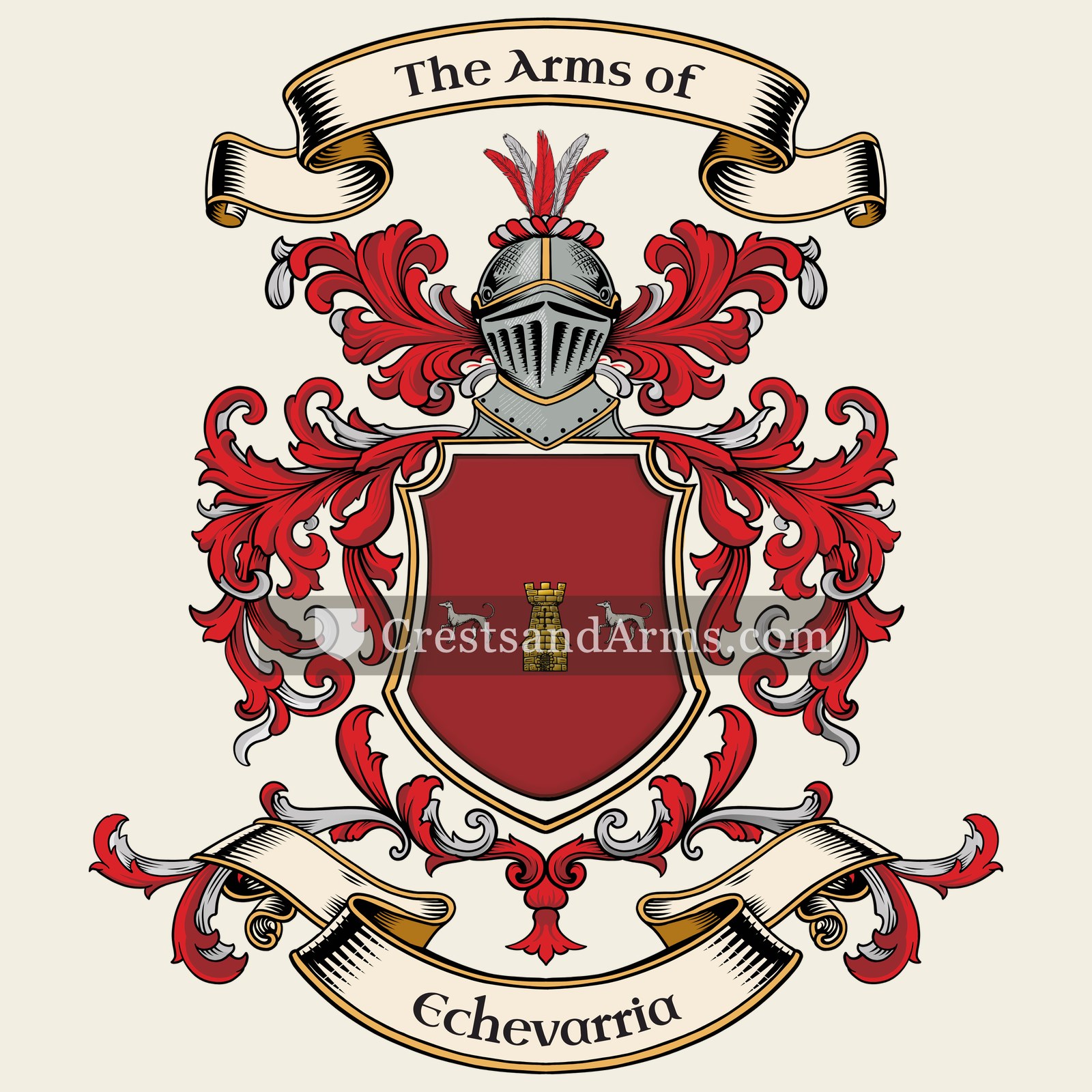
 towerGrandeur and solidity, and a stronghold defended
 greyhoundCourage, vigilance and loyalty
 towerGrandeur and solidity, and a stronghold defended
 greyhoundCourage, vigilance and loyalty