Map of Spain showing where the Echeverria arms are recorded
The Echeverria arms were recorded in Brabant, c. 1742.
Brabant lay at the heart of the Low Countries, where the trade routes met. Its towns were wealthy and its landowners many, and both kinds of family kept arms, which is why the region is so heavily represented.
This is where the arms were entered in the register. Families often moved to other parts of the country, so the same name can turn up in more than one region.
The body that granted and recorded arms in Spain in this period.
Philip V of Spain
Sovereign of the period
Philip V of Spain
1724–1746
Reigning in Spain when the Echeverria arms are first recorded.
How Arms Worked in Spain
In Spain, a coat of arms was considered a form of property that belonged to the entire family line. These arms were passed down from a father to all his children equally. Younger branches of the family usually kept the original design without needing to add any special marks to distinguish their specific line.
Granting authority
The Cronista Rey de Armas was the official body that regulated and granted coats of arms throughout Spain.
How they got arms
Families often obtained their arms through royal grants or by proving their noble status to the official heraldic authority.
Where arms were recorded
Coats of arms were officially recorded in the registers of the Cronista Rey de Armas starting in 1496.
The family's standing
Recorded among the armigerous families of Brabant.
Origin & History of the Echeverria Family in Spain
The family name Echeverria originates from the Basque language, which is spoken in the region between northern Spain and southwestern France. The name is derived from the Basque words "etxe," meaning house, and "berri," meaning new, effectively identifying the original family as the residents of the new house in their village. While the name is deeply rooted in Basque culture, historical records confirm that members of the family had migrated as far as the Duchy of Brabant by 1742. This movement suggests that the family was involved in the extensive trade networks or military service that connected the Spanish Netherlands to the rest of Europe during the eighteenth century. By settling in Brabant, these early family members became part of a diverse population in a region that served as a major crossroads for international commerce and cultural exchange.
Echeverria Meaning & Related Branches
Root word
etxe berri
Basque words for house and new.
This name
EcheverriaRefers to someone who lived in or originated from a new house.
also spelled
Echeveria
Echeverrie
Echeverry
Documented Sources
J. B. Rietstap, Armorial Général, Gouda: G. B. van Goor Zonen, 1884–87
Koldo Mitxelena, Apellidos vascos, 1953
Archivo General de Simancas, Secretaría de Guerra, 1742
Joseph de Moret, Annales del Reyno de Navarra, 1684
Digital archive packCoat of arms PNG, gold border print PDF, vector SVG and the certificate of authenticity. Sent to your email in minutes.


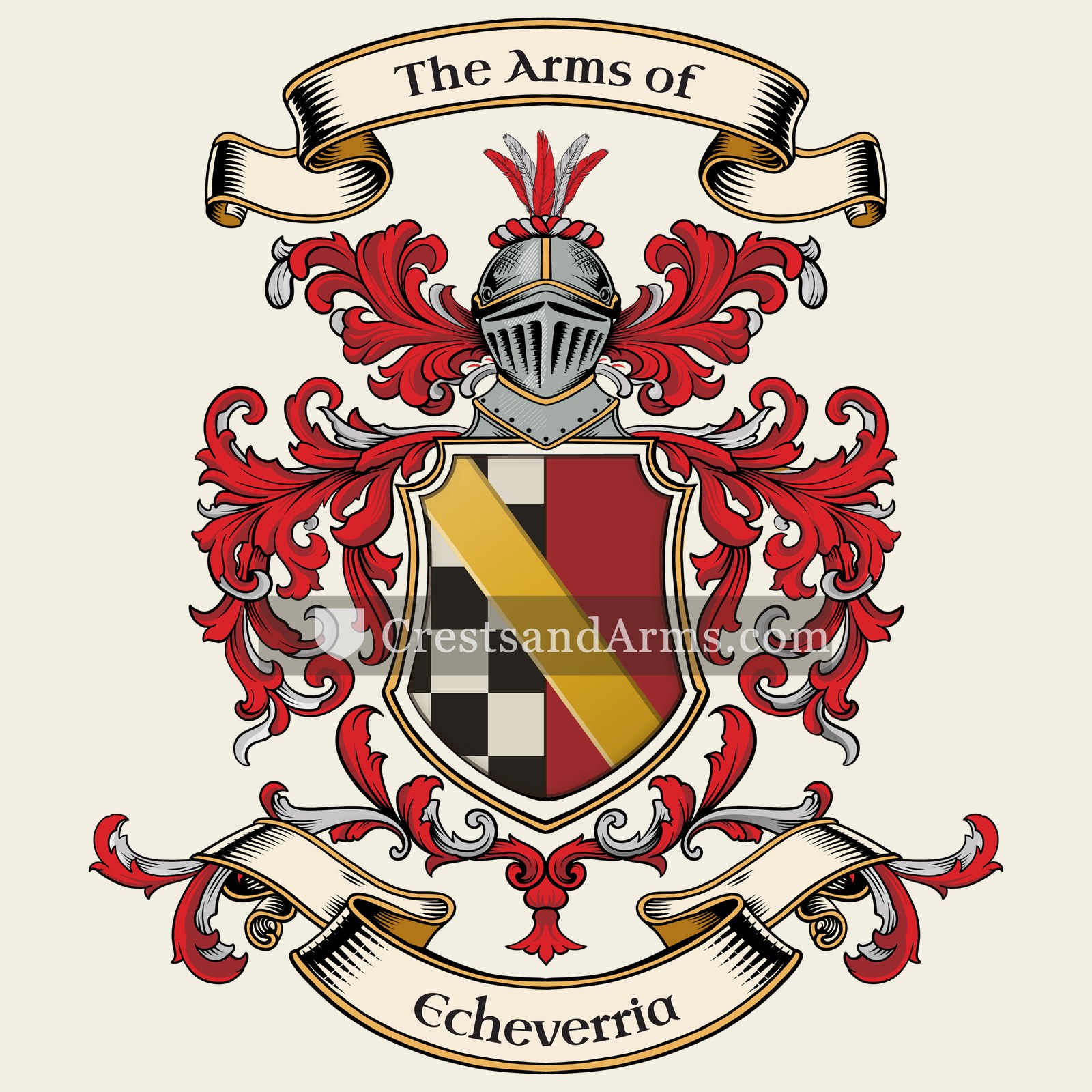
 chequyConstancy, and the counting-board
 bendDefence, and the scarf of a commander
 chequyConstancy, and the counting-board
 bendDefence, and the scarf of a commander