Map of Britain showing where the Echlin arms are recorded
The Echlin arms were recorded in Britain, c. 1721.
Arms such as these were typically recorded in Kent.
Kent sits between London and the short crossing to Europe, and the trade passing through made it wealthy. Merchant families bought land with that money, and it was landowners who took coats of arms.
This is where the arms were entered in the register. Families often moved to other parts of the country, so the same name can turn up in more than one region.
The body that granted and recorded arms in Britain in this period.
George I of Great Britain
Sovereign of the period
George I of Great Britain
1714–1727
Reigning in Britain when the Echlin arms are first recorded.
How Arms Worked in Britain
English heraldry allowed arms to be shared by all legitimate descendants of the original owner. These symbols were treated as personal property that moved through the generations to all children. While the eldest son kept the original design, other family members could use the same shield without needing to change it or register their own unique versions.
Granting authority
The College of Arms in London has regulated the use of coats of arms throughout England and Wales since 1484.
How they got arms
Families typically obtained their coats of arms through a formal grant from the Crown or by proving their ancient right to them.
Where arms were recorded
All official coats of arms are recorded in the registers kept at the College of Arms, which date back to the fifteenth century.
The family's standing
Recorded among the armigerous families of Britain.
Origin & History of the Echlin Family in Britain
The family name Echlin carries a history deeply rooted in the movement of people across the British Isles. While the name is often associated with later settlements in Ireland, records confirm that members of the family were firmly established in the county of Kent by 1721. During this period, families frequently moved between rural estates and growing urban centers to pursue opportunities in trade or local administration. The presence of the Echlin name in Kent suggests that the family was part of the broader social fabric of southern England, likely participating in the local agricultural or mercantile life that defined the region during the early eighteenth century. By tracing these early residents, we gain a clearer picture of how the family integrated into English society before spreading further across the country.
Coat of Arms & Family Crest Details
Symbols on this shield
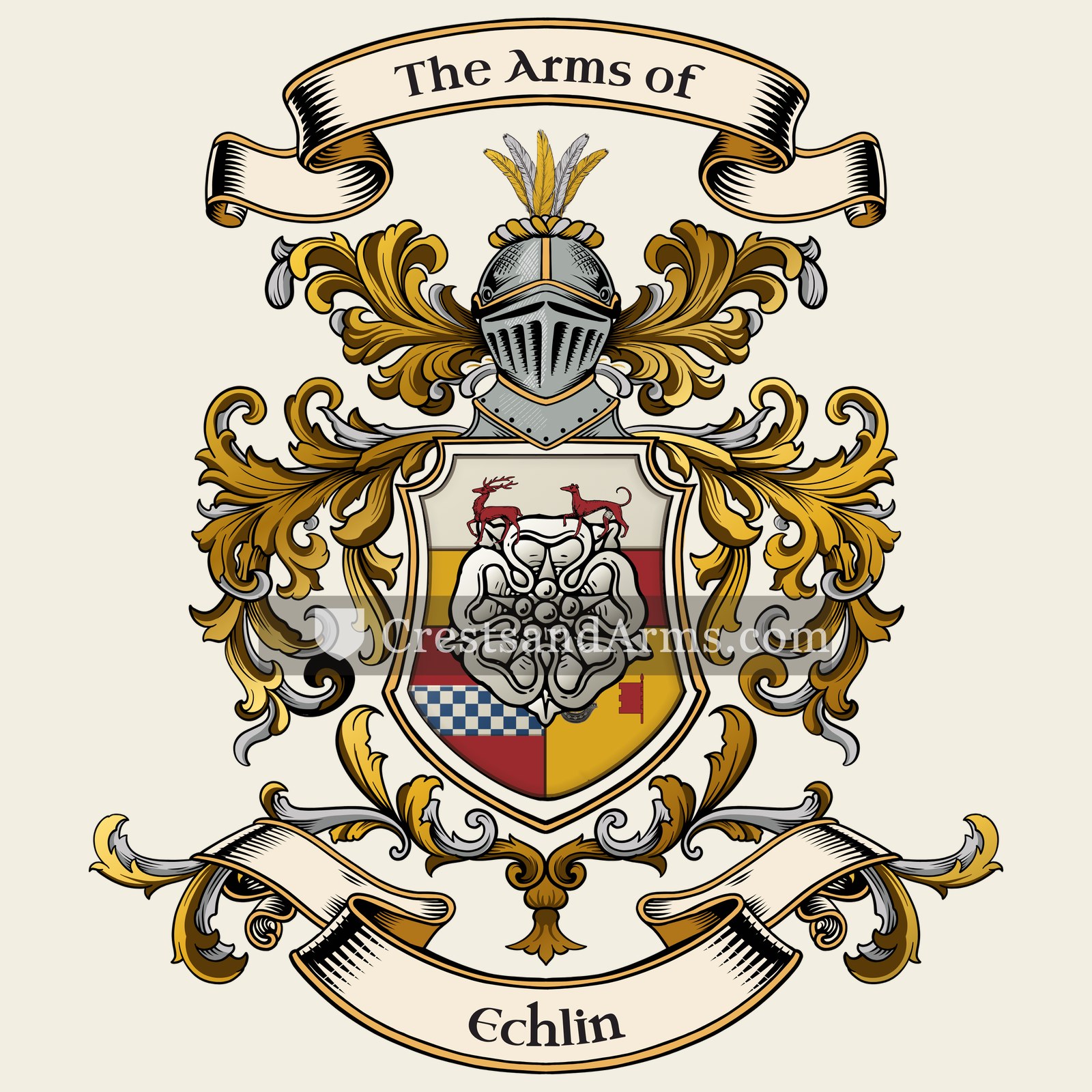
fessThe military belt, and readiness to serve
chequyConstancy, and the counting-board
chiefAuthority, wisdom and dominion
roseThe seventh son, and beauty with grace
stagPeace and harmony, and one who will not fight unprovoked
greyhoundCourage, vigilance and loyalty
shipEnterprise, and a great voyage undertaken
flag / pennantA command held, and a following kept
Colours
Gold (Or)Means: Generosity
Red (Gules)Means: Military strength
Silver (Argent)Means: Peace and sincerity
Blue (Azure)Means: Loyalty and truth
Black (Sable)Means: Constancy
Historical info
Source
Sir Bernard Burke, The General Armory of England, Scotland, Ireland and Wales, London: Harrison & Sons, 1884
Blazon (the actual original written record)
“Quarterly, 1st and 4th or, an antique galley with sails furled sa. a forked pennon gu.; 2nd and 3rd, gu. a fess chequy ar. and az., in the centre point over all a white rose ppr., on a chief ar. a deer at full speed pursued by a hound also gu”
TyroneTyrone, c. 1645
Digital archive packCoat of arms PNG, gold border print PDF, vector SVG and the certificate of authenticity. Sent to your email in minutes.
Map of Ireland showing where the Echlin arms are recorded
The Echlin arms were recorded in Tyrone, c. 1645.
Tyrone was northern Irish country of hills and small farms, planted with settlers in the seventeenth century. The new landowners took formal grants, and formal grants were recorded.
This is where the arms were entered in the register. Families often moved to other parts of the country, so the same name can turn up in more than one region.
The body that granted and recorded arms in Ireland in this period.
Charles I of England
Sovereign of the period
Charles I of England
1625–1649
Reigning in Britain when the Echlin arms are first recorded.
How Arms Worked in Ireland
The Ulster King of Arms granted coats of arms to individuals who proved their social standing and good character. These symbols were typically inherited by all legitimate descendants of the original holder. If a family branch wanted a unique look, they could apply for a specific change to their design through the office to ensure their identity remained distinct.
Granting authority
The Ulster King of Arms acted as the official body that regulated and issued all coats of arms throughout Ireland.
How they got arms
Families obtained their arms through formal grants issued by the office after proving their eligibility and paying the required fees.
Where arms were recorded
All official grants were recorded in the registers held by the Ulster King of Arms starting from the year 1552.
The family's standing
Recorded among the armigerous families of Tyrone.
Origin & History of the Echlin Family in Ireland
The Echlin family name has deep roots in the history of the Ulster Plantation, which significantly shaped their presence in Ireland during the seventeenth century. While the family originated in Scotland, they became prominent landowners in the north of Ireland as part of the movement of settlers encouraged by the British Crown. By 1645, records confirm that members of the family were well-established in County Tyrone, where they played an active role in the social and political life of the region. This period was marked by great instability, and the family had to navigate the complex conflicts that defined the mid-1600s in Ireland. Over time, they integrated into the local landscape, transitioning from newcomers to a recognized part of the landed gentry in the province of Ulster. Their early history reflects the broader patterns of migration and land settlement that transformed the Irish north during this era.
Coat of Arms & Family Crest Details
Symbols on this shield
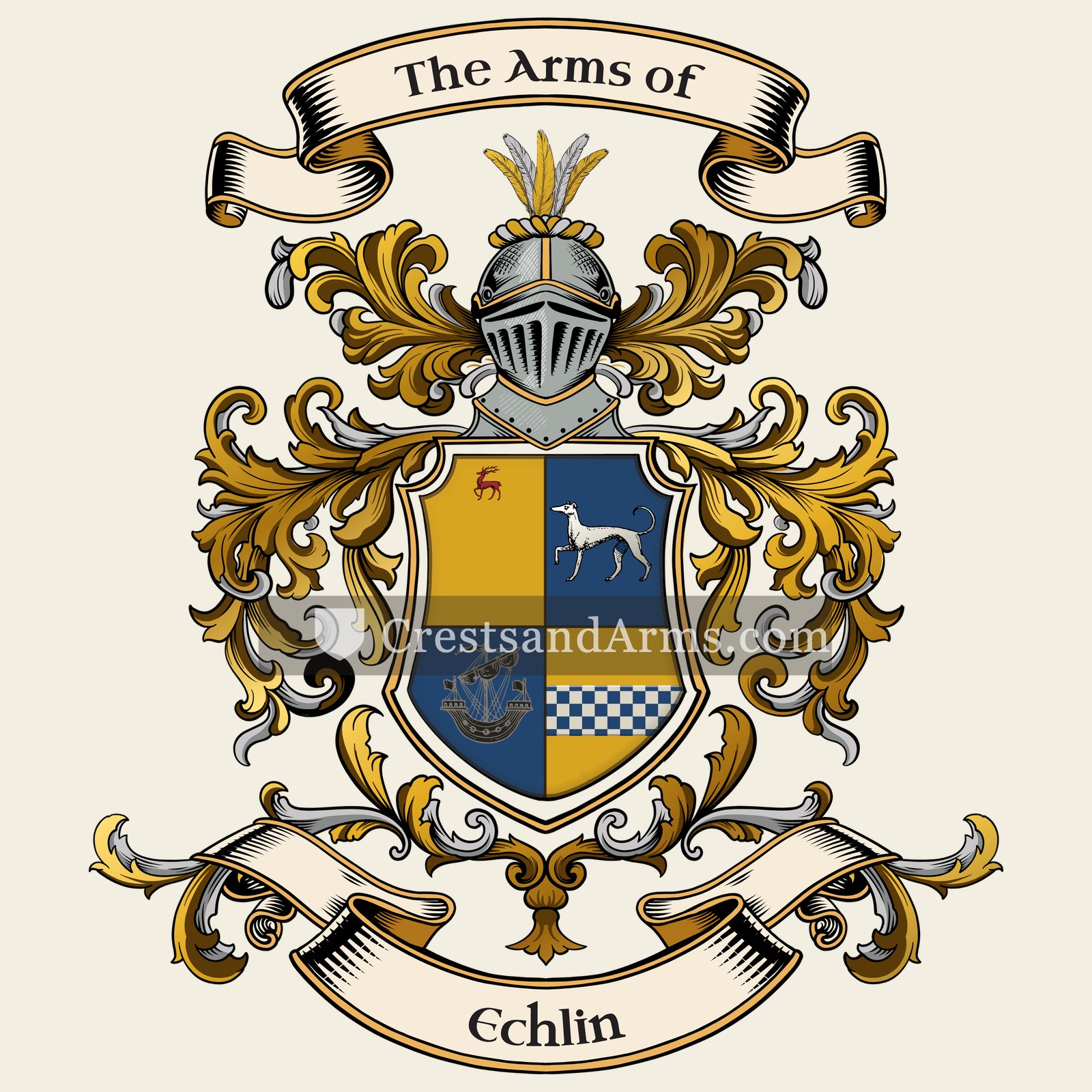
fessThe military belt, and readiness to serve
chequyConstancy, and the counting-board
stagPeace and harmony, and one who will not fight unprovoked
greyhoundCourage, vigilance and loyalty
shipEnterprise, and a great voyage undertaken
Colours
Gold (Or)Means: Generosity
Blue (Azure)Means: Loyalty and truth
Silver (Argent)Means: Peace and sincerity
Red (Gules)Means: Military strength
Black (Sable)Means: Constancy
Historical info
Source
Sir Bernard Burke, The General Armory of England, Scotland, Ireland and Wales, London: Harrison & Sons, 1884
Blazon (the actual original written record)
“Quarterly, 1st, or, a stag in chief gu.; 2nd, az. a hound in pursuit ar.; 3rd, ar. a lymphad sa. flags gu.; 4th, or, a fess chequy az. and ar”
FifePittadro · Fife, c. 1748
Digital archive packCoat of arms PNG, gold border print PDF, vector SVG and the certificate of authenticity. Sent to your email in minutes.
Map of Scotland showing where the Echlin arms are recorded
The Echlin arms were recorded in Fife, c. 1748.
Fife was farming country between two firths, with royal palaces and old burghs along its coast. Its landed families were numerous and close to the court, and closeness to the court brought arms.
This is where the arms were entered in the register. Families often moved to other parts of the country, so the same name can turn up in more than one region.
The body that granted and recorded arms in Scotland in this period.
George II of Great Britain
Sovereign of the period
George II of Great Britain
1727–1760
Reigning in Britain when the Echlin arms are first recorded.
How Arms Worked in Scotland
Scottish heraldry is unique because it treats a coat of arms as a piece of personal property protected by law. Only one person can own a specific design at any given time. When a family grows, the head keeps the original shield while other relatives must apply for their own distinct version with slight changes to prove their specific identity.
Granting authority
The Court of the Lord Lyon acts as the official body that regulates and controls all heraldic matters throughout Scotland.
How they got arms
Individuals obtain a legal right to their arms through a formal petition process that confirms their identity and family connection.
Where arms were recorded
All valid coats of arms are officially entered into the Public Register of All Arms and Bearings starting from 1672.
The family's standing
Recorded among the armigerous families of Fife.
Origin & History of the Echlin Family in Scotland
The Echlin family name has deep roots in the coastal landscape of Scotland, particularly within the region of Fife. While the name is often associated with later migrations to Ireland, the early history of the family is tied to the social and land-owning structures of the Scottish Lowlands. By the mid-eighteenth century, records confirm that members of the family were well-established residents in Fife, participating in the local community life that defined the era. During this period, families like the Echlins often held positions of local influence or managed agricultural estates, which allowed them to leave a lasting mark on the regional records. Their presence in Fife reflects the broader movement of families who navigated the changing economic and political climate of Scotland during the 1700s. Through these local connections, the family maintained a steady influence that helped preserve their name throughout the generations.
Echlin Meaning & Related Branches
Root word
Each
A Gaelic word referring to a horse or steed.
This name
EchlinDerived from a diminutive form meaning little horse or horseman, originating from Scottish Gaelic.
also spelled
Echlyn
Echlen
Eklin
Echlyne
Echlynn
Documented Sources
J. B. Rietstap, Armorial Général, Gouda: G. B. van Goor Zonen, 1884–87
Hasted, Edward. The History and Topographical Survey of the County of Kent. 1797
The National Archives, Kew. Records of the Prerogative Court of Canterbury, PROB 11
Digital archive packCoat of arms PNG, gold border print PDF, vector SVG and the certificate of authenticity. Sent to your email in minutes.


 shipEnterprise, and a great voyage undertaken
 shipEnterprise, and a great voyage undertaken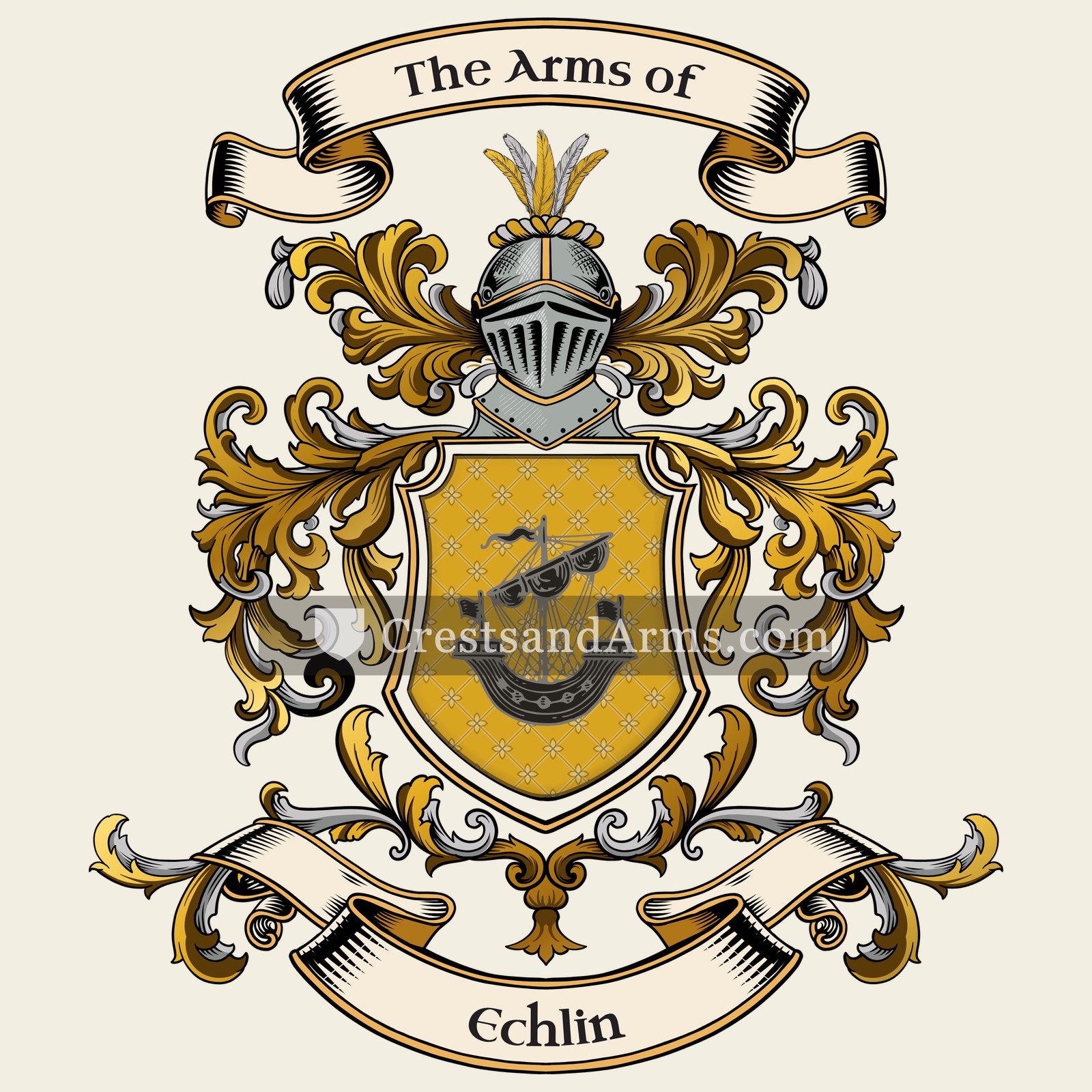


 fessThe military belt, and readiness to serve
 chequyConstancy, and the counting-board
 chiefAuthority, wisdom and dominion
 roseThe seventh son, and beauty with grace
 stagPeace and harmony, and one who will not fight unprovoked
 greyhoundCourage, vigilance and loyalty
 flag / pennantA command held, and a following kept