Map of Germany showing where the Echo arms are recorded
The Echo arms were recorded in Westphalia, c. 1765.
Westphalia was a land of small estates and fortified farmhouses in western Germany. Its families were numerous and not especially rich, but each held its own ground, and holding ground was what brought arms.
This is where the arms were entered in the register. Families often moved to other parts of the country, so the same name can turn up in more than one region.
The body that granted and recorded arms in Germany in this period.
Francis I, Holy Roman Emperor
Sovereign of the period
Francis I, Holy Roman Emperor
1745–1765
Reigning in Germany when the Echo arms are first recorded.
How Arms Worked in Germany
In the Holy Roman Empire, coats of arms were often granted to individuals by the Emperor or his representatives. These arms were then passed down through the generations to all legitimate descendants of the original holder. Younger branches of a family usually kept the same shield design without needing to change it, as the arms belonged to the entire lineage.
Granting authority
The Holy Roman Emperor held the sole power to grant new coats of arms throughout his vast imperial territories.
How they got arms
Families typically obtained their coats of arms through a formal imperial grant or by proving their noble status to the authorities.
Where arms were recorded
These grants were officially recorded in the Imperial Chancery registers, which began keeping formal records of such honors during the Middle Ages.
The family's standing
Recorded among the armigerous families of Westphalia.
Origin & History of the Echo Family in Germany
The family name Echo traces its roots to the historic region of Westphalia, where records confirm members of the family were established by 1765. During this period, Westphalia was a landscape defined by small farming communities and a growing network of trade routes that connected local families to the broader German economy. The name itself likely originated as a descriptive term or a nickname used to distinguish individuals within these tight-knit rural populations. As the 18th century progressed, families in this region often lived in close proximity to the land, relying on agriculture and local craftsmanship to sustain their households. By the mid-1700s, the Echo family was part of a stable social structure that valued community ties and regional identity. This early presence in Westphalia suggests that the family was well-integrated into the local administrative and parish systems that governed German life during the late Holy Roman Empire.
Meaning of the Echo family crest colors & symbols
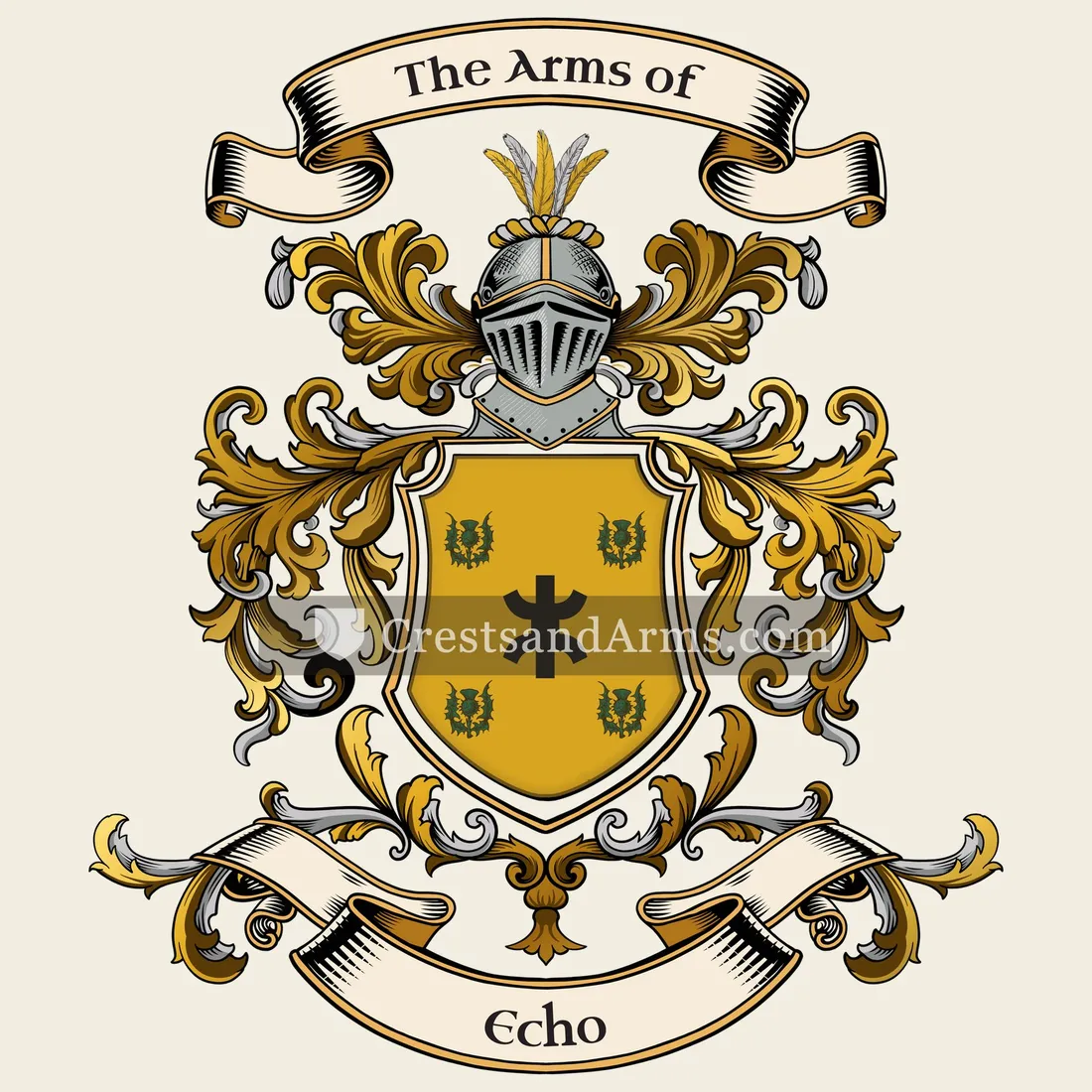
Symbols on this shield
millrind / fer de molineThe mill's iron, and the grinding of grain
plant thistleDefiance, and the defence of Scotland
Colours
Gold (Or)Means: Generosity
Black (Sable)Means: Constancy
Green (Vert)Means: Hope
Historical info
Source
J. B. Rietstap, Armorial Général, Gouda: G. B. van Goor Zonen, 1884–87
Blazon (the actual original written record)
“D'or à un fer-de-moulin de sa., cant. de quatre chardons fleuris de sin.”
LorraineLorraine, c. 1596
Digital archive packCoat of arms PNG, gold border print PDF, vector SVG and the certificate of authenticity. Sent to your email in minutes.
Map of France showing where the Echo arms are recorded
The Echo arms were recorded in Lorraine, c. 1596.
Lorraine sat on the border between France and the German lands, and border country bred soldiers. Families here held small estates and served in arms, and a fighting man was exactly the sort who carried a shield of his own.
This is where the arms were entered in the register. Families often moved to other parts of the country, so the same name can turn up in more than one region.
The body that granted and recorded arms in France in this period.
Henry IV of France
Sovereign of the period
Henry IV of France
1589–1610
Reigning in Germany when the Echo arms are first recorded.
How Arms Worked in France
In France, a coat of arms was a mark of honor that passed down through the male line to all legitimate descendants. Families often used the same shield without changes to show their shared heritage. If a branch wanted to stand out, they could add a small mark to their shield to show their specific place in the family tree.
Granting authority
The Juge d'armes de France acted as the official authority that regulated and verified coats of arms across the country.
How they got arms
Families typically inherited their arms from ancestors, though they could also receive them through royal grants or by proving their noble status.
Where arms were recorded
Coats of arms were officially recorded in the Armorial Général de France, which began its main collection in the year 1696.
The family's standing
Recorded among the armigerous families of Lorraine.
Origin & History of the Echo Family in France
The history of the Echo family in France begins in the late sixteenth century within the historic region of Lorraine. By 1596, records confirm that members of this family were established in the area, which served as a cultural crossroads between French and Germanic influences. During this period, Lorraine was a duchy that experienced significant social shifts due to religious tensions and regional conflicts. The Echo family likely lived as part of the local community during these turbulent times, navigating the agricultural and economic life of the province. Their presence in the region suggests they were settled inhabitants who contributed to the local society of the era. As the centuries progressed, the name remained tied to the eastern borders of France, reflecting the resilience of families who maintained their roots through changing political landscapes.
Echo Meaning & Related Branches
Root word
Eck
A corner or an edge of a field or building.
This name
EchoA topographical name for someone who lived near a corner or a sharp bend.
also spelled
Escher
Esh
Documented Sources
J. B. Rietstap, Armorial Général, Gouda: G. B. van Goor Zonen, 1884–87
Landesarchiv Nordrhein-Westfalen, Abteilung Westfalen, Kirchenbücher der evangelischen Kirchengemeinden in Westfalen (1765)
Müller, K., Die Siedlungsgeschichte Westfalens, 1952
Schulze, H., Namensforschung in den westfälischen Provinzen, 1988
Digital archive packCoat of arms PNG, gold border print PDF, vector SVG and the certificate of authenticity. Sent to your email in minutes.


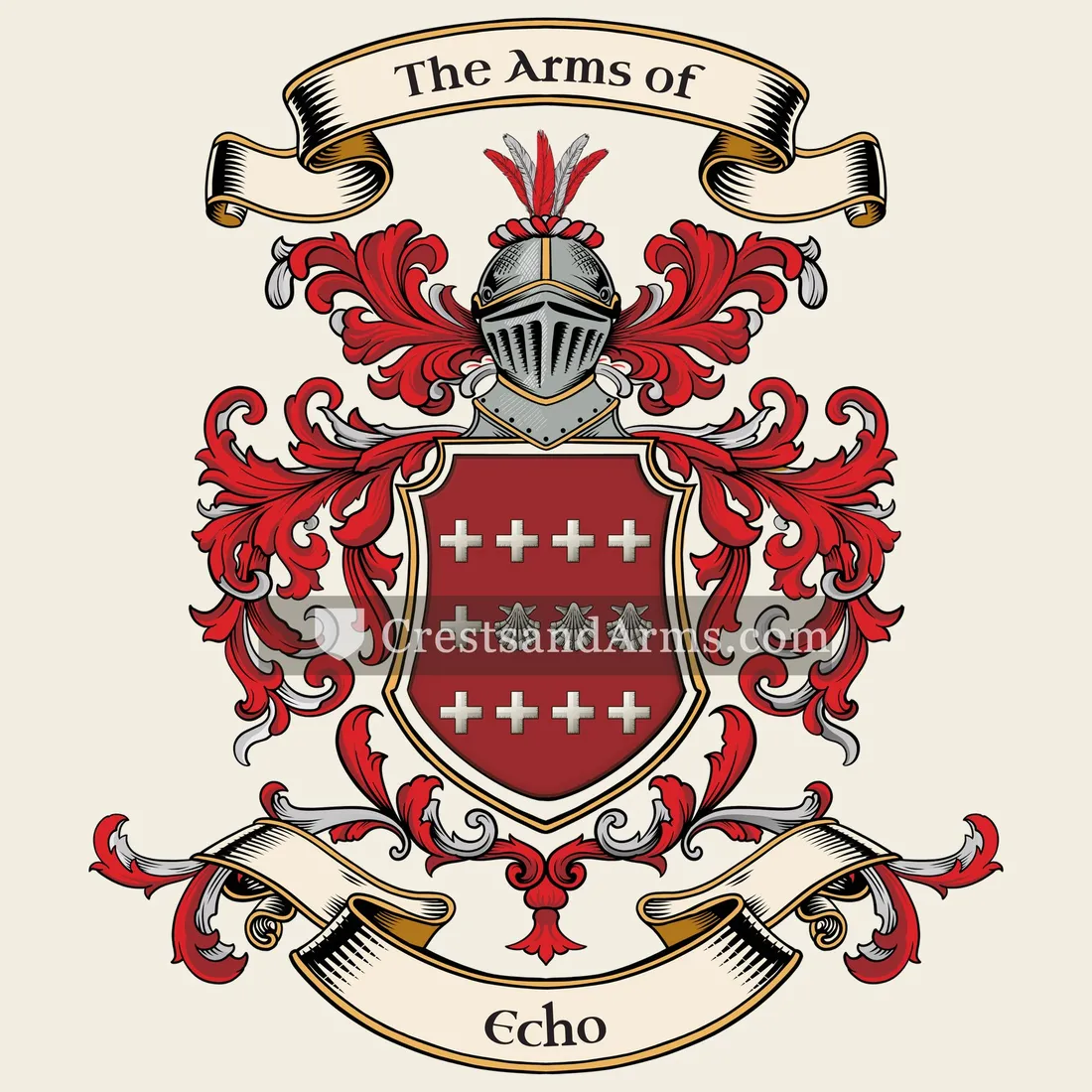
 cross symbolChristian faith and service
 escallopThe pilgrim's shell, and a long journey made
 cross symbolChristian faith and service
 escallopThe pilgrim's shell, and a long journey made


 millrind / fer de molineThe mill's iron, and the grinding of grain
 plant thistleDefiance, and the defence of Scotland