Map of England showing where the Edgerley arms are recorded
The Edgerley arms were recorded in Oxford, c. 1574.
Oxfordshire was farming country with the university at its centre, and both produced families of standing. Scholars and lawyers who did well bought manors nearby, and holding a manor was the ordinary route to a coat of arms.
This is where the arms were entered in the register. Families often moved to other parts of the country, so the same name can turn up in more than one region.
The body that granted and recorded arms in England in this period.
Elizabeth I of England
Sovereign of the period
Elizabeth I of England
1558–1603
Reigning in England when the Edgerley arms are first recorded.
How Arms Worked in England
English heraldry allowed arms to be shared by all legitimate descendants of the original owner. These symbols were treated as personal property that moved through the generations to all children. While the eldest son kept the original design, other family members could use the same shield without needing to change it or register their own unique versions.
Granting authority
The College of Arms in London has regulated the use of coats of arms throughout England and Wales since 1484.
How they got arms
Families typically obtained their coats of arms through a formal grant from the Crown or by proving their ancient right to them.
Where arms were recorded
All official coats of arms are recorded in the registers kept at the College of Arms, which date back to the fifteenth century.
The family's standing
Recorded among the armigerous families of Oxford.
Origin & History of the Edgerley Family in England
The surname Edgerley is a locative name, meaning it was originally derived from a specific place rather than a trade or a personal trait. Historical records confirm that the family was well-established in the region of Oxford by 1574, where they were active members of the local community. The name itself is believed to originate from an Old English combination of words referring to a clearing or a meadow located near a prominent ridge or edge. During the late sixteenth century, families with this name were often involved in the agricultural and civic life of Oxfordshire. As the family grew, members began to appear in various parish registers and legal documents, which helps historians track their movement and influence throughout the English countryside during the Elizabethan era.
Edgerley Meaning & Related Branches
Root word
Eadgar-leah
A clearing in the woods belonging to a person named Eadgar.
This name
EdgerleyDerived from an Old English locational name referring to a meadow or woodland clearing.
also spelled
Edgerly
Edgerlie
Edgerleigh
Related arms
Edgley, or Edgerleysame arms
Egerleysame arms
Egmoresame arms
Documented Sources
Sir Bernard Burke, The General Armory of England, Scotland, Ireland and Wales, London: Harrison & Sons, 1884
Clark, Andrew, Register of the University of Oxford, 1887
Oxfordshire Archives, Diocese of Oxford, Archdeaconry of Oxford Wills and Administrations, 1543–1857
Digital archive packCoat of arms PNG, gold border print PDF, vector SVG and the certificate of authenticity. Sent to your email in minutes.


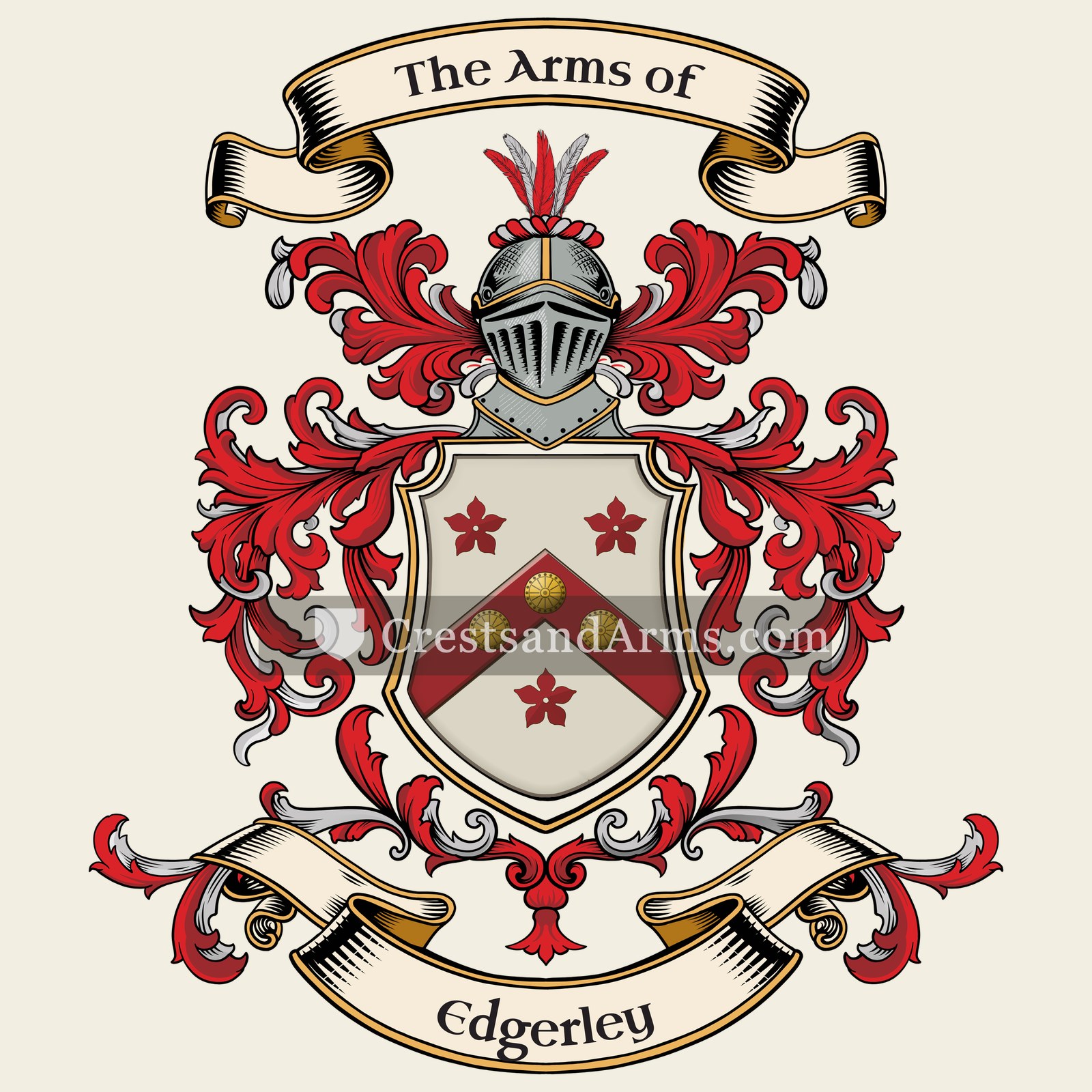
 chevronProtection, and faithful service completed
 cinquefoilHope and joy
 roundelA coin, and one who has been to the crusades
 chevronProtection, and faithful service completed
 cinquefoilHope and joy
 roundelA coin, and one who has been to the crusades