A record of documented arms, meaning and origin, researched for the Edin family lines. Documented in 3 countries.
Reg. 9824 · Britain, D–F
Coat of Arms & Family Crest Details
Symbols on this shield
chevronProtection, and faithful service completed
escallopThe pilgrim's shell, and a long journey made
wheatsheafPlenty, and the harvest of one's own labour
Colours
Red (Gules)Means: Military strength
Gold (Or)Means: Generosity
Black (Sable)Means: Constancy
Historical info
Source
J. B. Rietstap, Armorial Général, Gouda: G. B. van Goor Zonen, 1884–87
Blazon (the actual original written record)
“De gu. au chev. d'or, ch. de trois coquilles de sa. et acc. de trois gerbes du sec., liées de sin. C.: un bras, arm. au nat., la main empoignant une gerbe de l'écu, posée en fasce. D.: SI SIT PRUDENTIA.”
DurhamshireDurhamshire, c. 1672
Digital archive packCoat of arms PNG, gold border print PDF, vector SVG and the certificate of authenticity. Sent to your email in minutes.
Map of Britain showing where the Edin arms are recorded
The Edin arms were recorded in Durhamshire, c. 1672.
This is where the arms were entered in the register. Families often moved to other parts of the country, so the same name can turn up in more than one region.
The body that granted and recorded arms in Britain in this period.
Charles II of England
Sovereign of the period
Charles II of England
1660–1685
Reigning in Britain when the Edin arms are first recorded.
How Arms Worked in Britain
English heraldry allowed arms to be shared by all legitimate descendants of the original owner. These symbols were treated as personal property that moved through the generations to all children. While the eldest son kept the original design, other family members could use the same shield without needing to change it or register their own unique versions.
Granting authority
The College of Arms in London has regulated the use of coats of arms throughout England and Wales since 1484.
How they got arms
Families typically obtained their coats of arms through a formal grant from the Crown or by proving their ancient right to them.
Where arms were recorded
All official coats of arms are recorded in the registers kept at the College of Arms, which date back to the fifteenth century.
The family's standing
Recorded among the armigerous families of Durhamshire.
Origin & History of the Edin Family in Britain
The history of the Edin family in Britain is deeply rooted in the northern landscape of Durhamshire, where records confirm their presence as early as 1672. During the late seventeenth century, this region was a hub of agricultural and industrial development, and families like the Edins were often tied to the local land and parish communities. The name itself likely originated as a locative surname, meaning it was used to identify individuals based on the specific place or village where they resided. In the context of Durhamshire, this suggests that the family was well-established within the local social fabric, likely participating in the traditional trades and farming practices that defined life in the north of England during the Restoration period. By settling in this area, the early members of the family contributed to the long-standing history of the county, leaving behind a legacy that is preserved in the parish registers and local administrative documents of that era.
Coat of Arms & Family Crest Details
Symbols on this shield
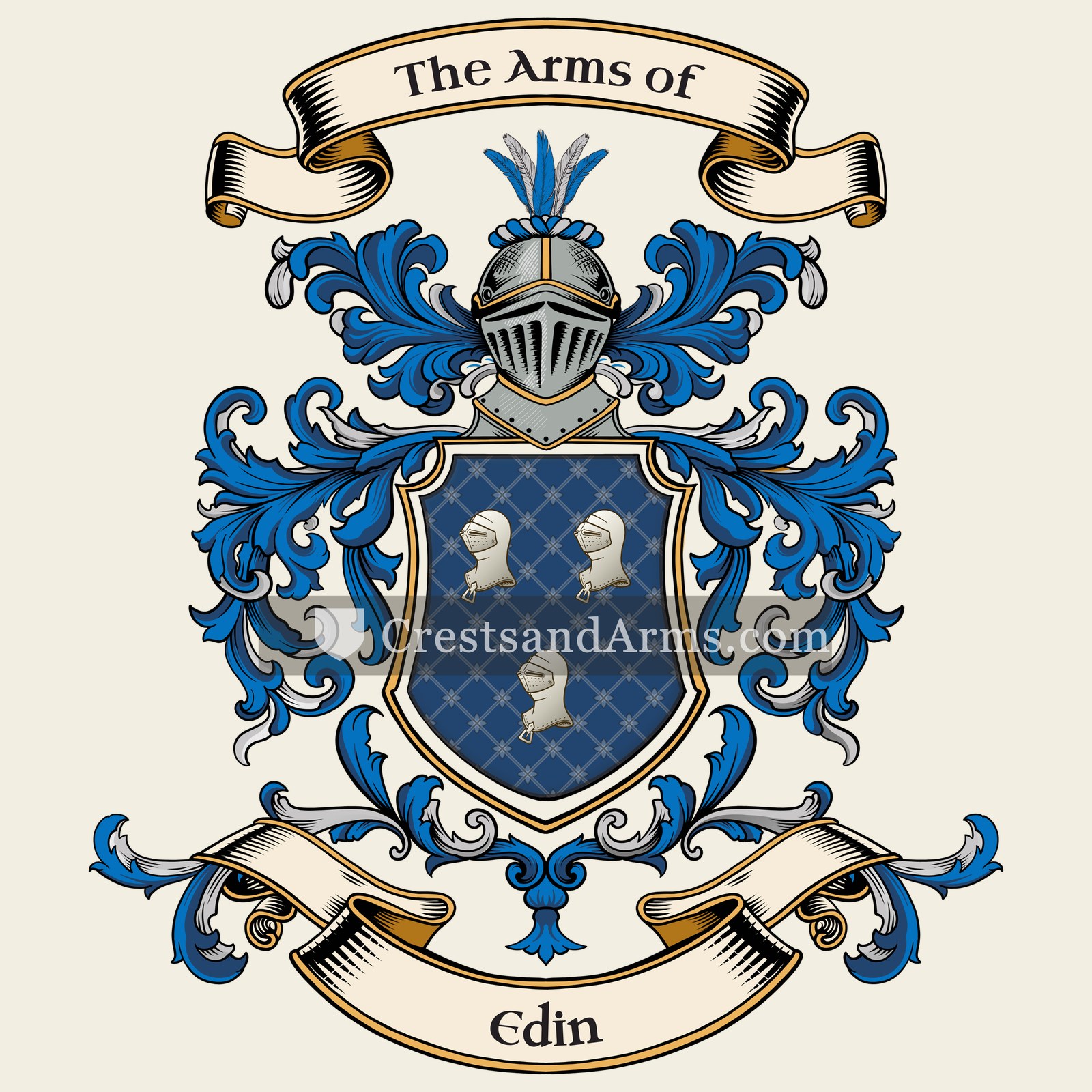
helmetWisdom and security in defence
Colours
Blue (Azure)Means: Loyalty and truth
Silver (Argent)Means: Peace and sincerity
Historical info
Source
Sir Bernard Burke, The General Armory of England, Scotland, Ireland and Wales, London: Harrison & Sons, 1884
Blazon (the actual original written record)
“Az. three helmets ar”
YorkYork, c. 1620
Digital archive packCoat of arms PNG, gold border print PDF, vector SVG and the certificate of authenticity. Sent to your email in minutes.
Map of England showing where the Edin arms are recorded
The Edin arms were recorded in York, c. 1620.
Yorkshire is the largest of the English counties, and it held more gentry families than any other. Land there was split among a great many households rather than a few, so a great many of them carried arms.
This is where the arms were entered in the register. Families often moved to other parts of the country, so the same name can turn up in more than one region.
The body that granted and recorded arms in England in this period.
James VI and I
Sovereign of the period
James VI and I
1603–1625
Reigning in Britain when the Edin arms are first recorded.
How Arms Worked in England
English heraldry allowed arms to be shared by all legitimate descendants of the original owner. These symbols were treated as personal property that moved through the generations to all children. While the eldest son kept the original design, other family members could use the same shield without needing to change it or register their own unique versions.
Granting authority
The College of Arms in London has regulated the use of coats of arms throughout England and Wales since 1484.
How they got arms
Families typically obtained their coats of arms through a formal grant from the Crown or by proving their ancient right to them.
Where arms were recorded
All official coats of arms are recorded in the registers kept at the College of Arms, which date back to the fifteenth century.
The family's standing
Recorded among the armigerous families of York.
Origin & History of the Edin Family in England
The history of the Edin family in England is deeply rooted in the northern city of York, where records confirm their presence as early as 1620. During the seventeenth century, York served as a vital hub for trade and administration, and families living in the city were often connected to the bustling merchant guilds or the local parish church communities. The name itself likely evolved from older linguistic roots, possibly reflecting a connection to a specific place or a descriptive nickname that became a permanent surname over generations. By settling in York, the early members of this family became part of a long tradition of urban life in one of England’s most historic cities. They lived through a period of significant social change, contributing to the local economy and the development of the community during the transition from the Elizabethan era into the Stuart period.
Edin Meaning & Related Branches
Root word
Eadwine
Old English elements meaning prosperous or rich and friend or protector.
This name
EdinA locational or patronymic surname derived from the Old English name meaning wealthy friend.
also spelled
Edin
Edon
Edyn
Documented Sources
J. B. Rietstap, Armorial Général, Gouda: G. B. van Goor Zonen, 1884–87
Durham County Record Office, Bishop’s Transcripts for the Diocese of Durham, 1672
Surtees, Robert, The History and Antiquities of the County Palatine of Durham, 1816
Digital archive packCoat of arms PNG, gold border print PDF, vector SVG and the certificate of authenticity. Sent to your email in minutes.


 chevronProtection, and faithful service completed
 escallopThe pilgrim's shell, and a long journey made
 wheatsheafPlenty, and the harvest of one's own labour
 chevronProtection, and faithful service completed
 escallopThe pilgrim's shell, and a long journey made
 wheatsheafPlenty, and the harvest of one's own labour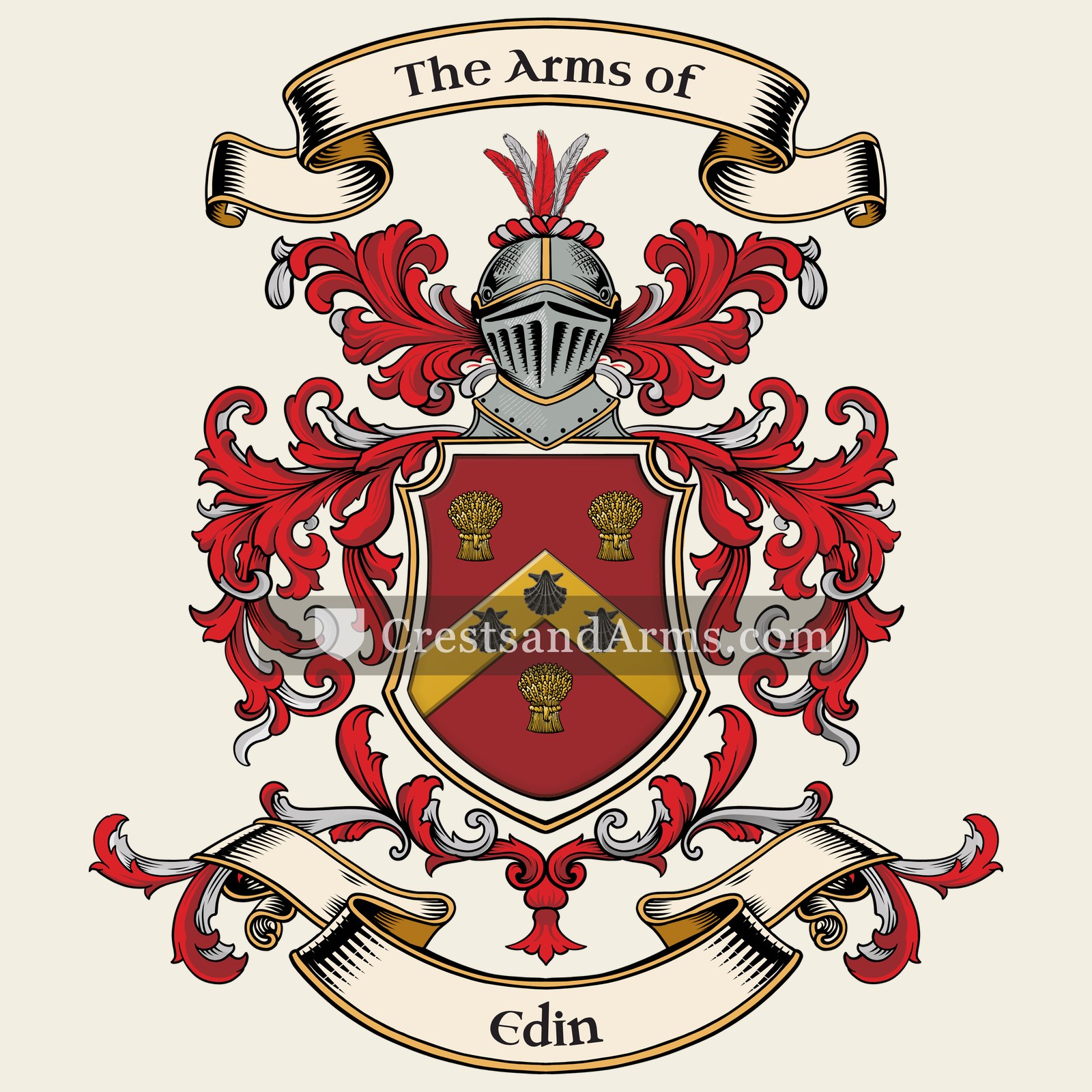


 helmetWisdom and security in defence