Map of France showing where the Eduard arms are recorded
The Eduard arms were recorded in Toulouse, c. 1663.
This is where the arms were entered in the register. Families often moved to other parts of the country, so the same name can turn up in more than one region.
The body that granted and recorded arms in France in this period.
Louis XIV of France
Sovereign of the period
Louis XIV of France
1643–1715
Reigning in France when the Eduard arms are first recorded.
How Arms Worked in France
In France, a coat of arms was a mark of honor that passed down through the male line to all legitimate descendants. Families often used the same shield without changes to show their shared heritage. If a branch wanted to stand out, they could add a small mark to their shield to show their specific place in the family tree.
Granting authority
The Juge d'armes de France acted as the official authority that regulated and verified coats of arms across the country.
How they got arms
Families typically inherited their arms from ancestors, though they could also receive them through royal grants or by proving their noble status.
Where arms were recorded
Coats of arms were officially recorded in the Armorial Général de France, which began its main collection in the year 1696.
The family's standing
Recorded among the armigerous families of France.
Origin & History of the Eduard Family in France
The name Eduard traces its roots back to the Germanic linguistic tradition, where it signifies a guardian of prosperity or wealth. By the mid-17th century, the family established a notable presence in the city of Toulouse, a major cultural and economic hub in southern France. During this period, families in the Languedoc region often navigated the complex social shifts following the religious conflicts of the previous century. Living in Toulouse in 1663 suggests that the family was likely integrated into the urban professional or merchant class, as the city served as a center for legal administration and trade. These early members of the Eduard family would have lived through a time of significant centralization under the French monarchy, which influenced how families documented their births, marriages, and property holdings in local parish registers. Their presence in this historic city highlights a long-standing connection to the administrative and social fabric of southern France.
Coat of Arms & Family Crest Details
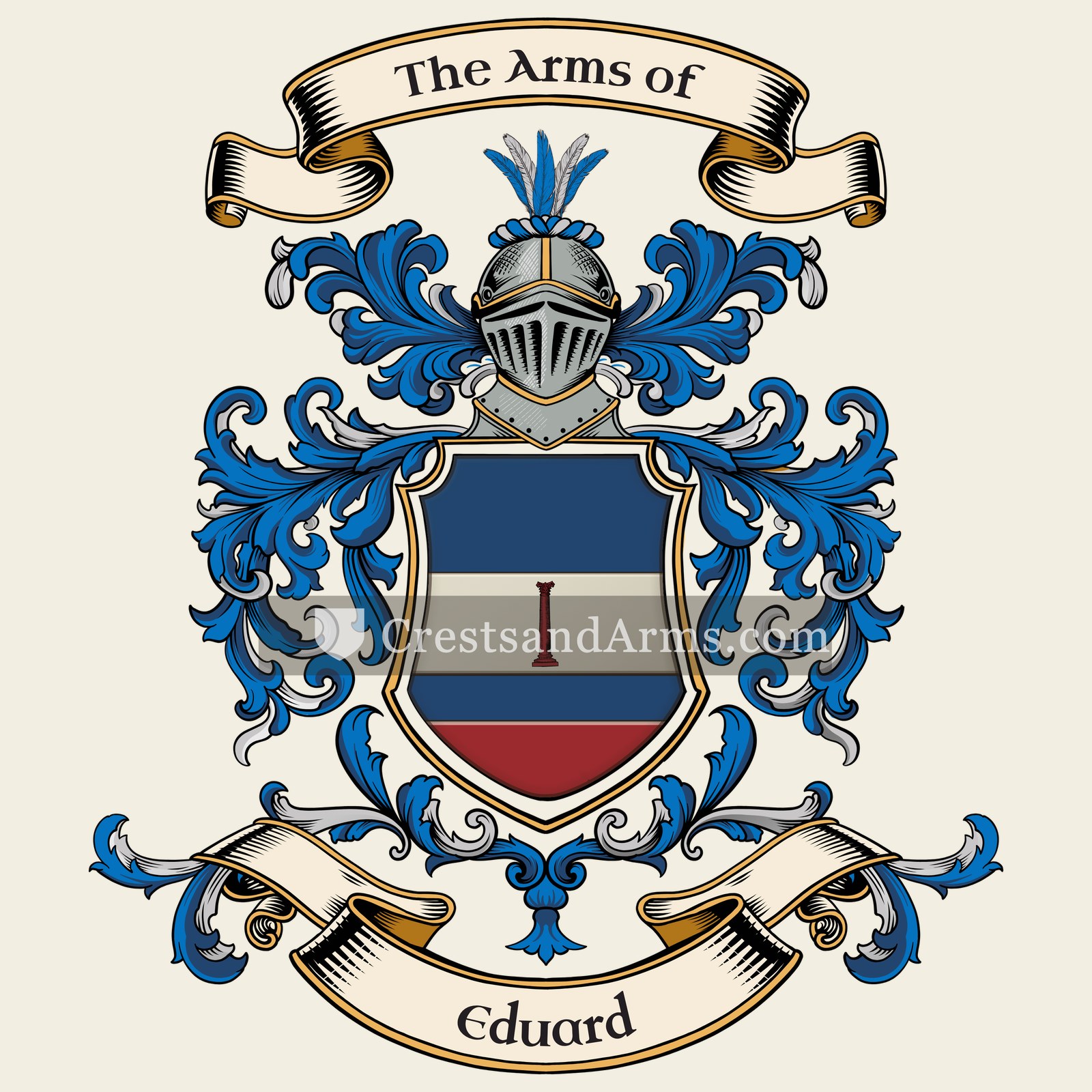
Symbols on this shield
fessThe military belt, and readiness to serve
columnFortitude and constancy
Colours
Blue (Azure)Means: Loyalty and truth
Silver (Argent)Means: Peace and sincerity
Red (Gules)Means: Military strength
Historical info
Source
Sir Bernard Burke, The General Armory of England, Scotland, Ireland and Wales, London: Harrison & Sons, 1884
Blazon (the actual original written record)
“Az. a fesse ar. surmounted of a marble pillar gu. issuing out of a base wavy of the field”
LinlithgowLongcroft · Linlithgow, c. 1748
Digital archive packCoat of arms PNG, gold border print PDF, vector SVG and the certificate of authenticity. Sent to your email in minutes.
Map of Scotland showing where the Eduard arms are recorded
The Eduard arms were recorded in Linlithgow, c. 1748.
Linlithgow, now West Lothian, held a royal palace between Edinburgh and Stirling. Families with court business settled nearby, and closeness to the court brought recorded arms.
This is where the arms were entered in the register. Families often moved to other parts of the country, so the same name can turn up in more than one region.
The body that granted and recorded arms in Scotland in this period.
George II of Great Britain
Sovereign of the period
George II of Great Britain
1727–1760
Reigning in France when the Eduard arms are first recorded.
How Arms Worked in Scotland
Scottish heraldry is unique because it treats a coat of arms as a piece of personal property protected by law. Only one person can own a specific design at any given time. When a family grows, the head keeps the original shield while other relatives must apply for their own distinct version with slight changes to prove their specific identity.
Granting authority
The Court of the Lord Lyon acts as the official body that regulates and controls all heraldic matters throughout Scotland.
How they got arms
Individuals obtain a legal right to their arms through a formal petition process that confirms their identity and family connection.
Where arms were recorded
All valid coats of arms are officially entered into the Public Register of All Arms and Bearings starting from 1672.
The family's standing
Recorded among the armigerous families of Linlithgow.
Origin & History of the Eduard Family in Scotland
The family name Eduard, while rooted in ancient linguistic traditions, established a notable presence in the historic royal burgh of Linlithgow by the mid-eighteenth century. Records confirm that members of the family were living in this town by 1748, a period when Linlithgow served as a vital center for trade and administration in the Scottish Lowlands. Families in this region during the 1700s were often closely tied to the local craft guilds or the agricultural life surrounding the town’s famous palace. As the name appears in local parish registers and legal documents from this era, it suggests that the Eduards were integrated into the social fabric of the community during a time of significant transition in Scotland. By settling in a place with such deep connections to the Scottish monarchy, these early family members lived in an environment defined by centuries of national history and local civic growth.
Eduard Meaning & Related Branches
Root word
Eadweard
Old English elements meaning rich or blessed and guardian or protector.
This name
EduardA guardian of prosperity or a wealthy protector of one's heritage.
also spelled
Edouart
Eduard
Edwar
Edward
Documented Sources
J. B. Rietstap, Armorial Général, Gouda: G. B. van Goor Zonen, 1884–87
Archives départementales de la Haute-Garonne, Registres paroissiaux et d'état civil
Wolff, Philippe, Histoire de Toulouse, 1974
Le Roy Ladurie, Emmanuel, Les Paysans de Languedoc, 1966
Digital archive packCoat of arms PNG, gold border print PDF, vector SVG and the certificate of authenticity. Sent to your email in minutes.


 cross symbolChristian faith and service
 lionCourage, strength and royalty
 cometA great event foretold, and swift renown
 cross symbolChristian faith and service
 lionCourage, strength and royalty
 cometA great event foretold, and swift renown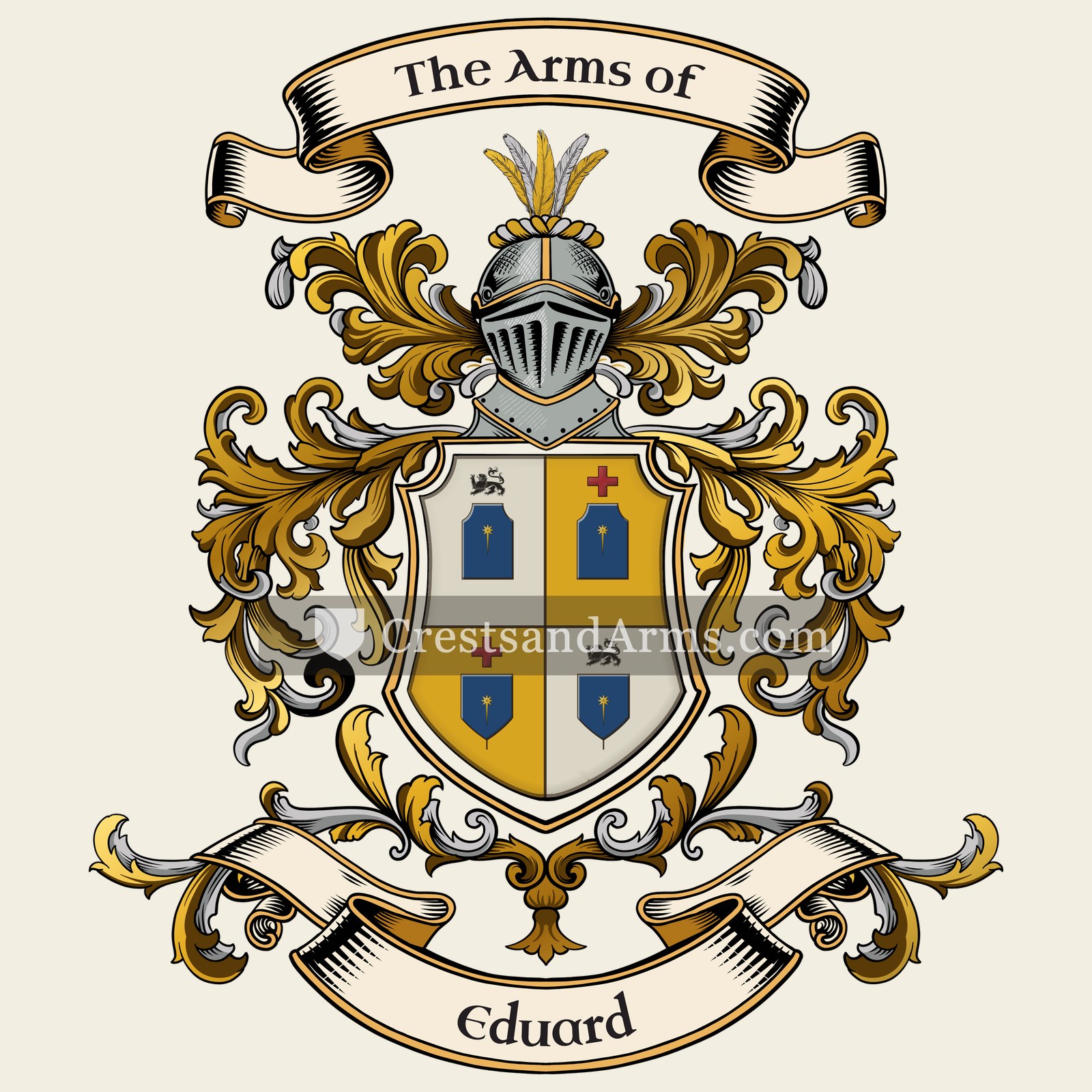


 fessThe military belt, and readiness to serve
 columnFortitude and constancy