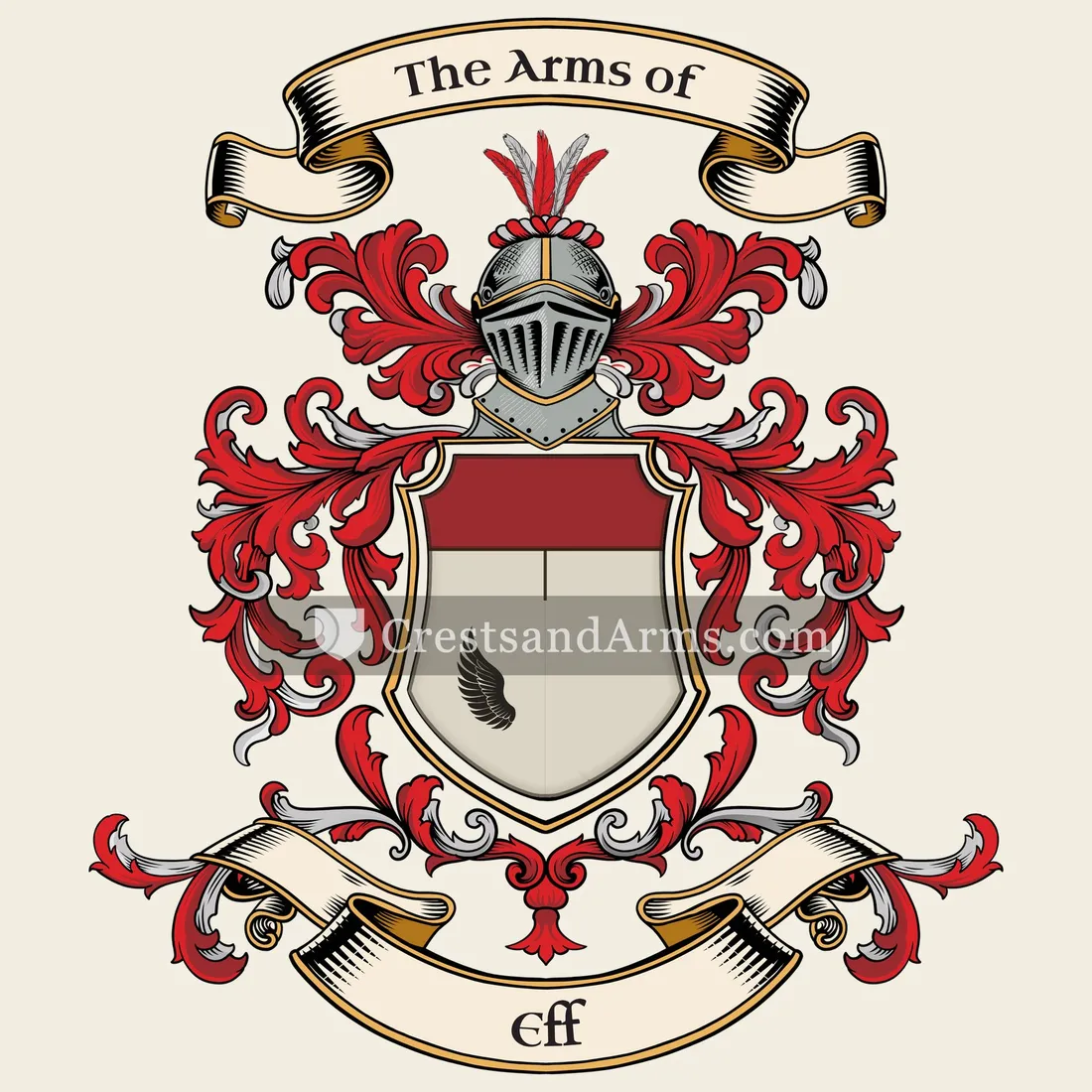
A record of documented arms, meaning and origin, researched for the Eff family of Germany.
Reg. 8214 · German, D–F
Meaning of the Eff family crest colors & symbols
Symbols on this shield
chiefAuthority, wisdom and dominion
wingSwiftness, and protection under a raised wing
Colours
Silver (Argent)Means: Peace and sincerity
Red (Gules)Means: Military strength
Black (Sable)Means: Constancy
Historical info
Source
J. B. Rietstap, Armorial Général, Gouda: G. B. van Goor Zonen, 1884–87
Blazon (the actual original written record)
“Parti: au 1 d'arg. à un demi-vol de sa.; au 2 d'arg. à un mortier d'or sur son affût de gu.; au chef de gu. C.: un demi-vol de sa., ch. du mortier. L.: à dextre d'arg. et de sa., à sen. d'arg. et de gu.”
HesseHesse, c. 1765
Digital archive packCoat of arms PNG, gold border print PDF, vector SVG and the certificate of authenticity. Sent to your email in minutes.
Map of Germany showing where the Eff arms are recorded
The Eff arms were recorded in Hesse, c. 1765.
Hesse was central German country, divided among a large number of small landowners and prosperous towns. So many separate households held ground there that the region produced an unusual number of coats of arms.
This is where the arms were entered in the register. Families often moved to other parts of the country, so the same name can turn up in more than one region.
The body that granted and recorded arms in Germany in this period.
Francis I, Holy Roman Emperor
Sovereign of the period
Francis I, Holy Roman Emperor
1745–1765
Reigning in Germany when the Eff arms are first recorded.
How Arms Worked in Germany
In the Holy Roman Empire, coats of arms were often granted to individuals by the Emperor or his representatives. These arms were then passed down through the generations to all legitimate descendants of the original holder. Younger branches of a family usually kept the same shield design without needing to change it, as the arms belonged to the entire lineage.
Granting authority
The Holy Roman Emperor held the sole power to grant new coats of arms throughout his vast imperial territories.
How they got arms
Families typically obtained their coats of arms through a formal imperial grant or by proving their noble status to the authorities.
Where arms were recorded
These grants were officially recorded in the Imperial Chancery registers, which began keeping formal records of such honors during the Middle Ages.
The family's standing
Recorded among the armigerous families of Hesse.
Origin & History of the Eff Family in Germany
The family name Eff traces its roots to the region of Hesse, Germany, where records confirm members of the family were established by 1765. During the eighteenth century, this area was characterized by small agricultural communities and local trade networks. Families with short, distinct surnames like Eff often lived in rural villages where they were known for their specific craftsmanship or their role in local land management. Because the name is quite brief, it likely originated as a shortened version of a longer Germanic given name or as a descriptive nickname used to identify a person within a small, tight-knit group. As the population grew and moved through the Hessian countryside, the family maintained its presence in the region, contributing to the local culture and economy long before the industrial changes of the following century.
Eff Meaning & Related Branches
Root word
Eberhard
Derived from Germanic elements meaning wild boar and brave or strong.
This name
EffA short form or variant of names beginning with the element Eber.
also spelled
Eif
Eyf
If
Eiff
Documented Sources
J. B. Rietstap, Armorial Général, Gouda: G. B. van Goor Zonen, 1884–87
Hessisches Staatsarchiv Marburg, Kirchenbücher der evangelischen Kirchengemeinden in Hessen, 1765
Knetsch, Carl, Die hessische Familienforschung, 1928
Digital archive packCoat of arms PNG, gold border print PDF, vector SVG and the certificate of authenticity. Sent to your email in minutes.


 chiefAuthority, wisdom and dominion
 wingSwiftness, and protection under a raised wing
 chiefAuthority, wisdom and dominion
 wingSwiftness, and protection under a raised wing