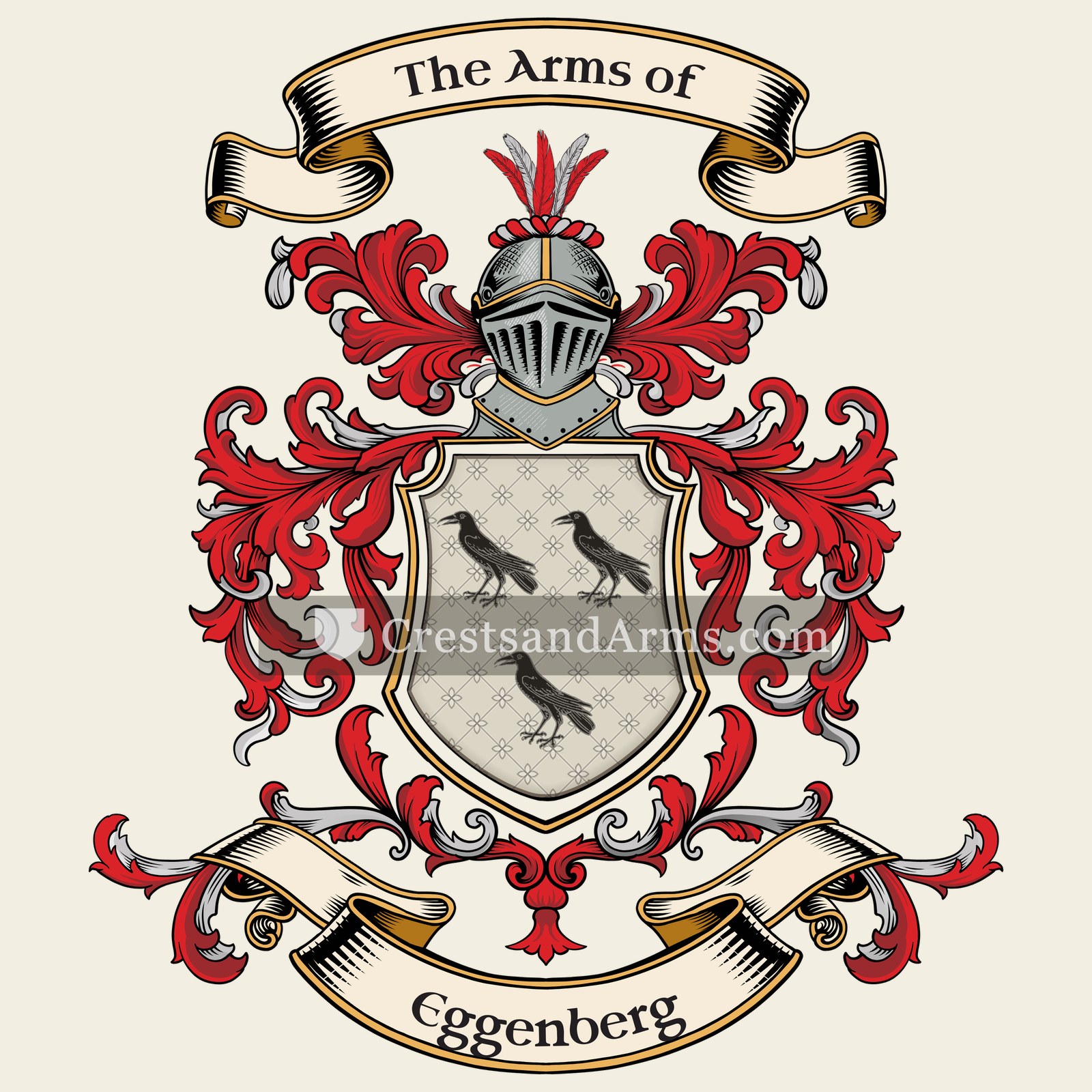
A record of documented arms, meaning and origin, researched for the Eggenberg family of Austria.
Reg. 2899 · Austrian, D–F
Coat of Arms & Family Crest Details
Symbols on this shield
ravenConstancy and divine providence
Colours
Silver (Argent)Means: Peace and sincerity
Black (Sable)Means: Constancy
Historical info
Source
J. B. Rietstap, Armorial Général, Gouda: G. B. van Goor Zonen, 1884–87
Blazon (the actual original written record)
“D'arg. à une couronne d'or, posée en abime, et trois corbeaux volants de sa., cour. d'or, dans l'attitude d'aigles héraldiques, posés en pairle, les têtes dirigées vers la couronne. Cq. cour. C.: un corbeau ess. ou au vol clos; ou, un vol à l'antique de sa. - (Concession du 18 mai 1598.) Les mêmes armes. Derrière l'écu un drapeau d'azur, ch. d'un écusson cour. aux armes du royaume de Bosnie, qui sont de gu. au bras paré d'or, brandissant un sabre d'arg. - (Barons d'Ehrenhausen, de Herberstorf et du St-Empire, 29 déc. 1598; branche ét. le 29 mars 1646.) Les armes de 1598. - (Princes d'Eggenberg et du St-Empire, ducs de Krumau et comtes d'Adelsberg, 15 avril 1628.) Ec.: au 1 d'arg. à cinq roses de gu., 2, 1 et 2 (Rosenberg); au 2 parti de gu. et d'azur; à une aigle d'arg., cour. d'or, br. sur le parti (Adelsberg); au 3 d'azur à une ancre d'or (Pettau); au 4 de gu. à une roue d'arg. (Radkersburg). Sur le tout les armes de 1469. Manteau de gu., doublé d'herm., sommé de la couronne de prince du St-Empire. (Comtes princiers de Gradisca et d'Aquileja, 1647; branche ét. le 23 fév. 1717.) Parti de deux traits, coupés”
StyriaStyria, c. 1469
Digital archive packCoat of arms PNG, gold border print PDF, vector SVG and the certificate of authenticity. Sent to your email in minutes.
Map of Austria showing where the Eggenberg arms are recorded
The Eggenberg arms were recorded in Styria, c. 1469.
Styria was mountain and forest country in southern Austria, with iron in its hills. Mining and landholding both made money, and families who held either kind of property took arms to seal their papers with.
This is where the arms were entered in the register. Families often moved to other parts of the country, so the same name can turn up in more than one region.
Region
Styria
First recorded
1469
Granting Authority for the Eggenberg Arms
Imperial and Royal chancery
Sodacan · CC BY-SA 3.0
The body that granted and recorded arms in Austria in this period.
Frederick III, Holy Roman Emperor
Sovereign of the period
Frederick III, Holy Roman Emperor
1452–1493
Reigning in Austria when the Eggenberg arms are first recorded.
How Arms Worked in Austria
Austrian coats of arms were often linked directly to noble titles granted by the Emperor. These symbols belonged to the entire family line rather than just one individual. When a family grew, new branches kept the original design without needing to change it. This system allowed all members of a noble house to share the same identity across many generations.
Granting authority
The Imperial and Royal chancery managed all heraldic matters and controlled the official granting of arms throughout the Austrian lands.
How they got arms
Families typically received their arms through a formal imperial decree that often accompanied the elevation of a person to noble status.
Where arms were recorded
Official records of these grants were kept in the Imperial Register of Nobility which began its formal documentation process in 1453.
The family's standing
Recorded among the armigerous families of Styria.
Origin & History of the Eggenberg Family in Austria
The Eggenberg family emerged as a significant force in the region of Styria during the fifteenth century. Historical records confirm their presence in the area by 1469, when they were already establishing themselves as influential figures within the local nobility. The name itself is linked to the geography of the region, specifically originating from the Eggenberg castle located near Graz. Early members of the family focused on building their wealth through trade and strategic service to the regional rulers. By managing local resources and forming strong political alliances, they transitioned from minor landowners into a prominent dynasty that would eventually play a major role in the broader history of the Holy Roman Empire. Their rise was marked by a steady accumulation of land and administrative authority, which allowed them to become central players in the social and economic life of Styria.
Eggenberg Meaning & Related Branches
Root word
Egg
A sharp edge, corner, or mountain ridge.
This name
EggenbergRefers to a person living near a mountain ridge or a prominent corner of land.
also spelled
Eggenburg
Egenberg
Documented Sources
J. B. Rietstap, Armorial Général, Gouda: G. B. van Goor Zonen, 1884–87
Barbaric, Franz, Die Eggenberger: Eine steirische Adelsfamilie, 1989
Kaiser, Robert, Der Aufstieg der Eggenberger, 1994
Steiermärkisches Landesarchiv, Urkunden und Akten der Familie Eggenberg
Digital archive packCoat of arms PNG, gold border print PDF, vector SVG and the certificate of authenticity. Sent to your email in minutes.


 ravenConstancy and divine providence