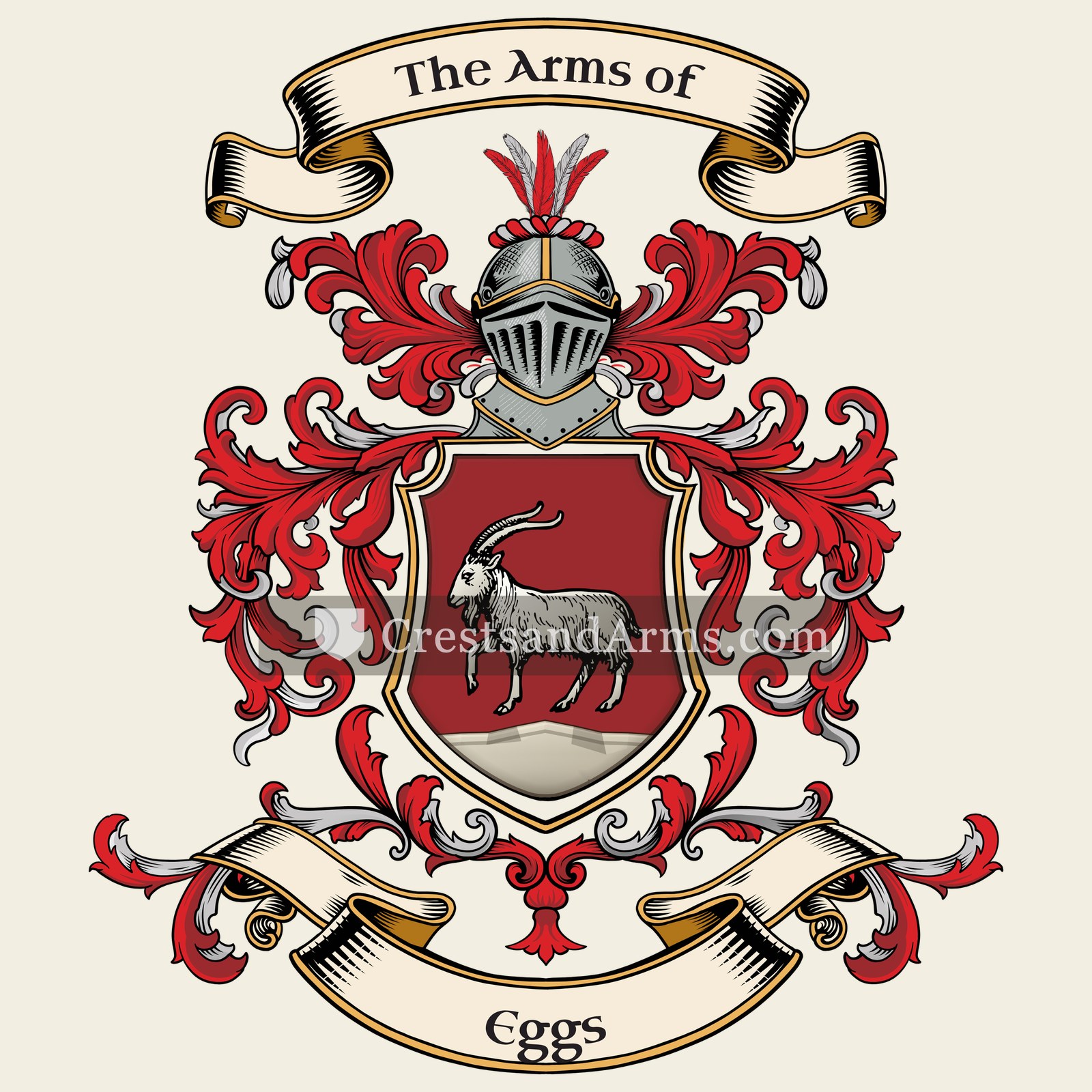
A record of documented arms, meaning and origin, researched for the Eggs family of Germany.
Reg. 5556 · German, D–F
Coat of Arms & Family Crest Details
Symbols on this shield
mountThe ground held, and steadfastness upon it
goatOne who wins by diplomacy rather than force
Colours
Red (Gules)Means: Military strength
Silver (Argent)Means: Peace and sincerity
Historical info
Source
J. B. Rietstap, Armorial Général, Gouda: G. B. van Goor Zonen, 1884–87
Blazon (the actual original written record)
“De gu. à un bouquetin d'arg., arrêté sur un tertre de trois coupeaux du même. Cq. cour. C.: un buset d'homme, hab. de gu., au rabat d'arg., coiffé d'un bonnet albanais de gu., retr. d'arg., orné de rubans d'or flottant à sen.”
SwabiaSwabia, c. 1592
Digital archive packCoat of arms PNG, gold border print PDF, vector SVG and the certificate of authenticity. Sent to your email in minutes.
Map of Germany showing where the Eggs arms are recorded
The Eggs arms were recorded in Swabia, c. 1592.
Swabia was broken into a great many small territories in southern Germany, and each had its own landowners and its own leading townsmen. That fragmentation produced an unusual number of families with arms.
This is where the arms were entered in the register. Families often moved to other parts of the country, so the same name can turn up in more than one region.
The body that granted and recorded arms in Germany in this period.
Emperor Rudolf II
Sovereign of the period
Emperor Rudolf II
1576–1612
Reigning in Germany when the Eggs arms are first recorded.
How Arms Worked in Germany
In the Holy Roman Empire, coats of arms were often granted to individuals by the Emperor or his representatives. These arms were then passed down through the generations to all legitimate descendants of the original holder. Younger branches of a family usually kept the same shield design without needing to change it, as the arms belonged to the entire lineage.
Granting authority
The Holy Roman Emperor held the sole power to grant new coats of arms throughout his vast imperial territories.
How they got arms
Families typically obtained their coats of arms through a formal imperial grant or by proving their noble status to the authorities.
Where arms were recorded
These grants were officially recorded in the Imperial Chancery registers, which began keeping formal records of such honors during the Middle Ages.
The family's standing
Recorded among the armigerous families of Swabia.
Origin & History of the Eggs Family in Germany
The family name Eggs finds its historical roots in the Swabian region of southwestern Germany, where records confirm members of the family were established by 1592. During this period, the name was likely linked to the local Alemannic dialect, which was common throughout the area. Many surnames from this time and region were derived from personal nicknames or descriptions of a person’s character, trade, or physical traits. In the context of the Swabian countryside, the name may have evolved from early linguistic variations or references to local landmarks and rural life. As the family grew, they became part of the social fabric of the Holy Roman Empire, living through a time of significant religious and political change in Central Europe. The persistence of the name in regional records suggests that the family maintained a stable presence in their community for generations.
Eggs Meaning & Related Branches
Root word
Egge
A sharp edge or corner of a blade or land.
This name
EggsA topographic name for someone living near a ridge or a sharp mountain edge.
also spelled
Egs
Egges
Documented Sources
J. B. Rietstap, Armorial Général, Gouda: G. B. van Goor Zonen, 1884–87
Kohlheim, Rosa and Volker Kohlheim, Duden Familiennamen: Herkunft und Bedeutung von 20.000 Nachnamen, 2005
Bahlow, Hans, Deutsches Namenlexikon: Familien- und Vornamen nach Ursprung und Sinn erklärt, 1967
Landesarchiv Baden-Württemberg, Bestand A 57 (Reichskammergericht)
Digital archive packCoat of arms PNG, gold border print PDF, vector SVG and the certificate of authenticity. Sent to your email in minutes.


 mountThe ground held, and steadfastness upon it
 goatOne who wins by diplomacy rather than force
 mountThe ground held, and steadfastness upon it
 goatOne who wins by diplomacy rather than force