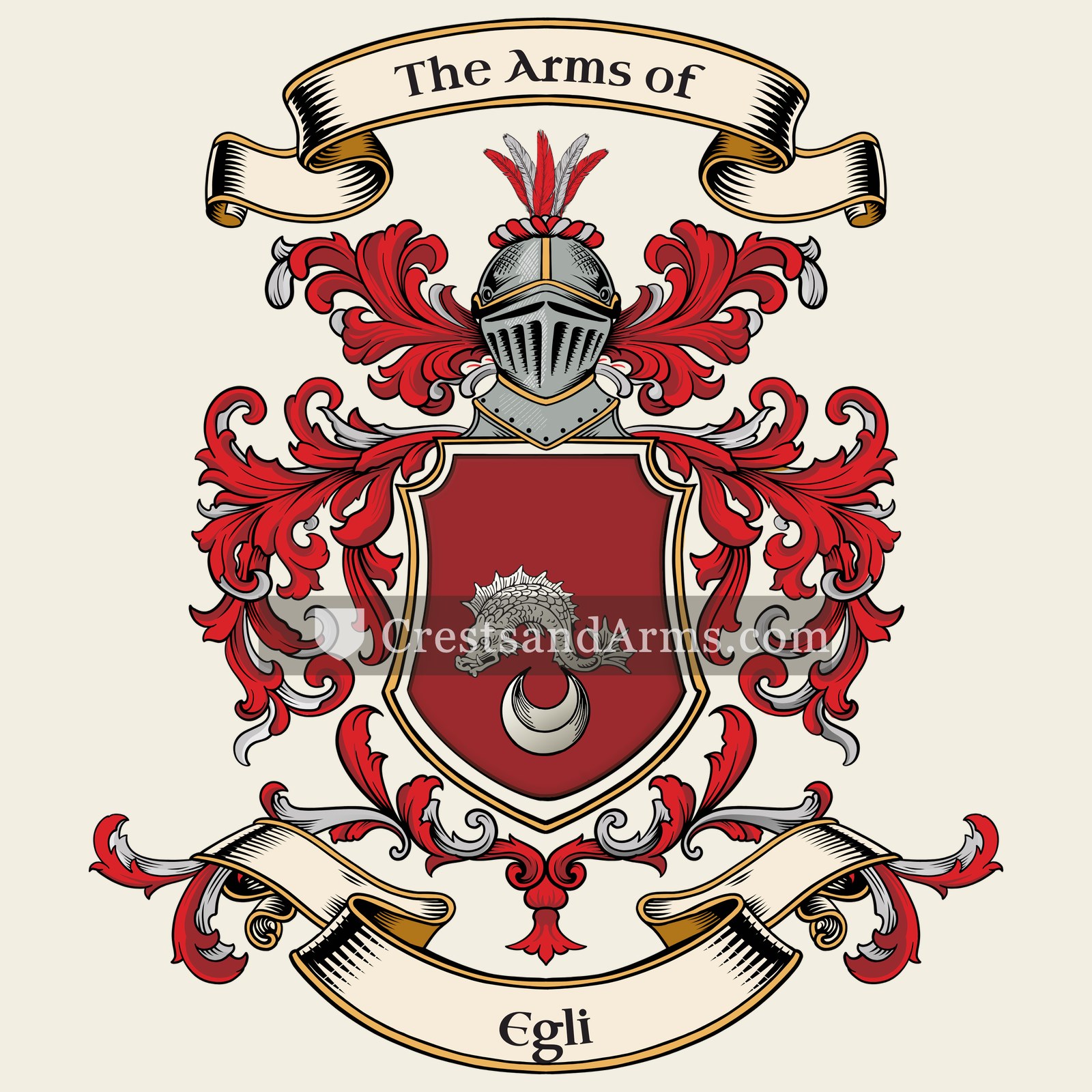
A record of documented arms, meaning and origin, researched for the Egli family of Switzerland.
Reg. 1178 · Swiss, D–F
Coat of Arms & Family Crest Details
Symbols on this shield
dolphinSwiftness, charity and love
crescentHonour by the sovereign, and the second son
Colours
Red (Gules)Means: Military strength
Silver (Argent)Means: Peace and sincerity
Historical info
Source
J. B. Rietstap, Armorial Général, Gouda: G. B. van Goor Zonen, 1884–87
Blazon (the actual original written record)
“De gu. à un dauphin d'arg., posé en pal, la queue recourbée à dextre et la tête abaissée sur la queue; ledit dauphin acc. d'un croiss. versé d'arg. en p.”
Switzerlandc. 1745
Digital archive packCoat of arms PNG, gold border print PDF, vector SVG and the certificate of authenticity. Sent to your email in minutes.
Map of Switzerland showing where the Egli arms are recorded
The Egli arms were recorded in Switzerland, c. 1745.
Arms such as these were typically recorded in Bern.
Bern was the largest of the Swiss cantons and ran itself, with its own council and its own courts. Its governing families held office for generations, and office of that kind carried a shield with it.
This is where the arms were entered in the register. Families often moved to other parts of the country, so the same name can turn up in more than one region.
The body that granted and recorded arms in Switzerland in this period.
How Arms Worked in Switzerland
In Switzerland, coats of arms were not restricted to the nobility and were often adopted by common citizens and families. These symbols were passed down through generations to show family identity. When branches of a family grew, they often changed small details of the design to distinguish their own line from the original group.
Granting authority
Cantonal and civic authorities managed the use of coats of arms within their specific regions and local jurisdictions.
How they got arms
Families typically assumed their own coats of arms based on local custom rather than receiving them from a central monarch.
Where arms were recorded
Arms were recorded in various cantonal and civic registers starting from the fourteenth century throughout the Swiss region.
The family's standing
Recorded among the armigerous families of Switzerland.
Origin & History of the Egli Family in Switzerland
The surname Egli originates from the German-speaking regions of Switzerland and is rooted in the medieval period. It is classified as a patronymic name, which means it was derived from a shortened version of a given name. Specifically, it evolved from the Old High German name Agil, which was a common personal name during the Middle Ages. By the time the family was firmly established in the canton of Bern by 1745, the name had become a permanent fixture of the local population. Families bearing this name were typically involved in agriculture or skilled trades, which were the primary ways people supported themselves in the Swiss countryside during the eighteenth century. Because the name was tied to a specific region, it helped officials and neighbors identify families within the tight-knit communities of the Bernese highlands.
Egli Meaning & Related Branches
Root word
Agil
Old High German word meaning edge, point, or sword blade.
This name
EgliA diminutive form referring to someone with a sharp or keen temperament.
also spelled
Egly
Eglee
Documented Sources
J. B. Rietstap, Armorial Général, Gouda: G. B. van Goor Zonen, 1884–87
Bahlow, Hans, Deutsches Namenlexikon: Familien- und Vornamen nach Ursprung und Sinn erklärt, 1967
State Archives of the Canton of Bern, Kirchenbücher (Parish Registers), 1745
Heer, Gottlieb Heinrich, Die Schweizer Familiennamen, 1940
Digital archive packCoat of arms PNG, gold border print PDF, vector SVG and the certificate of authenticity. Sent to your email in minutes.


 dolphinSwiftness, charity and love
 crescentHonour by the sovereign, and the second son
 dolphinSwiftness, charity and love
 crescentHonour by the sovereign, and the second son