A record of documented arms, meaning and origin, researched for the Eglin family lines. Documented in 2 countries.
Reg. 6642 · Swiss, D–F
Coat of Arms & Family Crest Details
Symbols on this shield
mulletThe third son, and a divine quality from above
fishA true and generous mind, and Christian faith
Colours
Blue (Azure)Means: Loyalty and truth
Red (Gules)Means: Military strength
Gold (Or)Means: Generosity
Silver (Argent)Means: Peace and sincerity
Historical info
Source
J. B. Rietstap, Armorial Général, Gouda: G. B. van Goor Zonen, 1884–87
Blazon (the actual original written record)
“Coupé: au 1 d'azur à trois étoiles mal-ordonnées d'or; au 2 de gu. à deux poissons d'arg., passés en saut. C.: un homme iss., hab. de gu., rebr. d'arg., au rabat du même, tenant une étoile d'or. L.: d'arg. et de gu.”
SwitzerlandBâle, c. 1745
Digital archive packCoat of arms PNG, gold border print PDF, vector SVG and the certificate of authenticity. Sent to your email in minutes.
Map of Switzerland showing where the Eglin arms are recorded
The Eglin arms were recorded in Bâle, c. 1745.
This is where the arms were entered in the register. Families often moved to other parts of the country, so the same name can turn up in more than one region.
The body that granted and recorded arms in Switzerland in this period.
How Arms Worked in Switzerland
In Switzerland, coats of arms were not restricted to the nobility and were often adopted by common citizens and families. These symbols were passed down through generations to show family identity. When branches of a family grew, they often changed small details of the design to distinguish their own line from the original group.
Granting authority
Cantonal and civic authorities managed the use of coats of arms within their specific regions and local jurisdictions.
How they got arms
Families typically assumed their own coats of arms based on local custom rather than receiving them from a central monarch.
Where arms were recorded
Arms were recorded in various cantonal and civic registers starting from the fourteenth century throughout the Swiss region.
The family's standing
Recorded among the armigerous families of Switzerland.
Origin & History of the Eglin Family in Switzerland
The Eglin family name holds deep roots in the Swiss region, with historical documentation confirming their presence in the city of Basel by the middle of the eighteenth century. The name itself likely evolved from the Germanic given name Egelin, which functioned as a diminutive form of names starting with the element "egil," meaning edge or sword point. Families bearing this name were often integrated into the urban fabric of Basel, a city known for its strategic location along the Rhine River and its importance as a center for trade and scholarship. By 1745, individuals carrying the Eglin name were established members of the local community, participating in the professional and social life of the city during a period of significant economic growth. Their history reflects the broader patterns of Swiss migration and settlement, where surnames became fixed indicators of lineage and local identity as families settled into specific cantons and cities.
Coat of Arms & Family Crest Details
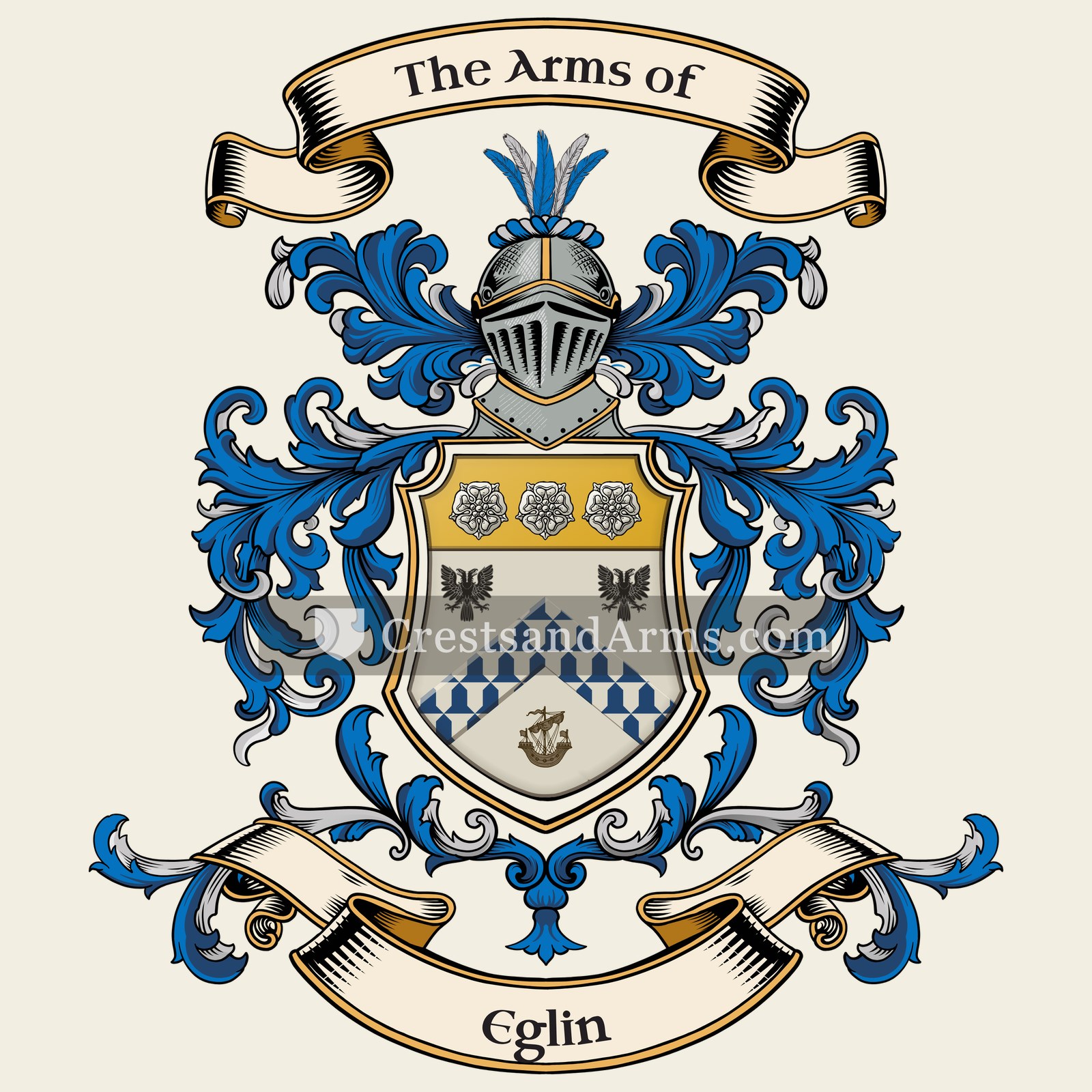
Symbols on this shield
chevronProtection, and faithful service completed
chiefAuthority, wisdom and dominion
eagleNobility, strength and a keen mind
shipEnterprise, and a great voyage undertaken
roseThe seventh son, and beauty with grace
Colours
Silver (Argent)Means: Peace and sincerity
Black (Sable)Means: Constancy
Gold (Or)Means: Generosity
Historical info
Source
Sir Bernard Burke, The General Armory of England, Scotland, Ireland and Wales, London: Harrison & Sons, 1884
Blazon (the actual original written record)
“Ar. a chev. vairé az. and or, betw. two eagles displ. in chief sa. and a merchant ship under sail in base ppr. on a chief of the second three roses of the field”
Englandc. 1620
Digital archive packCoat of arms PNG, gold border print PDF, vector SVG and the certificate of authenticity. Sent to your email in minutes.
Map of England showing where the Eglin arms are recorded
The Eglin arms were recorded in England, c. 1620.
Arms such as these were typically recorded in York.
Yorkshire is the largest of the English counties, and it held more gentry families than any other. Land there was split among a great many households rather than a few, so a great many of them carried arms.
This is where the arms were entered in the register. Families often moved to other parts of the country, so the same name can turn up in more than one region.
The body that granted and recorded arms in England in this period.
James VI and I
Sovereign of the period
James VI and I
1603–1625
Reigning in Switzerland when the Eglin arms are first recorded.
How Arms Worked in England
English heraldry allowed arms to be shared by all legitimate descendants of the original owner. These symbols were treated as personal property that moved through the generations to all children. While the eldest son kept the original design, other family members could use the same shield without needing to change it or register their own unique versions.
Granting authority
The College of Arms in London has regulated the use of coats of arms throughout England and Wales since 1484.
How they got arms
Families typically obtained their coats of arms through a formal grant from the Crown or by proving their ancient right to them.
Where arms were recorded
All official coats of arms are recorded in the registers kept at the College of Arms, which date back to the fifteenth century.
The family's standing
Recorded among the armigerous families of England.
Origin & History of the Eglin Family in England
The surname Eglin is rooted in the northern regions of England, where it emerged as a locative or patronymic name during the Middle Ages. By the early 17th century, the family had established a notable presence in the historic city of York. Records from 1620 confirm that members of the Eglin family were active participants in the social and economic life of this northern hub. During this period, York served as a vital center for trade and administration, and families like the Eglins often held roles that connected them to the local merchant classes or skilled trades. The name likely evolved from regional dialects, reflecting the linguistic shifts common in Yorkshire as families moved between rural villages and the growing urban environment of the city. This early documentation in York provides a clear window into the family’s long-standing connection to the north of England, marking them as part of the established citizenry long before the modern era.
Eglin Meaning & Related Branches
Root word
Agil
Old High German word meaning edge, point, or sword blade.
This name
EglinA diminutive form referring to a descendant of someone with a sharp or keen nature.
also spelled
Eglyne
Egling
Eglinton
Eglinham
Related arms
Cupersimilar arms
Horesimilar arms
Maloteausimilar arms
Egleingham, or Eglenhamvariant spelling
Documented Sources
J. B. Rietstap, Armorial Général, Gouda: G. B. van Goor Zonen, 1884–87
Historisches Lexikon der Schweiz, Familiennamenbuch der Schweiz, 1989
Staatsarchiv Basel-Stadt, Bürgerverzeichnisse und Einwohnerregister, 1745
Bahlow, Hans, Deutsches Namenlexikon: Familien- und Vornamen nach Ursprung und Sinn erklärt, 1967
Digital archive packCoat of arms PNG, gold border print PDF, vector SVG and the certificate of authenticity. Sent to your email in minutes.


 mulletThe third son, and a divine quality from above
 fishA true and generous mind, and Christian faith
 mulletThe third son, and a divine quality from above
 fishA true and generous mind, and Christian faith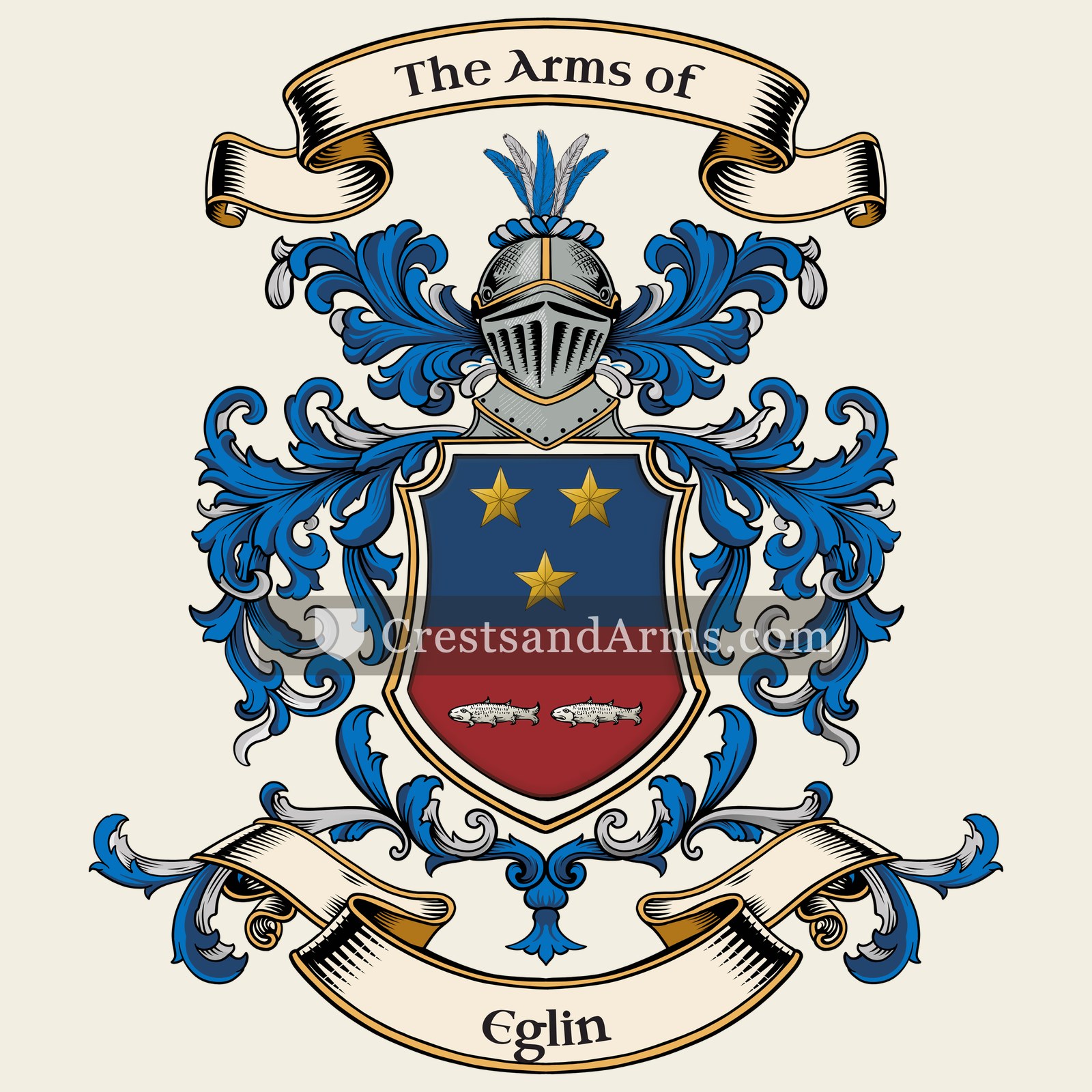

 chevronProtection, and faithful service completed
 chiefAuthority, wisdom and dominion
 eagleNobility, strength and a keen mind
 shipEnterprise, and a great voyage undertaken
 roseThe seventh son, and beauty with grace