Map of Spain showing where the Eguiluz arms are recorded
The Eguiluz arms were recorded in Guipuzcoa, c. 1722.
This is where the arms were entered in the register. Families often moved to other parts of the country, so the same name can turn up in more than one region.
The body that granted and recorded arms in Spain in this period.
Philip V of Spain
Sovereign of the period
Philip V of Spain
1714–1724
Reigning in Spain when the Eguiluz arms are first recorded.
How Arms Worked in Spain
In Spain, a coat of arms was considered a form of property that belonged to the entire family line. These arms were passed down from a father to all his children equally. Younger branches of the family usually kept the original design without needing to add any special marks to distinguish their specific line.
Granting authority
The Cronista Rey de Armas was the official body that regulated and granted coats of arms throughout Spain.
How they got arms
Families often obtained their arms through royal grants or by proving their noble status to the official heraldic authority.
Where arms were recorded
Coats of arms were officially recorded in the registers of the Cronista Rey de Armas starting in 1496.
The family's standing
Recorded among the armigerous families of Spain.
Origin & History of the Eguiluz Family in Spain
The family name Eguiluz originates from the Basque Country in northern Spain, specifically within the province of Guipúzcoa. Linguists believe the name is derived from the Basque words "eguzki," meaning sun, and "luze," meaning long, which may have originally described a family living on a sunny, extended hillside or a prominent field. By the early 18th century, the family was firmly established in this region, as evidenced by parish records from 1722 that document their presence in local communities. During this era, families in Guipúzcoa were often deeply connected to the land and the specific village where they resided. The Eguiluz name reflects the deep linguistic roots of the Basque people and their long-standing history of maintaining distinct family identities within the rugged landscape of the Pyrenees mountains.
Eguiluz Meaning & Related Branches
Root word
Egi-luz
Basque terms meaning field or pasture and light or clear.
This name
EguiluzRefers to a bright, clear, or luminous meadow or field.
also spelled
Eguilus
Egeelooz
Documented Sources
J. B. Rietstap, Armorial Général, Gouda: G. B. van Goor Zonen, 1884–87
Gorrotxategi, Mikel. Nombres de familia en el País Vasco. 2008
Mitxelena, Koldo. Apellidos vascos. 1955
Archivo Histórico Diocesano de San Sebastián. Libros de Bautismos de la Parroquia de San Salvador de Guetaria. 1722
Digital archive packCoat of arms PNG, gold border print PDF, vector SVG and the certificate of authenticity. Sent to your email in minutes.


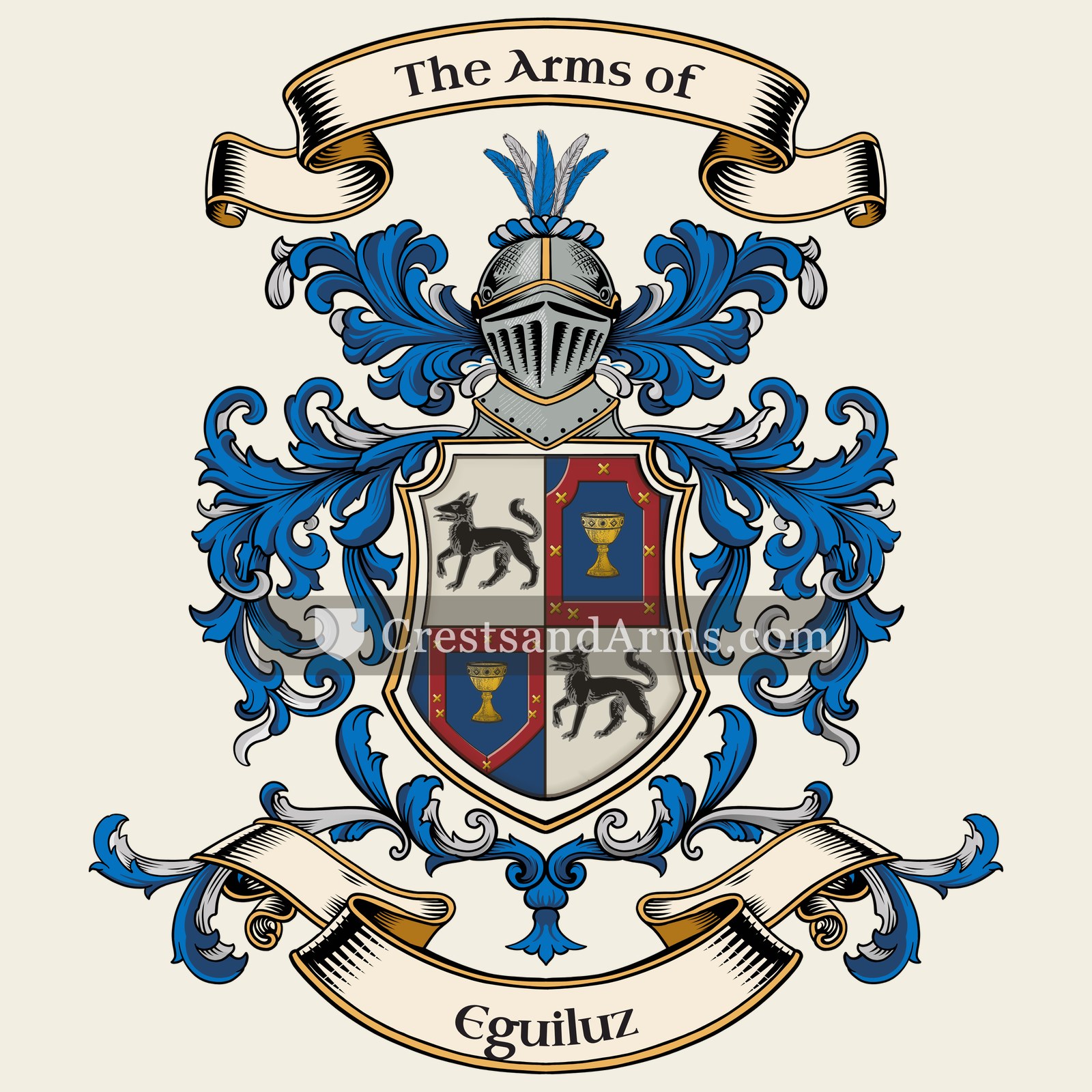
 wolfReward from long service and hard work
 cupFaith, office, and a trust discharged
 saltire coupedResolution, and the cross of St Andrew
 wolfReward from long service and hard work
 cupFaith, office, and a trust discharged
 saltire coupedResolution, and the cross of St Andrew