Map of Denmark showing where the Ehrenfeld arms are recorded
The Ehrenfeld arms were recorded in Denmark, c. 1719.
Arms such as these were typically recorded in Sjaælland.
Zealand held the Danish court, the crown's offices and Copenhagen itself. Families who served the king kept estates within reach of it, and royal service was the ordinary route to a coat of arms.
This is where the arms were entered in the register. Families often moved to other parts of the country, so the same name can turn up in more than one region.
The body that granted and recorded arms in Denmark in this period.
Frederik IV of Denmark
Sovereign of the period
Frederik IV of Denmark
1699–1730
Reigning in Denmark when the Ehrenfeld arms are first recorded.
How Arms Worked in Denmark
Danish heraldry during this period was closely tied to noble status and royal favor rather than being open to all citizens. Arms were typically granted by the monarch to individuals, and these symbols were then shared by all members of the noble house. If a family line died out, the right to use those specific arms ended with them.
Granting authority
The Danish royal chancery held the power to issue and regulate official coats of arms for the kingdom.
How they got arms
Families usually received their arms through a formal royal grant that confirmed their noble status and rights.
Where arms were recorded
These grants were officially recorded in the Danish Royal Chancery records starting in the sixteenth century.
The family's standing
Recorded among the armigerous families of Denmark.
Origin & History of the Ehrenfeld Family in Denmark
The Ehrenfeld family name first appears in the historical record of Denmark on the island of Sjælland in 1719. During this period, the name was associated with individuals who navigated the complex social and administrative structures of the Danish state. The name itself follows a naming convention common in Northern Europe, where descriptive terms were often combined to denote a specific identity or place of origin. By the early 18th century, members of the family were integrated into the local community, likely serving in roles that required literacy and record-keeping within the parish systems of the time. While the family remained a small part of the broader population, their presence in Sjælland suggests they were part of the growing class of citizens who moved between urban centers and rural estates to manage trade or administrative duties. This early documentation serves as a vital anchor for understanding how the family established its roots in the region during the reign of King Frederick IV.
Coat of Arms & Family Crest Details
Colours
Green (Vert)Means: Hope
Historical info
Source
J. B. Rietstap, Armorial Général, Gouda: G. B. van Goor Zonen, 1884–87
Blazon (the actual original written record)
“De sin. à une Minerve avec son bouclier et sa lance, le tout au nat.”
SilesiaSilesia, c. 1765
Digital archive packCoat of arms PNG, gold border print PDF, vector SVG and the certificate of authenticity. Sent to your email in minutes.
Map of Germany showing where the Ehrenfeld arms are recorded
The Ehrenfeld arms were recorded in Silesia, c. 1765.
Silesia was farming country in the east of the German lands, held in large estates by families who stayed put for generations. Owning land was what entitled a family to arms, so the region fills a good deal of the register.
This is where the arms were entered in the register. Families often moved to other parts of the country, so the same name can turn up in more than one region.
The body that granted and recorded arms in Germany in this period.
Francis I, Holy Roman Emperor
Sovereign of the period
Francis I, Holy Roman Emperor
1745–1765
Reigning in Denmark when the Ehrenfeld arms are first recorded.
How Arms Worked in Germany
In the Holy Roman Empire, coats of arms were often granted to individuals by the Emperor or his representatives. These arms were then passed down through the generations to all legitimate descendants of the original holder. Younger branches of a family usually kept the same shield design without needing to change it, as the arms belonged to the entire lineage.
Granting authority
The Holy Roman Emperor held the sole power to grant new coats of arms throughout his vast imperial territories.
How they got arms
Families typically obtained their coats of arms through a formal imperial grant or by proving their noble status to the authorities.
Where arms were recorded
These grants were officially recorded in the Imperial Chancery registers, which began keeping formal records of such honors during the Middle Ages.
The family's standing
Recorded among the armigerous families of Silesia.
Origin & History of the Ehrenfeld Family in Germany
The surname Ehrenfeld emerged within the German-speaking regions as a descriptive name, likely derived from the words for honor or prestige and field. By the mid-eighteenth century, historical records confirm that families bearing this name were well-established in the region of Silesia. In 1765, the Prussian administration conducted a detailed census of the population in this area to better manage taxation and military recruitment. These official documents show that the Ehrenfeld family was integrated into the local social structure during a time when Silesia was transitioning under Prussian rule. The name reflects a tradition of naming families after geographical features or aspirational qualities, which was a common practice in Central Europe during the eighteenth century. As the family lived in this borderland region, they were part of the complex cultural and political shifts that defined the history of the German territories during the Enlightenment.
Ehrenfeld Meaning & Related Branches
Root word
Ehrenfeld
Germanic roots meaning honor and field or open land.
This name
EhrenfeldA topographic name referring to a field associated with honor or noble status.
also spelled
Erenfeld
Documented Sources
J. B. Rietstap, Armorial Général, Gouda: G. B. van Goor Zonen, 1884–87
Rigsarkivet (Danish National Archives), Kirkebøger for Sjællands Stift (Parish registers for the Diocese of Sjælland), 1719
Trap, J.P., Statistisk-topographisk Beskrivelse af Kongeriget Danmark, 1858
Digital archive packCoat of arms PNG, gold border print PDF, vector SVG and the certificate of authenticity. Sent to your email in minutes.


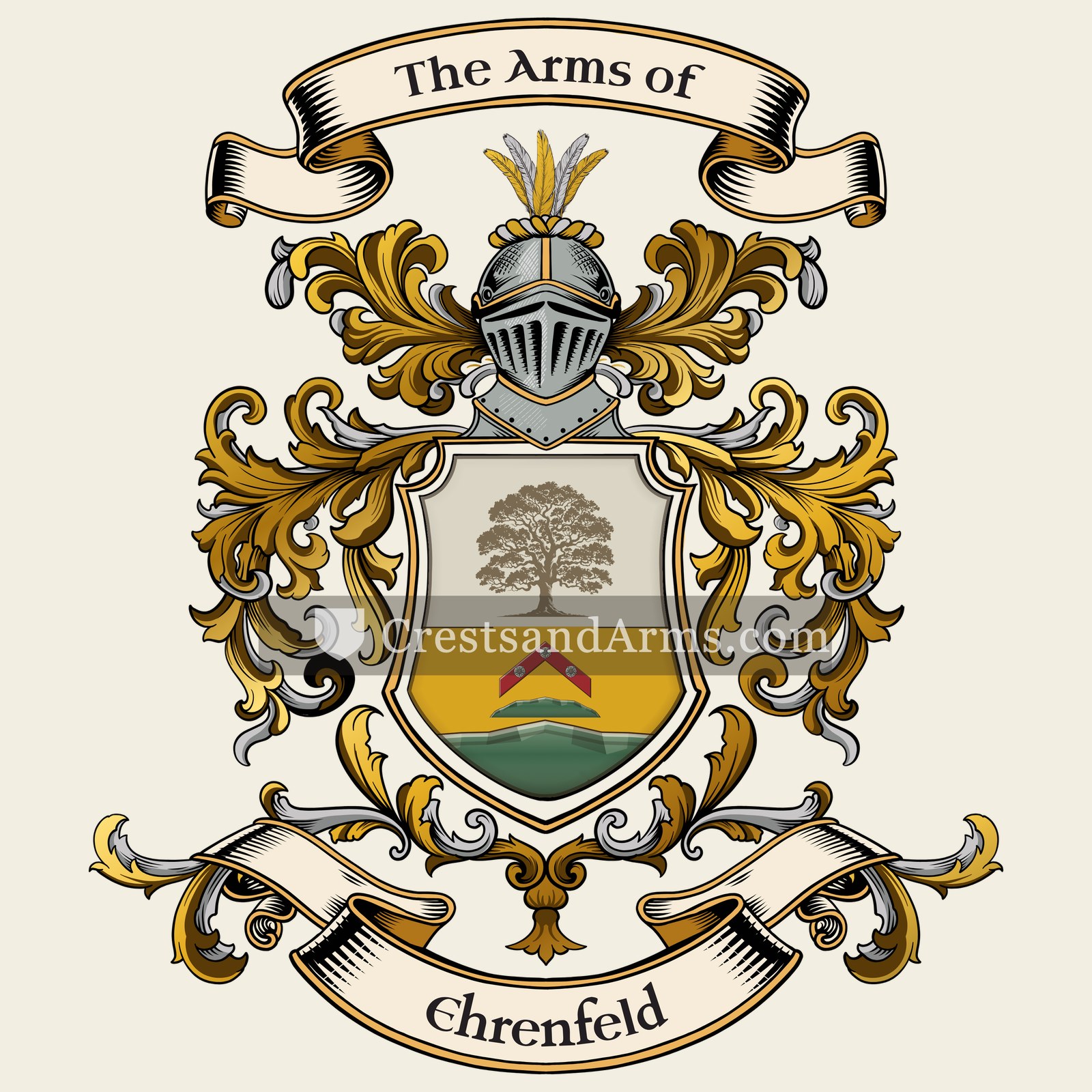
 mountThe ground held, and steadfastness upon it
 chevronProtection, and faithful service completed
 treeLife, endurance and deep roots
 roseThe seventh son, and beauty with grace
 mountThe ground held, and steadfastness upon it
 chevronProtection, and faithful service completed
 treeLife, endurance and deep roots
 roseThe seventh son, and beauty with grace