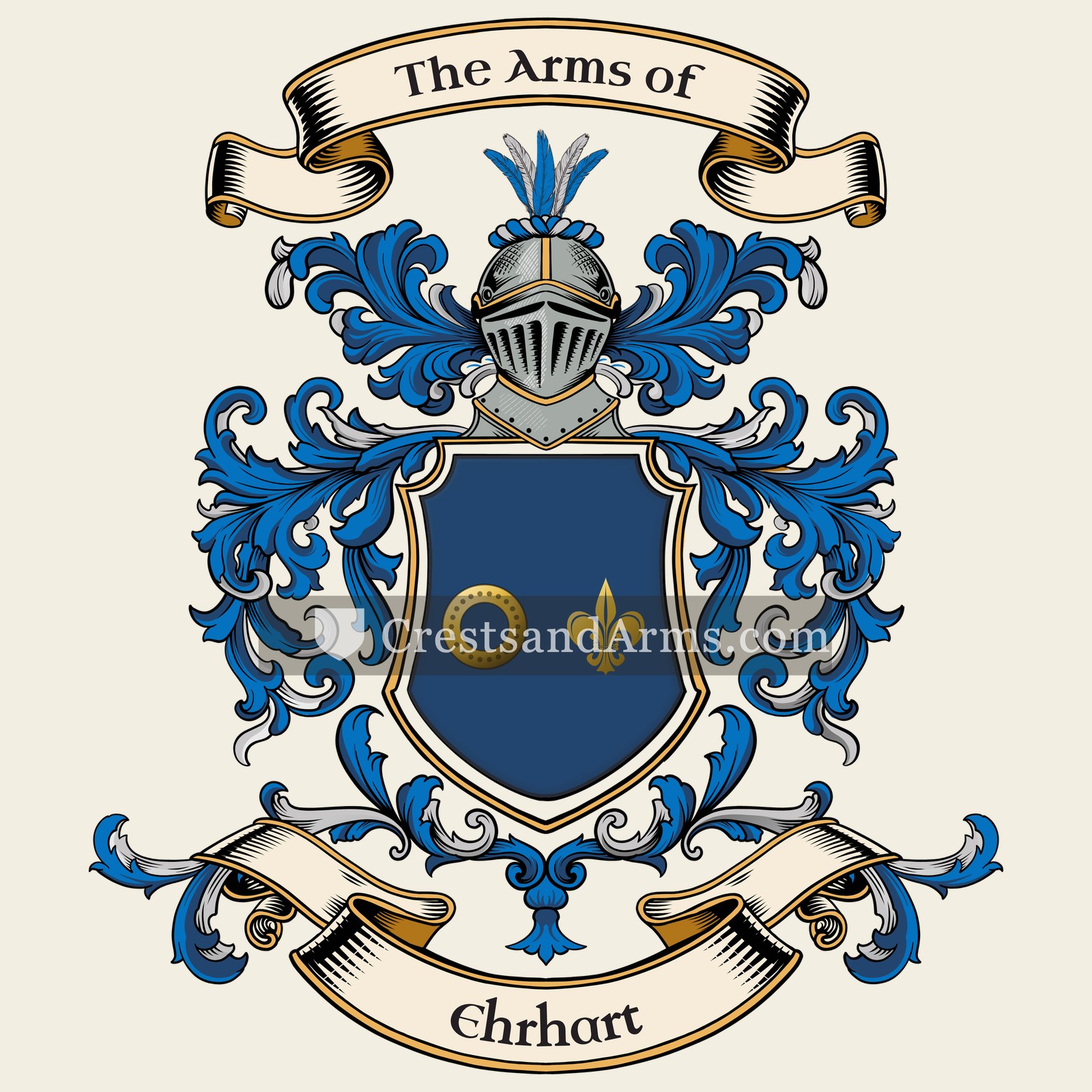
A record of documented arms, meaning and origin, researched for the Ehrhart family of Germany.
Reg. 3090 · German, D–F
Coat of Arms & Family Crest Details
Symbols on this shield
ringFidelity, and a promise kept
fleur de lisPurity, light, and the sixth son
Colours
Blue (Azure)Means: Loyalty and truth
Gold (Or)Means: Generosity
Historical info
Source
J. B. Rietstap, Armorial Général, Gouda: G. B. van Goor Zonen, 1884–87
Blazon (the actual original written record)
“D'azur à une bague d'or en forme de serpent arrondi, à deux têtes, la bague châtonnée d'une pierre précieuse; à une fleur-de-lis du sec., posée au centre de la bague. C.: les meubles de l'écu.”
GermanyMemmingen, c. 1795
Where the Ehrhart Arms Were Recorded
Memmingen
Map of Germany showing where the Ehrhart arms are recorded
The Ehrhart arms were recorded in Memmingen, c. 1795.
This is where the arms were entered in the register. Families often moved to other parts of the country, so the same name can turn up in more than one region.
The body that granted and recorded arms in Germany in this period.
Francis II, Holy Roman Emperor
Sovereign of the period
Francis II, Holy Roman Emperor
1792–1806
Reigning in Germany when the Ehrhart arms are first recorded.
How Arms Worked in Germany
In the Holy Roman Empire, coats of arms were often granted to individuals by the Emperor or his representatives. These arms were then passed down through the generations to all legitimate descendants of the original holder. Younger branches of a family usually kept the same shield design without needing to change it, as the arms belonged to the entire lineage.
Granting authority
The Holy Roman Emperor held the sole power to grant new coats of arms throughout his vast imperial territories.
How they got arms
Families typically obtained their coats of arms through a formal imperial grant or by proving their noble status to the authorities.
Where arms were recorded
These grants were officially recorded in the Imperial Chancery registers, which began keeping formal records of such honors during the Middle Ages.
The family's standing
Recorded among the armigerous families of Germany.
Origin & History of the Ehrhart Family in Germany
The surname Ehrhart is a German patronymic name that evolved from the ancient Germanic given name Erhard. This name is composed of the elements "era," meaning honor, and "hard," meaning brave or hardy. By the time the family was firmly established in the free imperial city of Memmingen in 1795, the name had been in use for several centuries across various regions of the Holy Roman Empire. Families bearing this name were often part of the growing middle class of artisans and merchants who helped define the economic life of southern German towns. During the late 18th century, Memmingen served as a hub for trade and craftsmanship, and the Ehrhart family likely participated in the local guilds that regulated these professions. Because the name was tied to personal character traits, it was adopted by different families independently rather than originating from a single common ancestor. This widespread adoption helped the name persist through generations as families moved across the German-speaking lands.
Related Branches & Arms
Root word
Erhart
Derived from the Germanic elements for honor and hardy or brave.
This name
EhrhartAn occupational or descriptive surname signifying a person of honorable strength or courageous character.
also spelled
Erhart
Ehrhardt
Related arms
Erhartvariant spelling
Documented Sources
J. B. Rietstap, Armorial Général, Gouda: G. B. van Goor Zonen, 1884–87
Bahlow, Hans. Deutsches Namenlexikon: Familien- und Vornamen nach Ursprung und Sinn erklärt. 1967
Heintze, Albert. Die deutschen Familiennamen: geschichtlich, geographisch, sprachlich. 1903
Stadtarchiv Memmingen, Bürgerbücher der Stadt Memmingen
Stadtarchiv Memmingen, Kirchenbücher der evangelischen Kirchengemeinde St. Martin
Digital archive packCoat of arms PNG, gold border print PDF, vector SVG and the certificate of authenticity. Sent to your email in minutes.


 ringFidelity, and a promise kept
 fleur de lisPurity, light, and the sixth son
 ringFidelity, and a promise kept
 fleur de lisPurity, light, and the sixth son