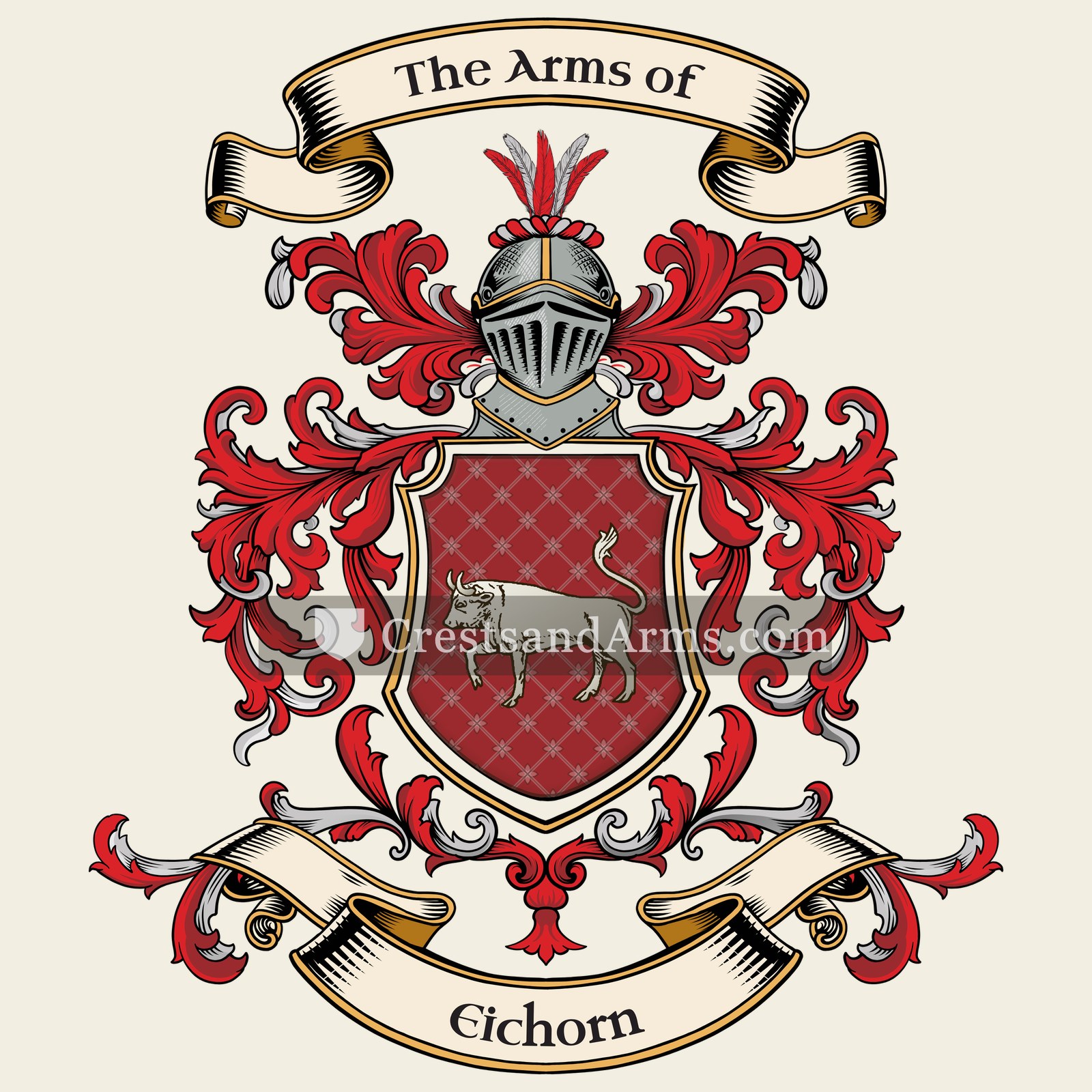
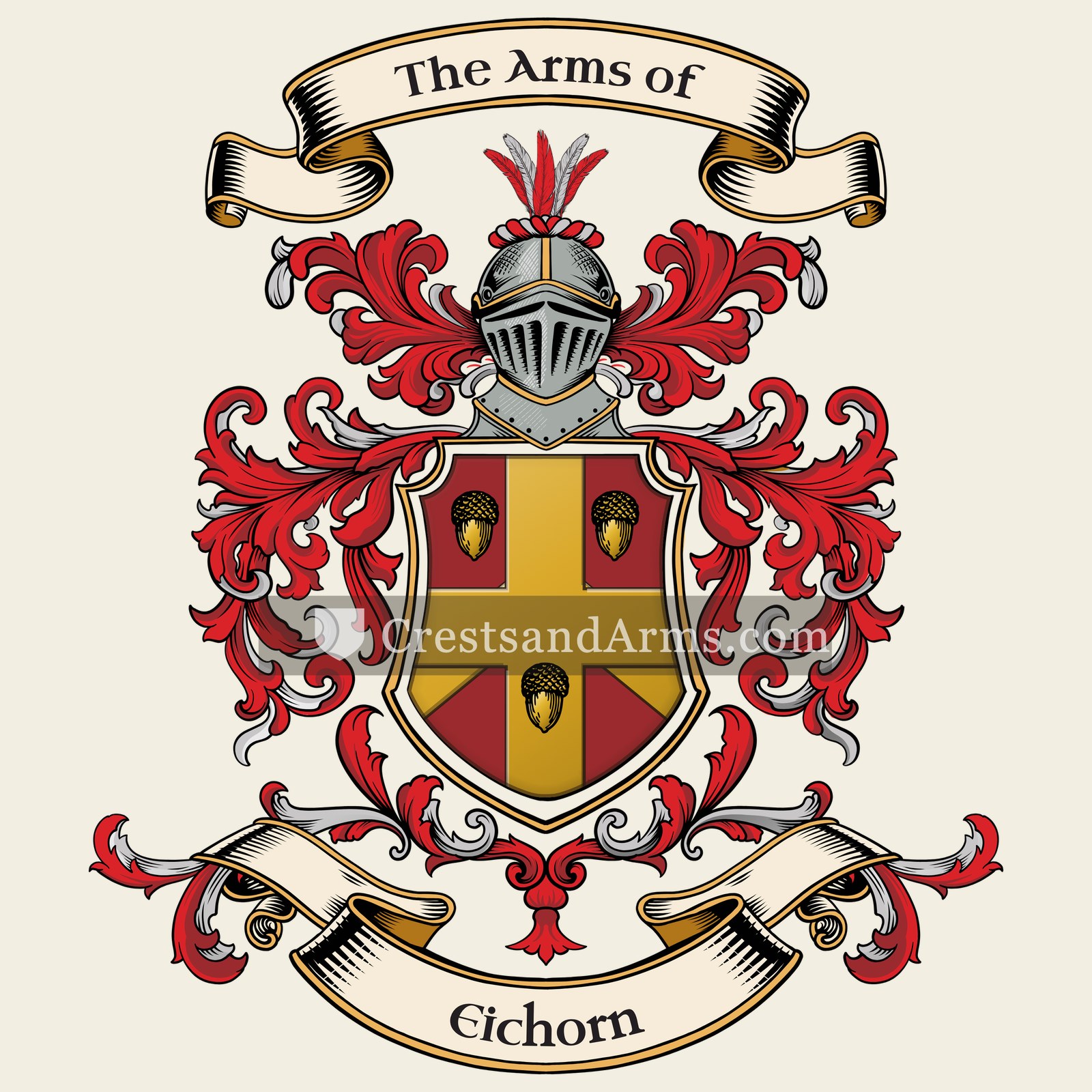
A record of documented arms, meaning and origin, researched for the Eichorn family lines. Documented in 2 countries.
Reg. 5644 · Belgian, D–F
Coat of Arms & Family Crest Details
Symbols on this shield
bullValour and generosity
Colours
Red (Gules)Means: Military strength
Silver (Argent)Means: Peace and sincerity
Historical info
Source
J. B. Rietstap, Armorial Général, Gouda: G. B. van Goor Zonen, 1884–87
Blazon (the actual original written record)
“De gu. à un rencontre de boeuf d'arg., accorné d'or. C.: un écureuil au nat., croquant une noix.”
BelgiumLuxemb, c. 1737
Where the Eichorn Arms Were Recorded
Luxemb
Map of Belgium showing where the Eichorn arms are recorded
The Eichorn arms were recorded in Luxemb, c. 1737.
This is where the arms were entered in the register. Families often moved to other parts of the country, so the same name can turn up in more than one region.
The body that granted and recorded arms in Belgium in this period.
Charles VI, Holy Roman Emperor
Sovereign of the period
Charles VI, Holy Roman Emperor
1711–1740
Reigning in Belgium when the Eichorn arms are first recorded.
How Arms Worked in Belgium
In Belgium, a coat of arms is considered personal property that is passed down through the male line to legitimate descendants. Families often use the same shield design across generations to show their shared heritage. If a branch of the family wants to change the design, they must apply for an official update to their specific version of the arms.
Granting authority
The Conseil héraldique is the official body that regulates and approves all coats of arms in Belgium.
How they got arms
Families obtain their coats of arms through formal royal grants or by confirming their historical right to use existing designs.
Where arms were recorded
All approved coats of arms are officially recorded in the public registers of the Conseil héraldique since 1844.
The family's standing
Recorded among the armigerous families of Belgium.
Origin & History of the Eichorn Family in Belgium
The family name Eichorn, which translates from German as "squirrel," has deep roots in the border regions between modern-day Belgium and Luxembourg. By 1737, records confirm that members of the family were well-established in the Luxembourg area, which at that time was part of the Austrian Netherlands. During the eighteenth century, this region was a crossroads for trade and migration, and families often moved between the rural villages of the Ardennes and the growing urban centers of the Low Countries. As the family spread into what is now eastern Belgium, they likely worked as skilled laborers, farmers, or foresters, as their name suggests a historical connection to the wooded landscapes of the region. Over the generations, the family integrated into the local culture, adapting to the shifting political borders while maintaining their identity through their distinct surname.
Coat of Arms & Family Crest Details
Symbols on this shield
chevronProtection, and faithful service completed
cross symbolChristian faith and service
acornAntiquity and strength from small beginnings
Colours
Red (Gules)Means: Military strength
Gold (Or)Means: Generosity
Historical info
Source
J. B. Rietstap, Armorial Général, Gouda: G. B. van Goor Zonen, 1884–87
Blazon (the actual original written record)
“De gu. au chev. pignonné de cinq degrés d'or, sommé d'une croix treflée iss. du même, ledit chev. acc. de trois glands d'or, tigés et feuillés du même, les queues en haut. Cq. cour. C.: un écureuil au nat., tenant de ses pattes un gland d'or, tigé et feuillé du même, la queue en bas; entre deux prob., d'or et de gu. L. d'or et de gu. S.: deux sauvages de carn., ceints et cour. de lierre, arm. de massues.”
GermanyBreslau, c. 1856
Where the Eichorn Arms Were Recorded
Bavaria
Map of Germany showing where the Eichorn arms are recorded
The Eichorn arms were recorded in Breslau, c. 1856.
Arms such as these were typically recorded in Bavaria.
Bavaria was a country of old landed families and walled market towns. Estates passed down the same line for centuries, and both the landowners and the leading townsmen kept arms, which is why so many Bavarian names sit in the registers.
This is where the arms were entered in the register. Families often moved to other parts of the country, so the same name can turn up in more than one region.
The body that granted and recorded arms in Germany in this period.
Frederick William IV of Prussia
Sovereign of the period
Frederick William IV of Prussia
1840–1861
Reigning in Belgium when the Eichorn arms are first recorded.
How Arms Worked in Germany
Prussian heraldry was strictly tied to social rank and noble status rather than being a free choice for every citizen. These symbols were treated as permanent family property that moved through the generations to all legitimate heirs. If a family branch wanted to change their design to stand out, they had to apply for official permission to alter their specific version of the shield.
Granting authority
The Prussian Heroldsamt acted as the central state office that managed and strictly controlled all noble titles and coats of arms.
How they got arms
Families usually obtained their arms through formal royal grants or by proving their long-standing noble status to the state authorities.
Where arms were recorded
All official coats of arms were kept in the rolls of the Prussian Heroldsamt, which functioned from 1706 until 1918.
The family's standing
Recorded among the armigerous families of Germany.
Origin & History of the Eichorn Family in Germany
The surname Eichorn is a classic example of a German topographic name, which was created to describe the landscape where an early family lived. The name is derived from the Middle High German words "eich" for oak and "horn" for a projecting piece of land or a corner. This suggests that the first people to carry the name likely lived near a prominent oak tree or a wooded corner of a valley. By the time records confirm the presence of the family in Bavaria in 1856, the name had already been established for centuries as a way to identify individuals by their connection to the local geography. During this era, many families in the Bavarian region were deeply tied to the land, and their surnames often reflected the specific forests or hills that defined their daily lives. This naming tradition helped neighbors and officials distinguish between different households in rural villages before modern census systems were fully developed.
Related Branches & Arms
Root word
Eichhorn
Germanic compound meaning oak and horn.
This name
EichornA topographic or habitational name referring to someone living near an oak tree.
also spelled
Eichorn
Eychhorn
Eichhorne
Eikhorn
Documented Sources
J. B. Rietstap, Armorial Général, Gouda: G. B. van Goor Zonen, 1884–87
Archives nationales de Luxembourg, État civil et registres paroissiaux
Archives de l'État à Arlon, Registres paroissiaux du Luxembourg belge
Heintz, Joseph, Les noms de famille au Luxembourg, 1985
Muller, Jean-Claude, Familles luxembourgeoises: Origines et migrations, 1992
Digital archive packCoat of arms PNG, gold border print PDF, vector SVG and the certificate of authenticity. Sent to your email in minutes.


 bullValour and generosity
 bullValour and generosity

 chevronProtection, and faithful service completed
 cross symbolChristian faith and service
 acornAntiquity and strength from small beginnings