A record of documented arms, meaning and origin, researched for the Eilers family lines. Documented in 2 countries.
Reg. 6113 · Danish, D–F
Coat of Arms & Family Crest Details
Symbols on this shield
roseThe seventh son, and beauty with grace
mulletThe third son, and a divine quality from above
crescentHonour by the sovereign, and the second son
Colours
Gold (Or)Means: Generosity
Red (Gules)Means: Military strength
Blue (Azure)Means: Loyalty and truth
Silver (Argent)Means: Peace and sincerity
Historical info
Source
J. B. Rietstap, Armorial Général, Gouda: G. B. van Goor Zonen, 1884–87
Blazon (the actual original written record)
“Tiercé en fasce: au 1 d'or à une rose de gu.; au 2 de gu. à trois étoiles d'or, rangées en fasce; au 3 d'azur à un croiss. figuré d'arg. Cq. cour. T.: deux anges, hab. de dalmatiques d'azur.”
Denmarkc. 1677
Digital archive packCoat of arms PNG, gold border print PDF, vector SVG and the certificate of authenticity. Sent to your email in minutes.
Map of Denmark showing where the Eilers arms are recorded
The Eilers arms were recorded in Denmark, c. 1677.
Arms such as these were typically recorded in Sjaælland.
Zealand held the Danish court, the crown's offices and Copenhagen itself. Families who served the king kept estates within reach of it, and royal service was the ordinary route to a coat of arms.
This is where the arms were entered in the register. Families often moved to other parts of the country, so the same name can turn up in more than one region.
The body that granted and recorded arms in Denmark in this period.
Christian V of Denmark
Sovereign of the period
Christian V of Denmark
1670–1699
Reigning in Denmark when the Eilers arms are first recorded.
How Arms Worked in Denmark
Danish heraldry during this period was closely tied to noble status and royal favor rather than being open to all citizens. Arms were typically granted by the monarch to individuals, and these symbols were then shared by all members of the noble house. If a family line died out, the right to use those specific arms ended with them.
Granting authority
The Danish royal chancery held the power to issue and regulate official coats of arms for the kingdom.
How they got arms
Families usually received their arms through a formal royal grant that confirmed their noble status and rights.
Where arms were recorded
These grants were officially recorded in the Danish Royal Chancery records starting in the sixteenth century.
The family's standing
Recorded among the armigerous families of Denmark.
Origin & History of the Eilers Family in Denmark
The Eilers family name has deep roots in the Danish landscape, with documented evidence placing members of the family on the island of Sjælland as early as 1677. During this period, Denmark was transitioning through a time of significant social and administrative change under the absolute monarchy. Families like the Eilers were often part of the growing class of landholders, farmers, or local officials who helped maintain the stability of the rural economy. Because the name is patronymic in origin, it suggests that the family line was established by an ancestor named Eiler, whose descendants adopted the name to signify their lineage. Living on Sjælland, the family would have been at the center of Danish cultural and political life, navigating the challenges of agricultural labor and the rigid social hierarchies of the late seventeenth century. Their presence in the historical record during this time serves as a testament to the family's long-standing integration into the fabric of Danish society.
Coat of Arms & Family Crest Details
Symbols on this shield
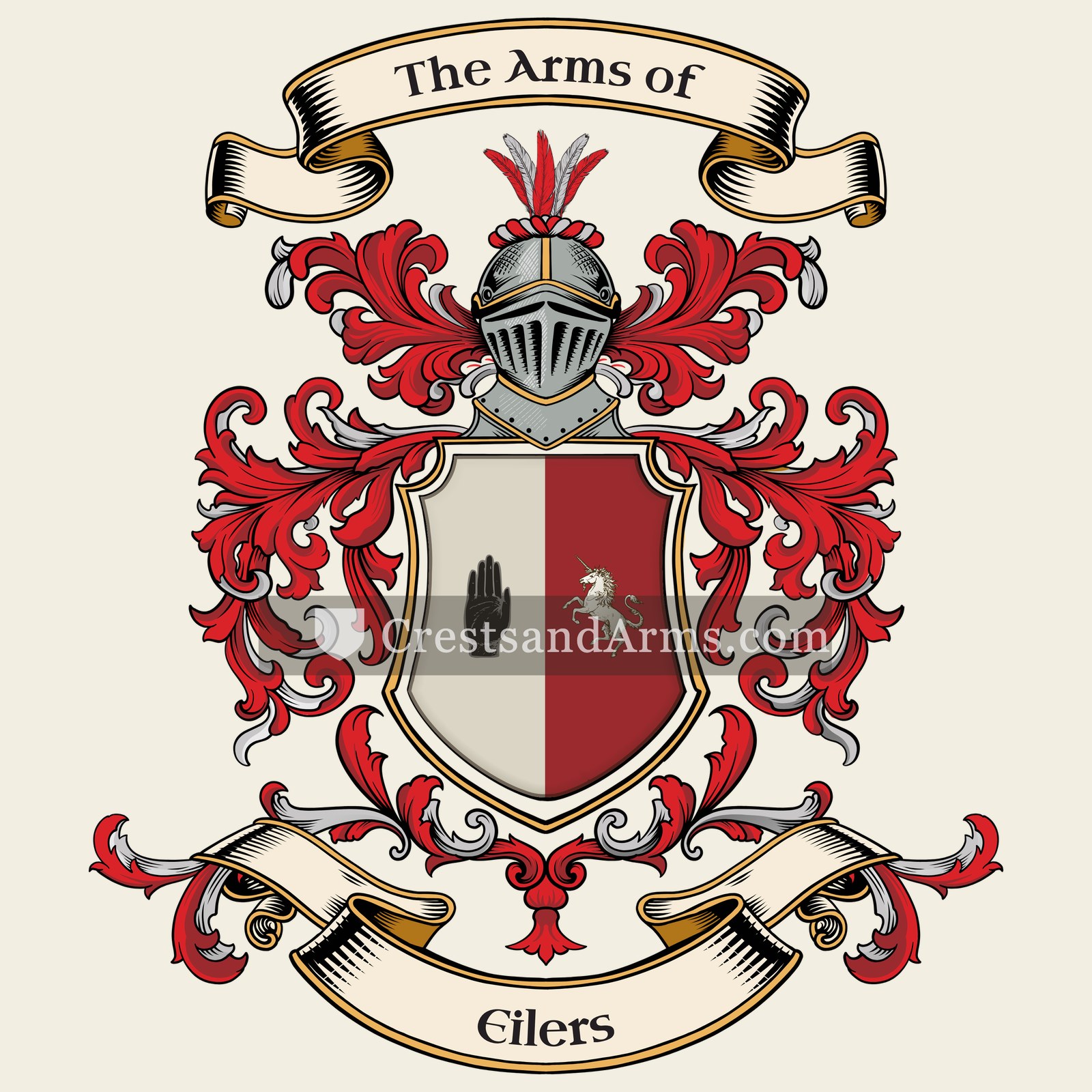
handFaith, sincerity and justice
unicornPurity, and extreme courage in defence of honour
Colours
Silver (Argent)Means: Peace and sincerity
Red (Gules)Means: Military strength
Black (Sable)Means: Constancy
Historical info
Source
J. B. Rietstap, Armorial Général, Gouda: G. B. van Goor Zonen, 1884–87
Blazon (the actual original written record)
“Parti: au 1 d'arg. à une main d'aigle cont. de sa.; au 2 de gu. à une licorne iss. et cont. d'arg., mouv. du parti. C.: un vol de sa. L.: à dextre d'arg. et de sa., à sen. d'arg. et de gu.”
GermanyHambourg, c. 1765
Digital archive packCoat of arms PNG, gold border print PDF, vector SVG and the certificate of authenticity. Sent to your email in minutes.
Map of Germany showing where the Eilers arms are recorded
The Eilers arms were recorded in Hambourg, c. 1765.
This is where the arms were entered in the register. Families often moved to other parts of the country, so the same name can turn up in more than one region.
The body that granted and recorded arms in Germany in this period.
Francis I, Holy Roman Emperor
Sovereign of the period
Francis I, Holy Roman Emperor
1745–1765
Reigning in Denmark when the Eilers arms are first recorded.
How Arms Worked in Germany
In the Holy Roman Empire, coats of arms were often granted to individuals by the Emperor or his representatives. These arms were then passed down through the generations to all legitimate descendants of the original holder. Younger branches of a family usually kept the same shield design without needing to change it, as the arms belonged to the entire lineage.
Granting authority
The Holy Roman Emperor held the sole power to grant new coats of arms throughout his vast imperial territories.
How they got arms
Families typically obtained their coats of arms through a formal imperial grant or by proving their noble status to the authorities.
Where arms were recorded
These grants were officially recorded in the Imperial Chancery registers, which began keeping formal records of such honors during the Middle Ages.
The family's standing
Recorded among the armigerous families of Germany.
Origin & History of the Eilers Family in Germany
The surname Eilers is a patronymic name, which means it originated as a way to identify someone as the son of a man named Eiler. This name is a Low German variation of the name Egilhard, which combines the ancient Germanic roots for edge or sword with the word for brave or hardy. By the mid-18th century, the Eilers family had established a notable presence in the bustling port city of Hamburg. As a major center for trade and maritime commerce, Hamburg provided a unique environment for families like the Eilers to thrive through merchant activities and skilled craftsmanship. Living in such a significant urban hub suggests that early family members were likely integrated into the professional guilds or the merchant class that defined the city’s economic growth during the 1700s. Their presence in the city records by 1765 reflects a time when surnames were becoming firmly fixed in German society to help officials track residents and property owners in rapidly expanding cities.
Related Branches & Arms
Root word
Eilert
Derived from the Germanic elements for edge of a sword and brave.
This name
EilersA patronymic surname meaning son of Eilert, indicating descent from a sword-wielding warrior.
also spelled
Ellers
Elersz
Elerz
Eleres
Documented Sources
J. B. Rietstap, Armorial Général, Gouda: G. B. van Goor Zonen, 1884–87
Dansk Demografisk Database, Folketællinger og kirkebøger
Rigsarkivet, Danske Kancelli, Sjællandske Tegnelser
Trap, J.P., Kongeriget Danmark, 1858
Digital archive packCoat of arms PNG, gold border print PDF, vector SVG and the certificate of authenticity. Sent to your email in minutes.


 roseThe seventh son, and beauty with grace
 mulletThe third son, and a divine quality from above
 crescentHonour by the sovereign, and the second son
 roseThe seventh son, and beauty with grace
 mulletThe third son, and a divine quality from above
 crescentHonour by the sovereign, and the second son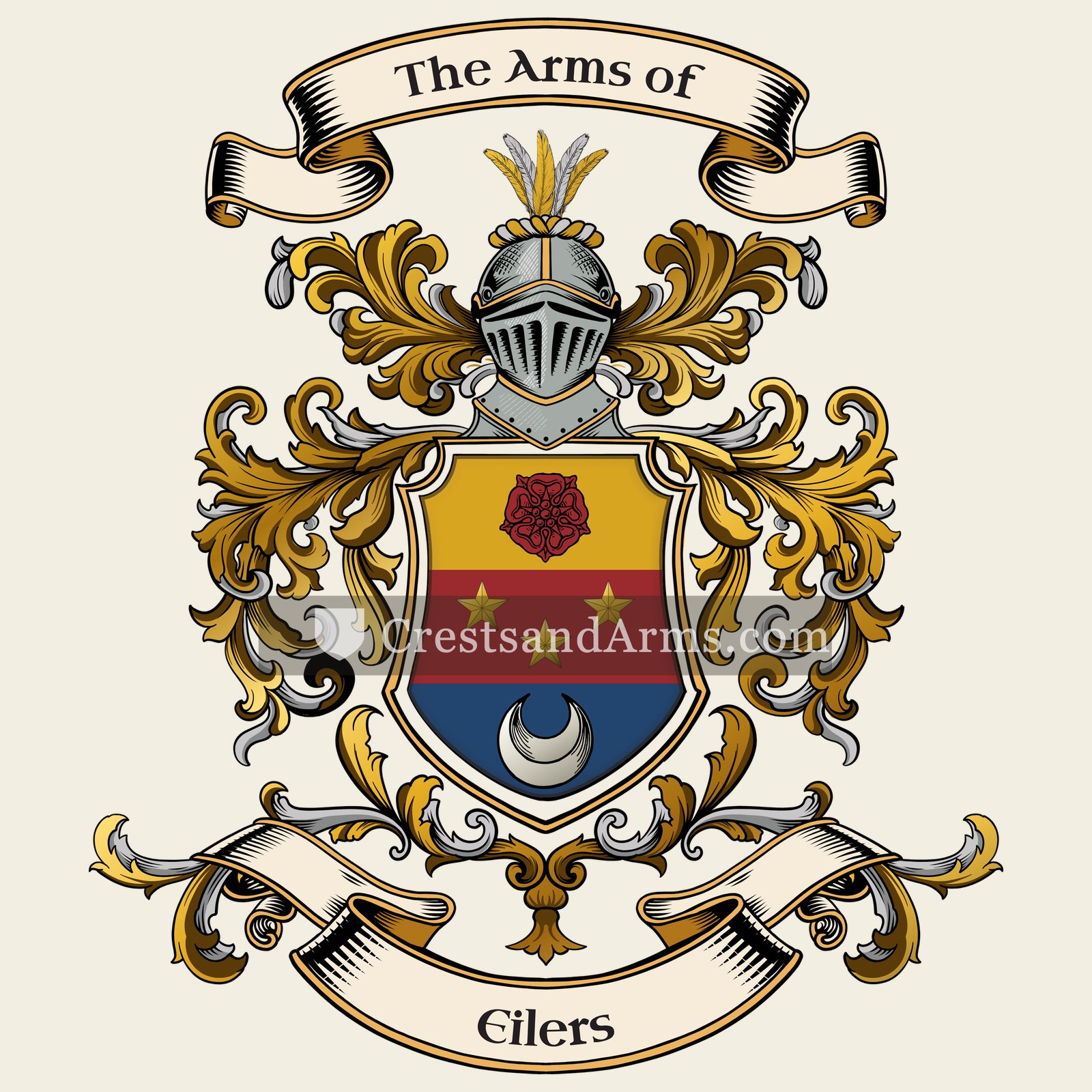


 handFaith, sincerity and justice
 unicornPurity, and extreme courage in defence of honour