Map of Germany showing where the El Bey arms are recorded
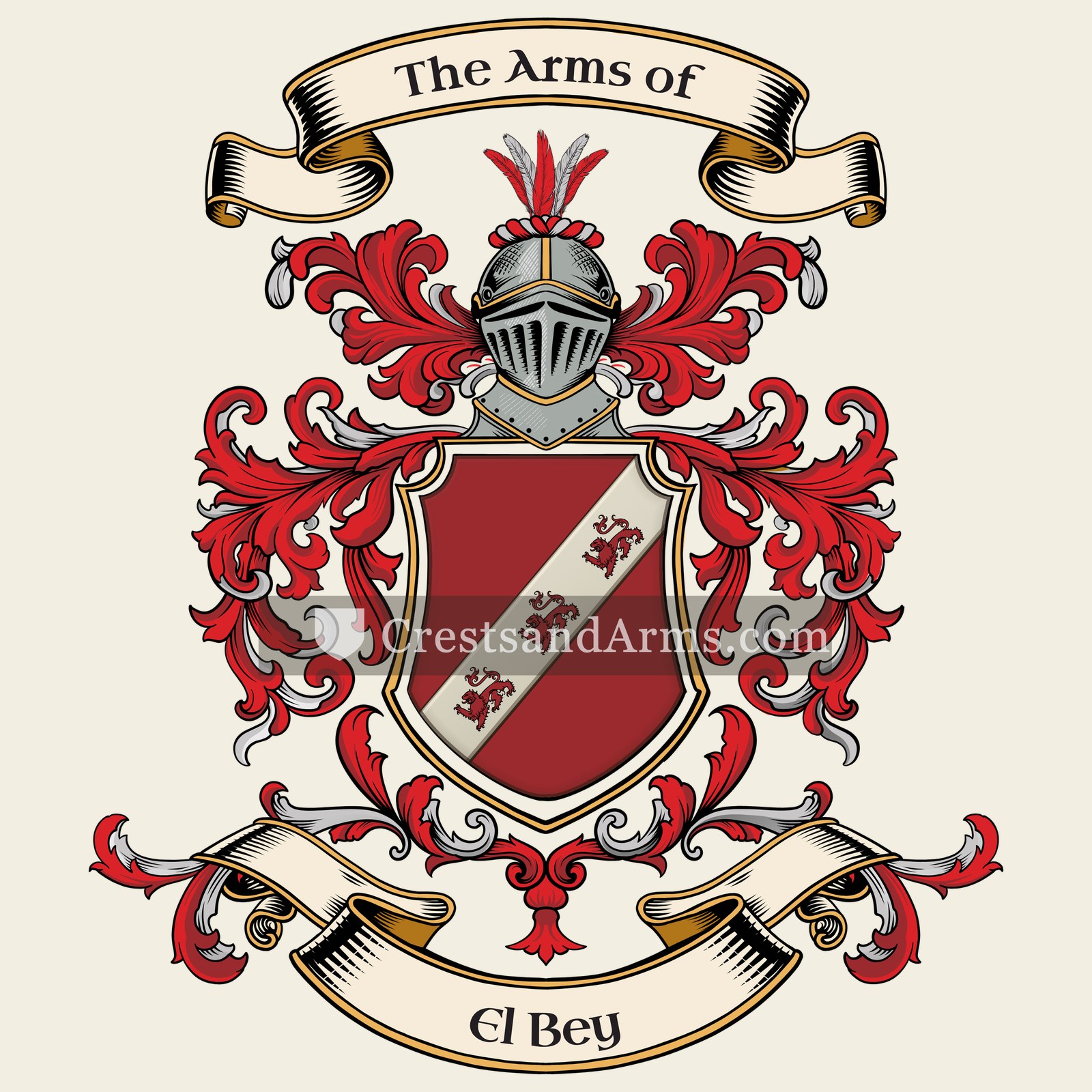
The El Bey arms were recorded in Pomerania, c. 1861.
Pomerania was flat farming country on the Baltic coast, held in large estates by a small number of families. They kept their land for generations, and generations of landholding is what fills the registers.
This is where the arms were entered in the register. Families often moved to other parts of the country, so the same name can turn up in more than one region.
The body that granted and recorded arms in Germany in this period.
Frederick William IV of Prussia
Sovereign of the period
Frederick William IV of Prussia
1840–1861
Reigning in Germany when the El Bey arms are first recorded.
How Arms Worked in Germany
Prussian heraldry was strictly tied to social rank and noble status rather than being a free choice for every citizen. These symbols were treated as permanent family property that moved through the generations to all legitimate heirs. If a family branch wanted to change their design to stand out, they had to apply for official permission to alter their specific version of the shield.
Granting authority
The Prussian Heroldsamt acted as the central state office that managed and strictly controlled all noble titles and coats of arms.
How they got arms
Families usually obtained their arms through formal royal grants or by proving their long-standing noble status to the state authorities.
Where arms were recorded
All official coats of arms were kept in the rolls of the Prussian Heroldsamt, which functioned from 1706 until 1918.
The family's standing
Recorded among the armigerous families of Pomerania.
Origin & History of the El Bey Family in Germany
The history of the El Bey family name in the mid-nineteenth century is deeply connected to the movement of people across the Baltic region. By 1861, records confirm that members of the family were established in Pomerania, a historical region that spanned parts of modern-day Germany and Poland. During this era, the name appeared in local administrative documents, suggesting that the family was integrated into the social and economic life of the Prussian province. The name itself reflects a unique cultural intersection, as the title "Bey" historically denoted a leader or official in various regions, while its presence in a Northern European setting points to the complex migration patterns and shifting borders of the time. These early ancestors likely navigated the agricultural and industrial changes occurring in Pomerania, leaving behind a legacy that bridges different geographic and cultural traditions.
El Bey Meaning & Related Branches
Root word
Bey
A Turkish title of nobility meaning chieftain or provincial governor.
This name
El BeyAn honorific title often adopted by individuals of Moorish or Ottoman descent.
also spelled
Elbee
Elbey
Documented Sources
J. B. Rietstap, Armorial Général, Gouda: G. B. van Goor Zonen, 1884–87
Landesarchiv Greifswald, Zivilstandsregister der preußischen Provinz Pommern, 1861


 lionCourage, strength and royalty
 lionCourage, strength and royalty