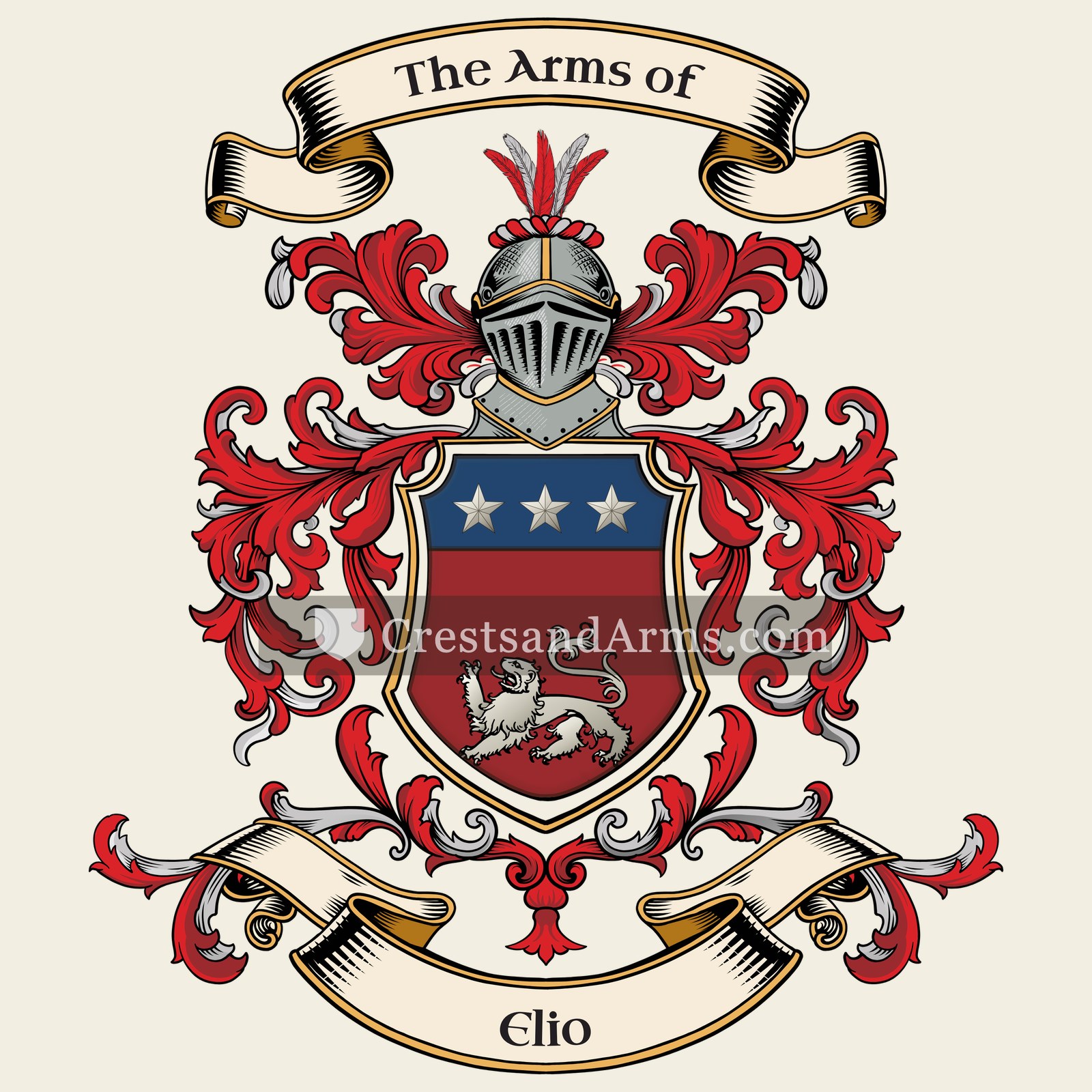
A record of documented arms, meaning and origin, researched for the Elio family of France.
Reg. 0489 · French, D–F
Coat of Arms & Family Crest Details
Symbols on this shield
chiefAuthority, wisdom and dominion
lionCourage, strength and royalty
mulletThe third son, and a divine quality from above
Colours
Red (Gules)Means: Military strength
Blue (Azure)Means: Loyalty and truth
Silver (Argent)Means: Peace and sincerity
Historical info
Source
J. B. Rietstap, Armorial Général, Gouda: G. B. van Goor Zonen, 1884–87
Blazon (the actual original written record)
“De gu. au lion d'arg.; au chef d'azur, ch. de trois étoiles du sec. [François Xavier Elio, général, gouverneur de Valence, condamné à mort par le gouvernement révolutionnaire et exécuté le 7 sept. 1822.]”
NavarreNavarre, c. 1663
Digital archive packCoat of arms PNG, gold border print PDF, vector SVG and the certificate of authenticity. Sent to your email in minutes.
Map of France showing where the Elio arms are recorded
The Elio arms were recorded in Navarre, c. 1663.
Navarre was mountain country straddling the Pyrenees, with a strong class of small independent landholders. A great many households counted as gentry there, and each needed a shield to be told apart.
This is where the arms were entered in the register. Families often moved to other parts of the country, so the same name can turn up in more than one region.
The body that granted and recorded arms in France in this period.
Louis XIV of France
Sovereign of the period
Louis XIV of France
1643–1715
Reigning in France when the Elio arms are first recorded.
How Arms Worked in France
In France, a coat of arms was a mark of honor that passed down through the male line to all legitimate descendants. Families often used the same shield without changes to show their shared heritage. If a branch wanted to stand out, they could add a small mark to their shield to show their specific place in the family tree.
Granting authority
The Juge d'armes de France acted as the official authority that regulated and verified coats of arms across the country.
How they got arms
Families typically inherited their arms from ancestors, though they could also receive them through royal grants or by proving their noble status.
Where arms were recorded
Coats of arms were officially recorded in the Armorial Général de France, which began its main collection in the year 1696.
The family's standing
Recorded among the armigerous families of Navarre.
Origin & History of the Elio Family in France
The family name Elio finds its historical roots in the rugged landscape of the Kingdom of Navarre, a region nestled between the Pyrenees mountains and the Ebro River. By the mid-seventeenth century, records confirm that members of the Elio family were established residents of this area, living during a time when Navarre functioned as a distinct territory with its own unique laws and customs. The name itself is thought to be linked to the ancient Latin name Aelius, which suggests a deep connection to the Roman influence that once shaped the Iberian Peninsula. Families in this region often identified themselves through their local landholdings or specific village ties, and the Elio name likely grew in prominence as these early ancestors participated in the agricultural and administrative life of the Navarrese countryside. Over time, the family became deeply woven into the social fabric of northern Spain, maintaining a presence in the region that spanned several generations.
Elio Meaning & Related Branches
Root word
Helios
The ancient Greek personification and god of the sun.
This name
ElioDerived from the sun, symbolizing brightness, light, and radiant energy.
also spelled
Eliio
Related arms
Beaupuysimilar arms
Bourgessimilar arms
Cambonsimilar arms
Formetsimilar arms
Documented Sources
J. B. Rietstap, Armorial Général, Gouda: G. B. van Goor Zonen, 1884–87
Yanguas y Miranda, José, Diccionario de antigüedades del Reino de Navarra, 1840
Caro Baroja, Julio, La casa en Navarra, 1982
Archivo General de Navarra, Sección de Procesos Judiciales
Archivo General de Navarra, Sección de Protocolos Notariales
Digital archive packCoat of arms PNG, gold border print PDF, vector SVG and the certificate of authenticity. Sent to your email in minutes.


 chiefAuthority, wisdom and dominion
 lionCourage, strength and royalty
 mulletThe third son, and a divine quality from above
 chiefAuthority, wisdom and dominion
 lionCourage, strength and royalty
 mulletThe third son, and a divine quality from above