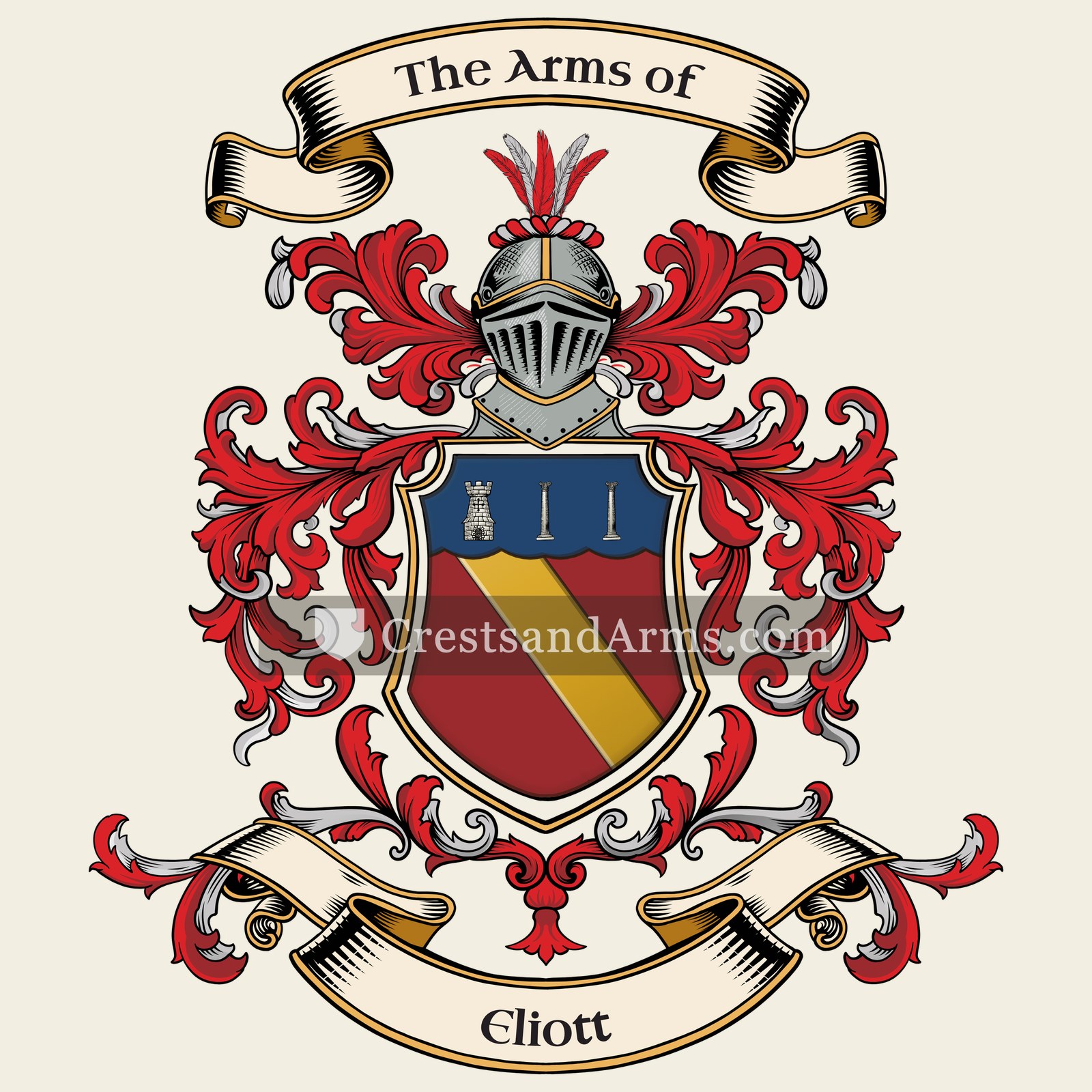
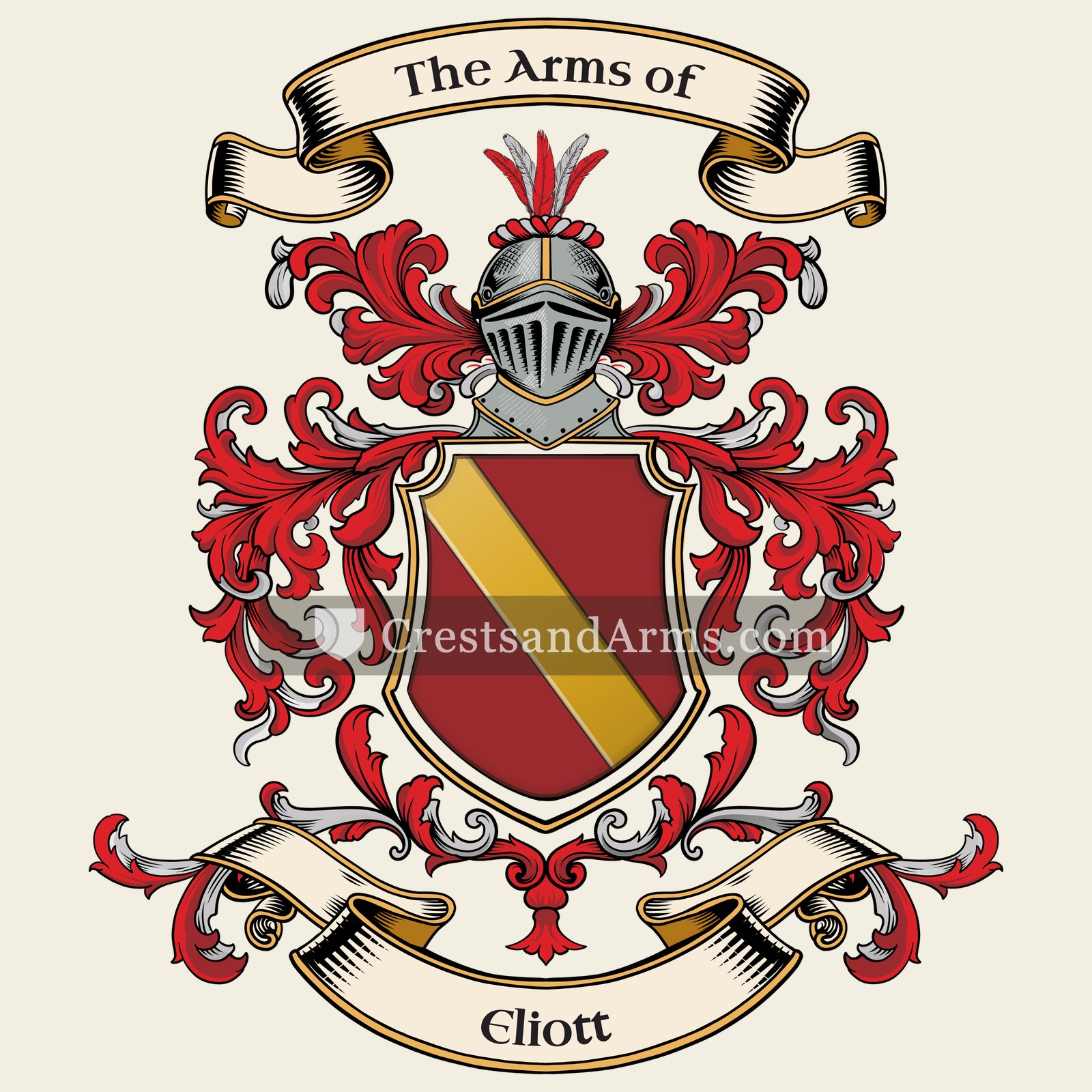
A record of documented arms, meaning and origin, researched for the Eliott family lines. Documented in 2 countries.
Reg. 5490 · French, D–F
Coat of Arms & Family Crest Details
Symbols on this shield
bendDefence, and the scarf of a commander
chiefAuthority, wisdom and dominion
towerGrandeur and solidity, and a stronghold defended
columnFortitude and constancy
Colours
Red (Gules)Means: Military strength
Gold (Or)Means: Generosity
Blue (Azure)Means: Loyalty and truth
Silver (Argent)Means: Peace and sincerity
Historical info
Source
J. B. Rietstap, Armorial Général, Gouda: G. B. van Goor Zonen, 1884–87
Blazon (the actual original written record)
“De gu. à la bande engr. d'or, ch. d'un bâton aisé d'azur, posé dans le sens de la bande; au chef d'azur, ch. d'un château flanqué de deux tours d'arg., maçonné de sa., acosté de deux colonnes d'arg., soutenuës de piédestaux du même, maçonnés de sa., ledit château ayant une porte de sa. ch. d'une clé d'arg.; le tout acc. du mot GIBRALTAR en lettres d'arg., posé au-dessous du château. C.: 1º une main gantelée, posée en pal, brandissant un badelaire et surm. de la Légende: FORTITER ET RECTE; 2º une main dextre de carn., posée en pal, appaumée, ch. d'un oeil humain au nat. et surm. de la Légende: CREDUNT QUOD VIDENT. S.: à dextre un bélier au nat., coll. d'une couronne de laurier de sin., posant le pied sen. sur une couronne murale d'or; à sen. un bouc au nat., coll. d'une couronne de laurier de sin., posant le pied dextre sur une couronne murale d'or. D.: SOYEZ SAGE.”
Francec. 1787
Digital archive packCoat of arms PNG, gold border print PDF, vector SVG and the certificate of authenticity. Sent to your email in minutes.
Map of France showing where the Eliott arms are recorded
The Eliott arms were recorded in France, c. 1787.
Arms such as these were typically recorded in Bretagne.
More families held coats of arms in Bretagne than anywhere else in France. The land was divided into many small estates rather than a few large ones, so far more households counted as gentry, and each needed a shield of its own to be told apart.
This is where the arms were entered in the register. Families often moved to other parts of the country, so the same name can turn up in more than one region.
The body that granted and recorded arms in France in this period.
Louis XVI of France
Sovereign of the period
Louis XVI of France
1774–1791
Reigning in France when the Eliott arms are first recorded.
How Arms Worked in France
In France, a coat of arms was a mark of honor that passed down through the male line to all legitimate descendants. Families often used the same shield without changes to show their shared heritage. If a branch wanted to stand out, they could add a small mark to their shield to show their specific place in the family tree.
Granting authority
The Juge d'armes de France acted as the official authority that regulated and verified coats of arms across the country.
How they got arms
Families typically inherited their arms from ancestors, though they could also receive them through royal grants or by proving their noble status.
Where arms were recorded
Coats of arms were officially recorded in the Armorial Général de France, which began its main collection in the year 1696.
The family's standing
Recorded among the armigerous families of France.
Origin & History of the Eliott Family in France
The history of the Eliott family in France is deeply connected to the cultural landscape of the Brittany region during the late eighteenth century. By 1787, members of the family were firmly established in this area, living during a time of great social transition just before the French Revolution. The name itself likely evolved from older linguistic roots, reflecting the movement of people across borders and the blending of regional dialects. As the family settled into life in Brittany, they became part of the local fabric, participating in the daily activities and administrative life of their communities. Their presence in the region suggests a history of integration, where they adapted to the customs and social structures of the French countryside while maintaining their distinct family identity. This period serves as a vital anchor for understanding how the family established their roots in France before the major political shifts that would soon reshape the nation.
Coat of Arms & Family Crest Details
Symbols on this shield
bendDefence, and the scarf of a commander
Colours
Red (Gules)Means: Military strength
Gold (Or)Means: Generosity
Historical info
Source
Sir Bernard Burke, The General Armory of England, Scotland, Ireland and Wales, London: Harrison & Sons, 1884
Blazon (the actual original written record)
“Gu. on a bend engr. or, a baton az”
RoxburghStobs · Roxburgh, c. 1666
Digital archive packCoat of arms PNG, gold border print PDF, vector SVG and the certificate of authenticity. Sent to your email in minutes.
Map of Scotland showing where the Eliott arms are recorded
The Eliott arms were recorded in Roxburgh, c. 1666.
Roxburghshire was Scottish border country, fought over for three hundred years. Land was held in return for defending it, and a family that fought needed a shield it could be recognised by.
This is where the arms were entered in the register. Families often moved to other parts of the country, so the same name can turn up in more than one region.
The body that granted and recorded arms in Scotland in this period.
Charles II of England
Sovereign of the period
Charles II of England
1660–1685
Reigning in France when the Eliott arms are first recorded.
How Arms Worked in Scotland
Scottish heraldry is unique because it treats a coat of arms as a piece of personal property protected by law. Only one person can own a specific design at any given time. When a family grows, the head keeps the original shield while other relatives must apply for their own distinct version with slight changes to prove their specific identity.
Granting authority
The Court of the Lord Lyon acts as the official body that regulates and controls all heraldic matters throughout Scotland.
How they got arms
Individuals obtain a legal right to their arms through a formal petition process that confirms their identity and family connection.
Where arms were recorded
All valid coats of arms are officially entered into the Public Register of All Arms and Bearings starting from 1672.
The family's standing
Recorded among the armigerous families of Roxburgh.
Origin & History of the Eliott Family in Scotland
The history of the Eliott family in Scotland is deeply tied to the rugged landscape of the Scottish Borders. By the mid-seventeenth century, members of the family were firmly established in the region of Roxburgh. During this era, the Borders were a challenging place to live, defined by a long history of shifting loyalties and local conflicts between powerful clans. Families like the Elliotts often played a significant role in maintaining order and managing land throughout these turbulent years. As the seventeenth century progressed, the family became increasingly integrated into the social and economic fabric of the Scottish lowlands. Their presence in Roxburgh by 1666 reflects a period of transition where families moved from the chaotic life of the borderlands toward more settled agricultural and legal roles within the Scottish kingdom.
Eliott Meaning & Related Branches
Root word
Elijah
The Lord is my God
This name
EliottA French diminutive form derived from the Hebrew name meaning the Lord is my God.
also spelled
Eliot
Elyott
Ellyot
Elyot
Related arms
Eliotvariant spelling
Ellyotvariant spelling
Elyotvariant spelling
Elyottvariant spelling
Documented Sources
J. B. Rietstap, Armorial Général, Gouda: G. B. van Goor Zonen, 1884–87
Archives départementales du Finistère, Série E (Dépôt des archives communales)
Archives départementales d'Ille-et-Vilaine, Série B (Cours et juridictions)
Duine, François, Inventaire historique des sources de l'histoire de Bretagne, 1914
Le Moyne de La Borderie, Arthur, Histoire de Bretagne, 1896
Digital archive packCoat of arms PNG, gold border print PDF, vector SVG and the certificate of authenticity. Sent to your email in minutes.


 bendDefence, and the scarf of a commander
 chiefAuthority, wisdom and dominion
 towerGrandeur and solidity, and a stronghold defended
 columnFortitude and constancy