Map of Belgium showing where the Elle arms are recorded
The Elle arms were recorded in Bruges, c. 1737.
This is where the arms were entered in the register. Families often moved to other parts of the country, so the same name can turn up in more than one region.
The body that granted and recorded arms in Belgium in this period.
Charles VI, Holy Roman Emperor
Sovereign of the period
Charles VI, Holy Roman Emperor
1711–1740
Reigning in Belgium when the Elle arms are first recorded.
How Arms Worked in Belgium
In Belgium, a coat of arms is considered personal property that is passed down through the male line to legitimate descendants. Families often use the same shield design across generations to show their shared heritage. If a branch of the family wants to change the design, they must apply for an official update to their specific version of the arms.
Granting authority
The Conseil héraldique is the official body that regulates and approves all coats of arms in Belgium.
How they got arms
Families obtain their coats of arms through formal royal grants or by confirming their historical right to use existing designs.
Where arms were recorded
All approved coats of arms are officially recorded in the public registers of the Conseil héraldique since 1844.
The family's standing
Recorded among the armigerous families of Belgium.
Origin & History of the Elle Family in Belgium
The family name Elle finds its historical roots in the vibrant urban landscape of Flanders, with documented evidence placing members of the family in the city of Bruges by 1737. During the eighteenth century, Bruges served as a significant center for trade and craftsmanship, and families like the Elles were often integrated into the local merchant or artisan classes that defined the city’s economy. The name itself likely evolved from regional linguistic patterns common in the Low Countries, where short, phonetic surnames were frequently used to identify individuals based on their occupation or their specific location within a neighborhood. As the family established their presence in the city, they became part of the long-standing tradition of urban life in Bruges, contributing to the social and economic fabric of a region known for its historical influence on European commerce.
Elle Meaning & Related Branches
Root word
Alia
A Germanic element meaning all or entirely.
This name
ElleA diminutive form of names beginning with the Germanic element for all.
also spelled
Ellee
Ell
Related arms
Ellvariant spelling
Documented Sources
J. B. Rietstap, Armorial Général, Gouda: G. B. van Goor Zonen, 1884–87
Stadsarchief Brugge (City Archives of Bruges), Parochieregisters van Brugge (Parish Registers of Bruges), 1737
De Flou, Karel, Woordenboek der Toponymie van westelijk Vlaanderen, Vlaamsch-Artois, het Land van den Hoek, de Fransche Westhoek, Staats-Vlaanderen en het Doorniksche, 1914
Digital archive packCoat of arms PNG, gold border print PDF, vector SVG and the certificate of authenticity. Sent to your email in minutes.


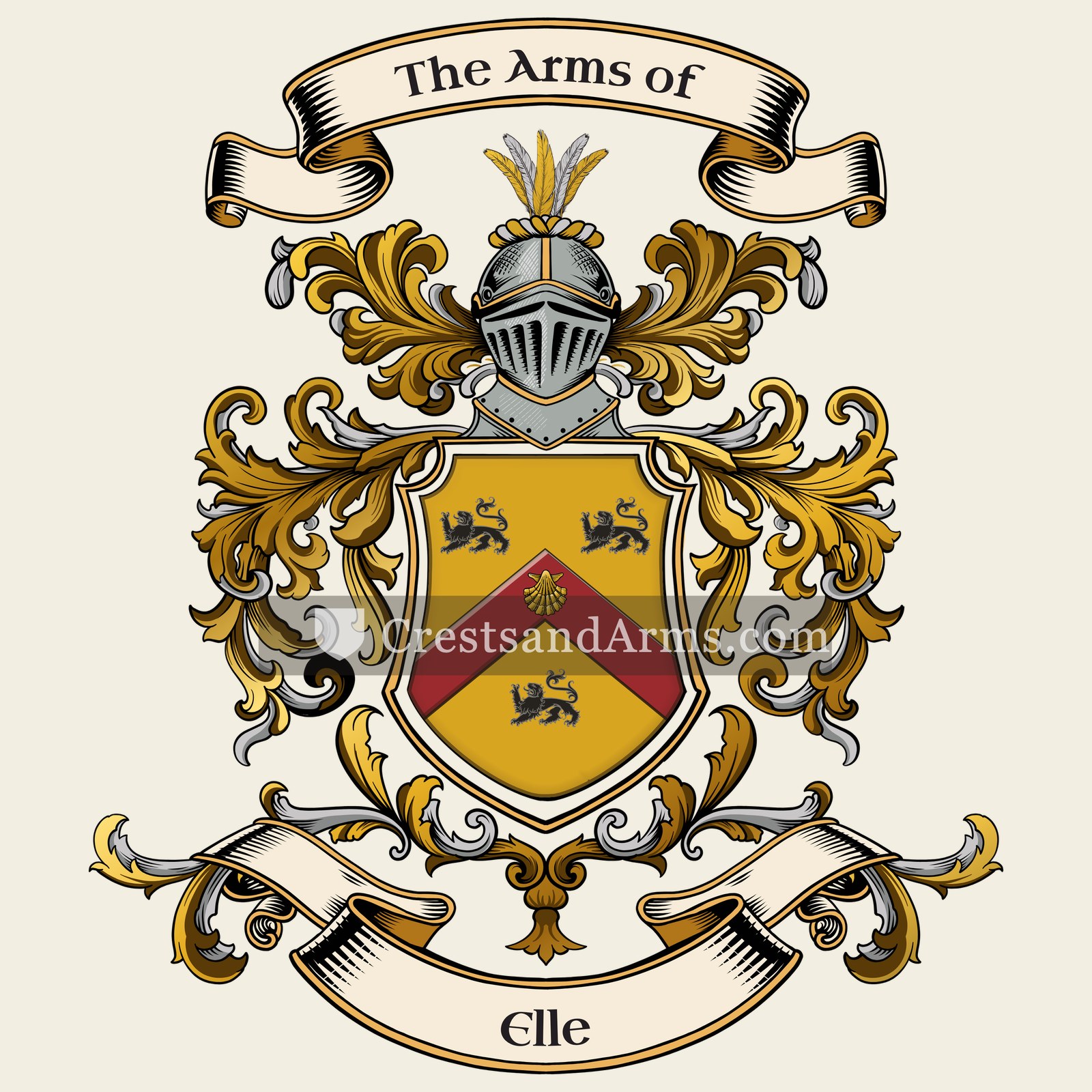
 chevronProtection, and faithful service completed
 escallopThe pilgrim's shell, and a long journey made
 lionCourage, strength and royalty
 chevronProtection, and faithful service completed
 escallopThe pilgrim's shell, and a long journey made
 lionCourage, strength and royalty