Map of Belgium showing where the Ellingboe arms are recorded
The Ellingboe arms were recorded in Luxemb, c. 1737.
This is where the arms were entered in the register. Families often moved to other parts of the country, so the same name can turn up in more than one region.
The body that granted and recorded arms in Belgium in this period.
Charles VI, Holy Roman Emperor
Sovereign of the period
Charles VI, Holy Roman Emperor
1711–1740
Reigning in Belgium when the Ellingboe arms are first recorded.
How Arms Worked in Belgium
In Belgium, a coat of arms is considered personal property that is passed down through the male line to legitimate descendants. Families often use the same shield design across generations to show their shared heritage. If a branch of the family wants to change the design, they must apply for an official update to their specific version of the arms.
Granting authority
The Conseil héraldique is the official body that regulates and approves all coats of arms in Belgium.
How they got arms
Families obtain their coats of arms through formal royal grants or by confirming their historical right to use existing designs.
Where arms were recorded
All approved coats of arms are officially recorded in the public registers of the Conseil héraldique since 1844.
The family's standing
Recorded among the armigerous families of Belgium.
Origin & History of the Ellingboe Family in Belgium
The surname Ellingboe is rooted in the Scandinavian naming tradition, specifically originating as a topographic or patronymic identifier in Norway. The name likely evolved from the Old Norse name Erlingr, combined with a suffix denoting a specific farmstead or dwelling place. While the family name is deeply connected to Norwegian history, records confirm that members of the family were present in the region of Luxemb by 1737. This suggests that early ancestors were part of the migration patterns that moved people across Northern Europe during the eighteenth century. These individuals were often farmers or skilled laborers who maintained strong ties to their local communities. By tracking these early movements, historians can see how the name transitioned from a local descriptor into a lasting family legacy that eventually spread far beyond its original borders.
Related Branches & Arms
Root word
Elling
Derived from the Old Norse name Ellingr meaning noble or descendant.
This name
EllingboeA habitational name referring to a farm or dwelling belonging to the Elling family.
also spelled
Elling
Documented Sources
J. B. Rietstap, Armorial Général, Gouda: G. B. van Goor Zonen, 1884–87
Norsk Slektshistorisk Forening, Norsk Slektskalender, 1951
Statens Arkiver, Kirkebøker for Luxemb prestegjeld, 1737
Rygh, Oluf, Norske Gaardnavne, 1897
Digital archive packCoat of arms PNG, gold border print PDF, vector SVG and the certificate of authenticity. Sent to your email in minutes.


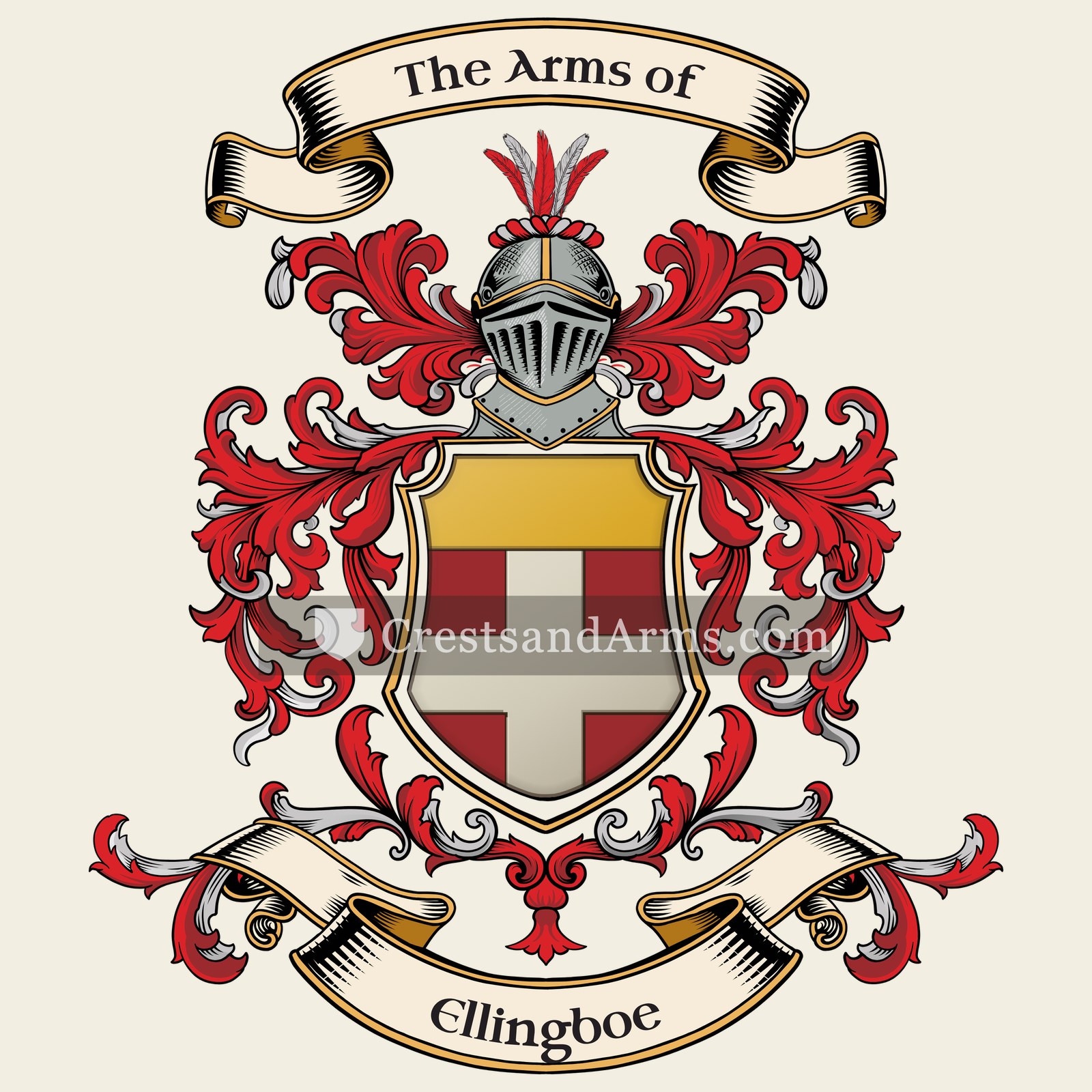
 cross symbolChristian faith and service
 chiefAuthority, wisdom and dominion
 cross symbolChristian faith and service
 chiefAuthority, wisdom and dominion