Map of England showing where the Elliot arms are recorded
The Elliot arms were recorded in Suffolk, c. 1614.
Suffolk was wool country, and its cloth towns were among the wealthiest in England. Clothier families bought manors with their profits, and holding a manor was the ordinary route to a coat of arms.
This is where the arms were entered in the register. Families often moved to other parts of the country, so the same name can turn up in more than one region.
The body that granted and recorded arms in England in this period.
James VI and I
Sovereign of the period
James VI and I
1603–1625
Reigning in England when the Elliot arms are first recorded.
How Arms Worked in England
English heraldry allowed arms to be shared by all legitimate descendants of the original owner. These symbols were treated as personal property that moved through the generations to all children. While the eldest son kept the original design, other family members could use the same shield without needing to change it or register their own unique versions.
Granting authority
The College of Arms in London has regulated the use of coats of arms throughout England and Wales since 1484.
How they got arms
Families typically obtained their coats of arms through a formal grant from the Crown or by proving their ancient right to them.
Where arms were recorded
All official coats of arms are recorded in the registers kept at the College of Arms, which date back to the fifteenth century.
The family's standing
Recorded among the armigerous families of Suffolk.
Origin & History of the Elliot Family in England
The surname Elliot originated as a diminutive form of the name Elias, which was a popular choice in medieval England due to its biblical roots. By the early 17th century, the family had established a notable presence in the county of Suffolk. Records from 1614 show members of the family living in this region, where they likely worked as farmers or tradespeople within the local village economy. During this period, surnames were becoming more fixed as families stayed in the same communities for generations. The name evolved through various spellings as it was recorded in parish registers and legal documents by local clerks. These early ancestors were part of a growing class of English citizens who helped shape the social and economic landscape of rural Suffolk before many families began to migrate further afield.
Coat of Arms & Family Crest Details
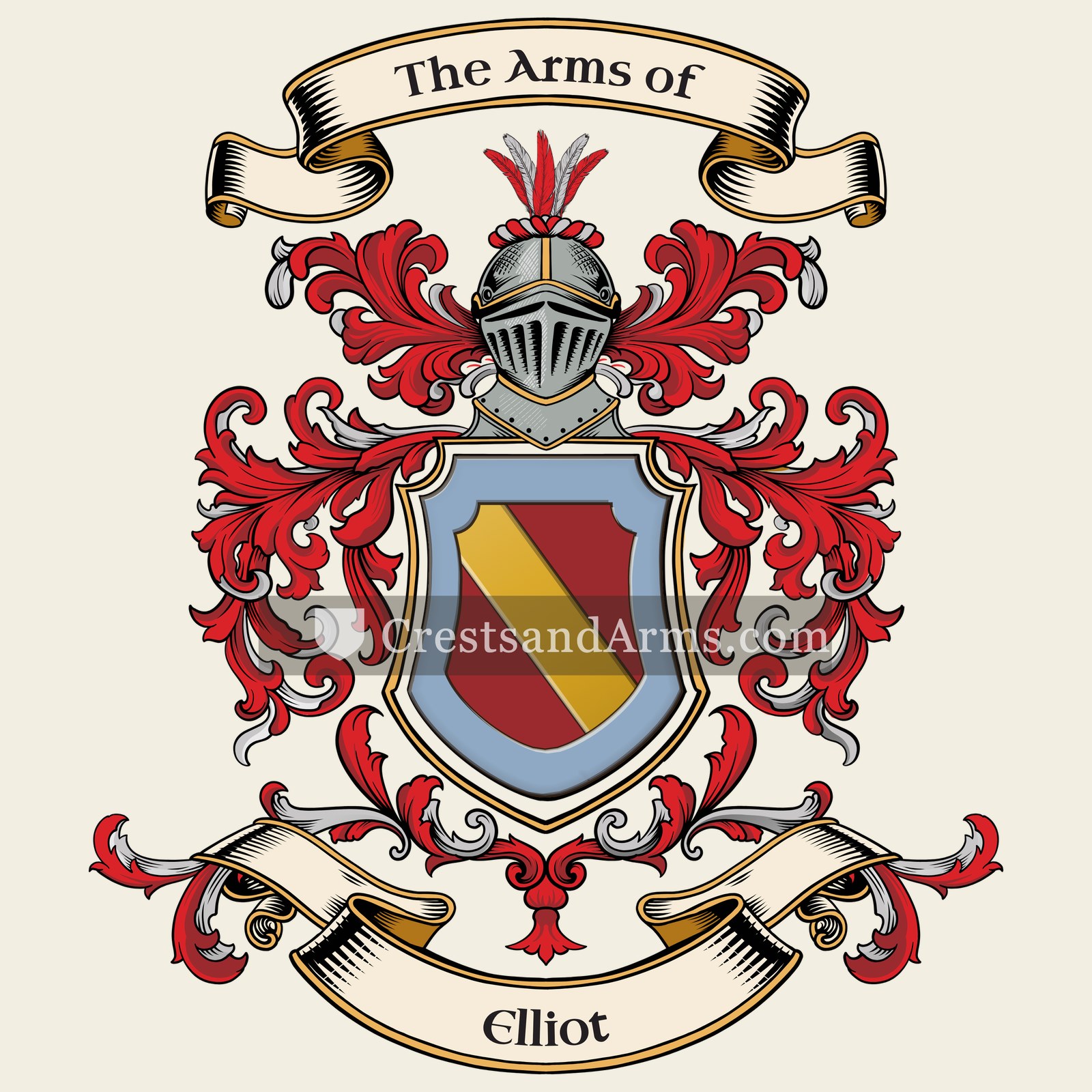
Symbols on this shield
bendDefence, and the scarf of a commander
bordureA difference between branches of one family
vairProtection, and the winter fur
Colours
Red (Gules)Means: Military strength
Gold (Or)Means: Generosity
VairMeans: Protection
Historical info
Source
Sir Bernard Burke, The General Armory of England, Scotland, Ireland and Wales, London: Harrison & Sons, 1884
Blazon (the actual original written record)
“Gu. on a bend engr. or, a baton az. all within a bordure vair”
RoxburghMinto · Roxburgh, c. 1693
Digital archive packCoat of arms PNG, gold border print PDF, vector SVG and the certificate of authenticity. Sent to your email in minutes.
Map of Scotland showing where the Elliot arms are recorded
The Elliot arms were recorded in Roxburgh, c. 1693.
Roxburghshire was Scottish border country, fought over for three hundred years. Land was held in return for defending it, and a family that fought needed a shield it could be recognised by.
This is where the arms were entered in the register. Families often moved to other parts of the country, so the same name can turn up in more than one region.
The body that granted and recorded arms in Scotland in this period.
Mary II of England
Sovereign of the period
Mary II of England
1689–1694
Reigning in England when the Elliot arms are first recorded.
How Arms Worked in Scotland
Scottish heraldry is unique because it treats a coat of arms as a piece of personal property protected by law. Only one person can own a specific design at any given time. When a family grows, the head keeps the original shield while other relatives must apply for their own distinct version with slight changes to prove their specific identity.
Granting authority
The Court of the Lord Lyon acts as the official body that regulates and controls all heraldic matters throughout Scotland.
How they got arms
Individuals obtain a legal right to their arms through a formal petition process that confirms their identity and family connection.
Where arms were recorded
All valid coats of arms are officially entered into the Public Register of All Arms and Bearings starting from 1672.
The family's standing
Recorded among the armigerous families of Roxburgh.
Origin & History of the Elliot Family in Scotland
The Elliot family name has deep roots in the rugged landscape of the Scottish Borders, particularly within the county of Roxburgh. By the late seventeenth century, the family was well established in this region, which was historically known for its turbulent and independent spirit. The Elliots were recognized as a prominent Border clan, a group defined by strong kinship ties and a shared responsibility to protect their lands. Living in Roxburgh in 1693 placed the family at the heart of a territory that had long served as a buffer zone between Scotland and England. This location shaped the identity of the early Elliots, as they had to be resilient and adaptable to survive the constant shifts in regional power. Over time, their presence in the area became a permanent part of the local history, reflecting the broader story of families who built their lives in the challenging terrain of the Scottish frontier.
Elliot Meaning & Related Branches
Root word
Elijah
The Lord is my God
This name
ElliotA medieval diminutive form derived from the Hebrew name meaning the Lord is my God.
also spelled
Elyot
Ellyot
Elyott
Related arms
Bentincksimilar arms
Campbell-McIversimilar arms
Humesimilar arms
Ellyotvariant spelling
Documented Sources
Sir Bernard Burke, The General Armory of England, Scotland, Ireland and Wales, London: Harrison & Sons, 1884
Reaney, P.H. and Wilson, R.M., A Dictionary of English Surnames, 1991
Suffolk Archives, Parish Registers of Suffolk, 1614
Digital archive packCoat of arms PNG, gold border print PDF, vector SVG and the certificate of authenticity. Sent to your email in minutes.


 fessThe military belt, and readiness to serve
 fessThe military belt, and readiness to serve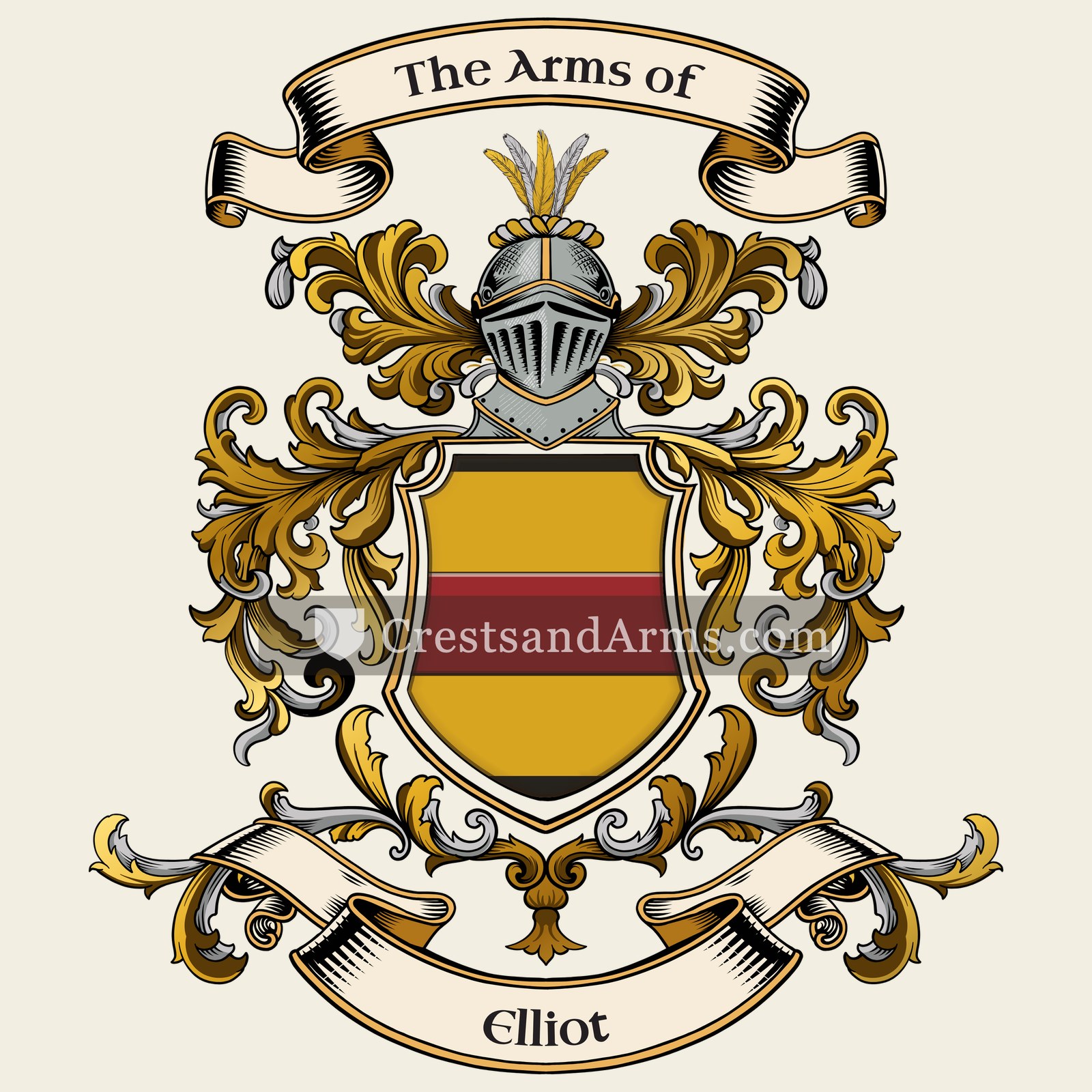


 bendDefence, and the scarf of a commander
 bordureA difference between branches of one family