A record of documented arms, meaning and origin, researched for the Elston family lines. Documented in 2 countries.
Reg. 0541 · German, D–F
Coat of Arms & Family Crest Details
Symbols on this shield
mountThe ground held, and steadfastness upon it
mulletThe third son, and a divine quality from above
Colours
Silver (Argent)Means: Peace and sincerity
Blue (Azure)Means: Loyalty and truth
Black (Sable)Means: Constancy
Gold (Or)Means: Generosity
Historical info
Source
J. B. Rietstap, Armorial Général, Gouda: G. B. van Goor Zonen, 1884–87
Blazon (the actual original written record)
“Ec.: aux 1 et 4 d'arg. à un rocher escarpé de sa.; aux 2 et 3 d'azur à une étoile d'or. C.: trois pl. d'aut.: d'or, d'azur et d'arg. L.: d'arg. et d'azur.”
GermanyBade, c. 1836
Digital archive packCoat of arms PNG, gold border print PDF, vector SVG and the certificate of authenticity. Sent to your email in minutes.
Map of Germany showing where the Elston arms are recorded
The Elston arms were recorded in Bade, c. 1836.
This is where the arms were entered in the register. Families often moved to other parts of the country, so the same name can turn up in more than one region.
The body that granted and recorded arms in Germany in this period.
Frederick William III of Prussia
Sovereign of the period
Frederick William III of Prussia
1797–1840
Reigning in Germany when the Elston arms are first recorded.
How Arms Worked in Germany
Prussian heraldry was strictly tied to social rank and noble status rather than being a free choice for every citizen. These symbols were treated as permanent family property that moved through the generations to all legitimate heirs. If a family branch wanted to change their design to stand out, they had to apply for official permission to alter their specific version of the shield.
Granting authority
The Prussian Heroldsamt acted as the central state office that managed and strictly controlled all noble titles and coats of arms.
How they got arms
Families usually obtained their arms through formal royal grants or by proving their long-standing noble status to the state authorities.
Where arms were recorded
All official coats of arms were kept in the rolls of the Prussian Heroldsamt, which functioned from 1706 until 1918.
The family's standing
Recorded among the armigerous families of Germany.
Origin & History of the Elston Family in Germany
The family name Elston carries deep roots within the historical landscape of southwestern Germany. By the early nineteenth century, records confirm that members of the family were established in the region of Baden. During this era, Baden was a collection of small states undergoing significant social and economic shifts as it transitioned toward the formation of the German Empire. Families like the Elstons often lived in agricultural communities where daily life revolved around the rhythms of the seasons and local village governance. As the population grew and land became harder to secure, many families in this region began to look toward new opportunities, eventually leading to the migration patterns that spread the name across the globe. The presence of the family in Baden during the 1830s places them at a pivotal moment in German history, just before the widespread political unrest and industrial changes that would reshape the lives of all citizens in the region.
Coat of Arms & Family Crest Details
Symbols on this shield
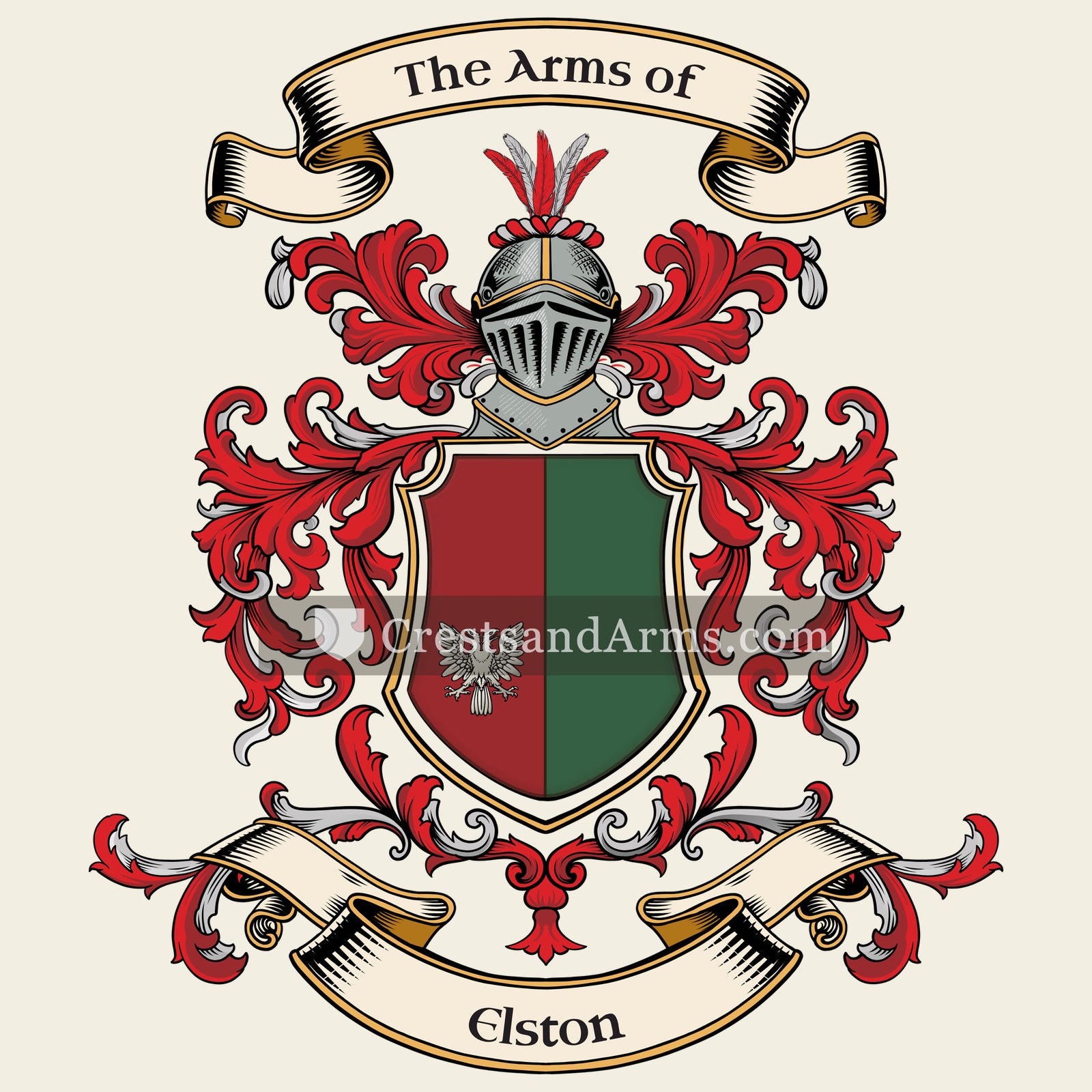
eagleNobility, strength and a keen mind
Colours
Red (Gules)Means: Military strength
Green (Vert)Means: Hope
Silver (Argent)Means: Peace and sincerity
Historical info
Source
Sir Bernard Burke, The General Armory of England, Scotland, Ireland and Wales, London: Harrison & Sons, 1884
Blazon (the actual original written record)
“Per pale gu. and vert an eagle displ. ar”
NottinghamElston · Nottingham, c. 1620
Digital archive packCoat of arms PNG, gold border print PDF, vector SVG and the certificate of authenticity. Sent to your email in minutes.
Map of England showing where the Elston arms are recorded
The Elston arms were recorded in Nottingham, c. 1620.
Nottinghamshire had coal under it and forest across it, and both were worth money. Families who profited bought manors, and a manor was the ordinary reason for a family to take a coat of arms.
This is where the arms were entered in the register. Families often moved to other parts of the country, so the same name can turn up in more than one region.
The body that granted and recorded arms in England in this period.
James VI and I
Sovereign of the period
James VI and I
1603–1625
Reigning in Germany when the Elston arms are first recorded.
How Arms Worked in England
English heraldry allowed arms to be shared by all legitimate descendants of the original owner. These symbols were treated as personal property that moved through the generations to all children. While the eldest son kept the original design, other family members could use the same shield without needing to change it or register their own unique versions.
Granting authority
The College of Arms in London has regulated the use of coats of arms throughout England and Wales since 1484.
How they got arms
Families typically obtained their coats of arms through a formal grant from the Crown or by proving their ancient right to them.
Where arms were recorded
All official coats of arms are recorded in the registers kept at the College of Arms, which date back to the fifteenth century.
The family's standing
Recorded among the armigerous families of Nottingham.
Origin & History of the Elston Family in England
The surname Elston is a locational name that originated from small settlements in England, specifically from a place called Elston in Nottinghamshire. The name itself is derived from Old English, combining a personal name with the word "tun," which meant an enclosed piece of land or a farmstead. By the early 17th century, the family was well-established in the Nottingham area, as evidenced by records from 1620. During this period, families often took their surnames from the villages where they lived and worked for generations. Because the name is tied to specific geography, it suggests that early members of the family were likely landowners or tenant farmers who were deeply connected to the local landscape of the East Midlands. Over time, as people moved away from their ancestral villages for work or trade, they carried the name with them, helping it spread across the region while maintaining its link to those original Nottinghamshire roots.
Elston Meaning & Related Branches
Root word
Aethelstan
Old English elements meaning noble and stone.
This name
ElstonDerived from a place name meaning noble stone or noble settlement.
also spelled
Elstoun
Elstowne
Related arms
Elestonevariant spelling
Braddyllrecorded with Elston, same area
Emersonrecorded with Elston, same area
Peakerecorded with Elston, same area
Documented Sources
J. B. Rietstap, Armorial Général, Gouda: G. B. van Goor Zonen, 1884–87


 mountThe ground held, and steadfastness upon it
 mulletThe third son, and a divine quality from above
 mountThe ground held, and steadfastness upon it
 mulletThe third son, and a divine quality from above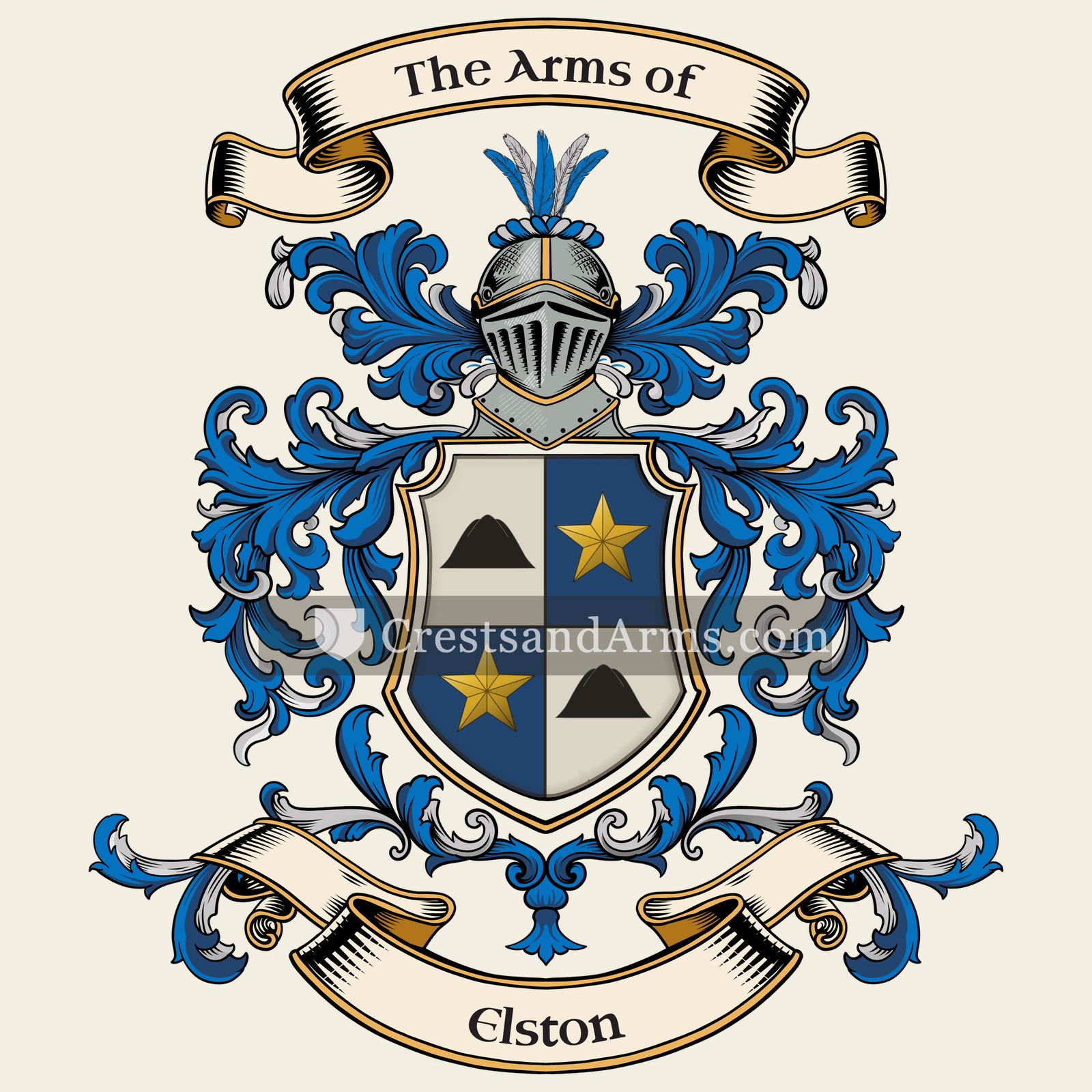


 eagleNobility, strength and a keen mind