Map of Germany showing where the Emboss arms are recorded
The Emboss arms were recorded in Franconia, c. 1765.
Franconia was a patchwork of small territories in central Germany, full of minor landowners and prosperous market towns. So many separate households held land there that the region produced a great many coats of arms.
This is where the arms were entered in the register. Families often moved to other parts of the country, so the same name can turn up in more than one region.
The body that granted and recorded arms in Germany in this period.
Francis I, Holy Roman Emperor
Sovereign of the period
Francis I, Holy Roman Emperor
1745–1765
Reigning in Germany when the Emboss arms are first recorded.
How Arms Worked in Germany
In the Holy Roman Empire, coats of arms were often granted to individuals by the Emperor or his representatives. These arms were then passed down through the generations to all legitimate descendants of the original holder. Younger branches of a family usually kept the same shield design without needing to change it, as the arms belonged to the entire lineage.
Granting authority
The Holy Roman Emperor held the sole power to grant new coats of arms throughout his vast imperial territories.
How they got arms
Families typically obtained their coats of arms through a formal imperial grant or by proving their noble status to the authorities.
Where arms were recorded
These grants were officially recorded in the Imperial Chancery registers, which began keeping formal records of such honors during the Middle Ages.
The family's standing
Recorded among the armigerous families of Franconia.
Origin & History of the Emboss Family in Germany
The family name Emboss traces its roots to the historical region of Franconia, where members of the family were firmly established by 1765. During the eighteenth century, Franconia was a diverse area characterized by small principalities and a strong tradition of skilled craftsmanship. The name likely emerged as a descriptive identifier for individuals who worked in trades involving metalwork, leather, or printing. In these professions, the act of creating raised designs on a surface was a common practice. As families began to adopt permanent surnames to distinguish themselves within growing village communities, this professional task became a natural way to identify the household. By the mid-1700s, these families were integrated into the local social fabric, contributing to the agricultural and artisanal economy that defined the region before the major political shifts of the nineteenth century.
Emboss Meaning & Related Branches
Root word
Ambos
A heavy iron block used by blacksmiths for shaping metal.
This name
EmbossAn occupational surname for a blacksmith or someone who worked at an anvil.
also spelled
Emps
Documented Sources
J. B. Rietstap, Armorial Général, Gouda: G. B. van Goor Zonen, 1884–87
Bader, Karl S., Der deutsche Südwesten in seiner territorialgeschichtlichen Entwicklung, 1950
Bavarian State Archives (Bayerisches Hauptstaatsarchiv), General-Landes-Archivalien, Bestand: Fränkische Reichskreise, 1765
Dudenredaktion, Duden Familiennamen: Herkunft und Bedeutung von 20.000 Nachnamen, 2005
Digital archive packCoat of arms PNG, gold border print PDF, vector SVG and the certificate of authenticity. Sent to your email in minutes.


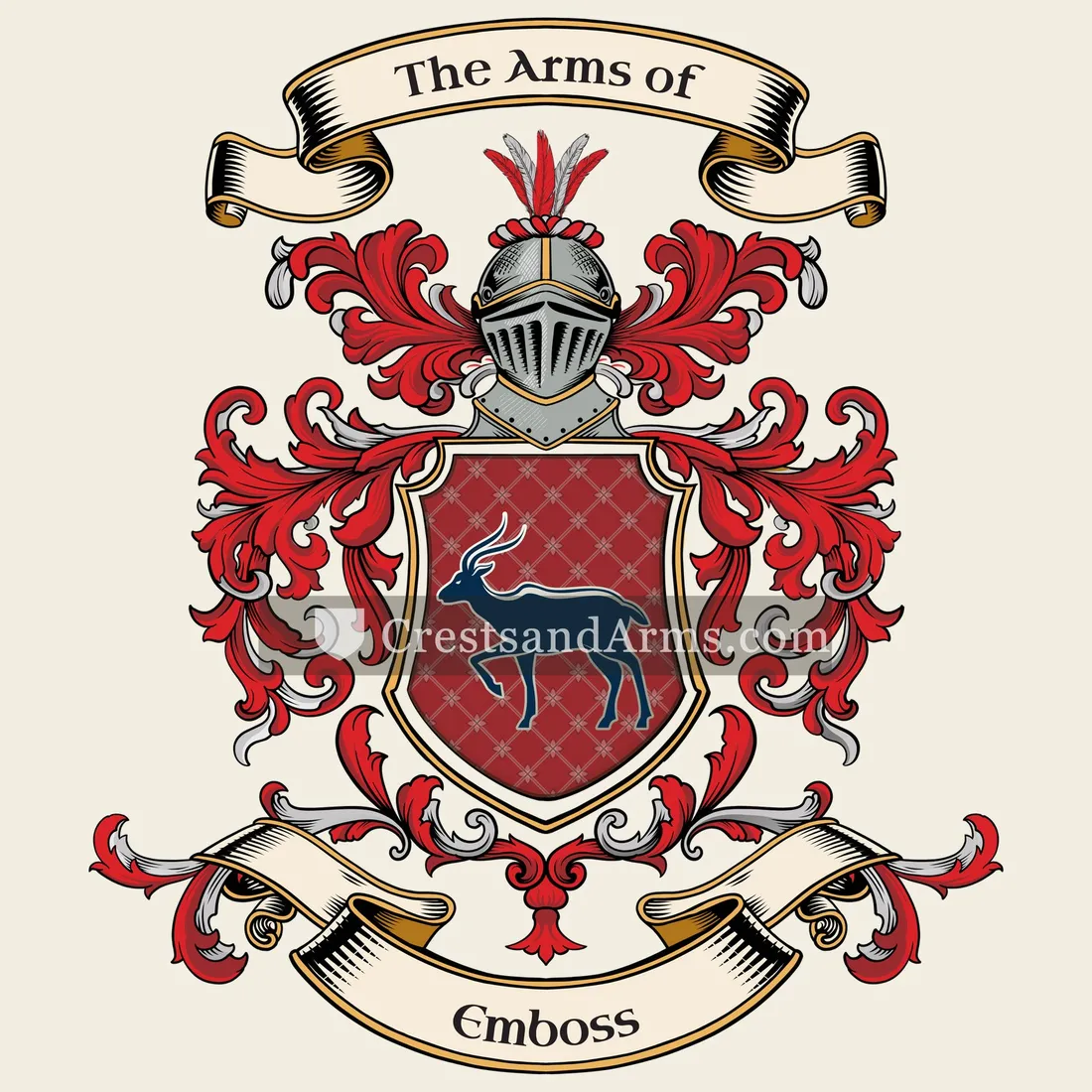
 antelopeHarmony, polity and peace
 antelopeHarmony, polity and peace