Map of Germany showing where the Emmy arms are recorded
The Emmy arms were recorded in Ostfrise, c. 1765.
This is where the arms were entered in the register. Families often moved to other parts of the country, so the same name can turn up in more than one region.
The body that granted and recorded arms in Germany in this period.
Francis I, Holy Roman Emperor
Sovereign of the period
Francis I, Holy Roman Emperor
1745–1765
Reigning in Germany when the Emmy arms are first recorded.
How Arms Worked in Germany
In the Holy Roman Empire, coats of arms were often granted to individuals by the Emperor or his representatives. These arms were then passed down through the generations to all legitimate descendants of the original holder. Younger branches of a family usually kept the same shield design without needing to change it, as the arms belonged to the entire lineage.
Granting authority
The Holy Roman Emperor held the sole power to grant new coats of arms throughout his vast imperial territories.
How they got arms
Families typically obtained their coats of arms through a formal imperial grant or by proving their noble status to the authorities.
Where arms were recorded
These grants were officially recorded in the Imperial Chancery registers, which began keeping formal records of such honors during the Middle Ages.
The family's standing
Recorded among the armigerous families of Germany.
Origin & History of the Emmy Family in Germany
The family name Emmy finds its historical roots in the region of East Frisia, known locally as Ostfriesland, where records confirm the presence of family members by 1765. During this period, the name likely functioned as a shortened form of Germanic names beginning with the element "ermin," which translates to universal or whole. In the rural landscape of eighteenth-century East Frisia, families often lived in small, tight-knit farming communities where names were passed down through generations to maintain local identity. As the family established itself in this coastal region, they became part of the unique cultural tapestry of the North Sea area, which was defined by its distinct dialect and traditional agricultural practices. Over time, the name evolved alongside the shifting borders and social structures of the region, serving as a lasting link to the family's early life in the flat, windswept plains of northern Germany.
Emmy Meaning & Related Branches
Root word
Irmin
A Germanic deity associated with the entire universe or whole.
This name
EmmyDerived from Germanic elements meaning universal, whole, or entire.
also spelled
Emmi
Emmy
Emius
Documented Sources
J. B. Rietstap, Armorial Général, Gouda: G. B. van Goor Zonen, 1884–87
Beninga, Eggerik. Cronica der Fresen. 1560
Niedersächsisches Landesarchiv (Aurich). Ostfriesische Landschaft, Repräsentationen und Steuerlisten. 1765
Ubbo Emmius. Rerum Frisicarum Historia. 1616
Digital archive packCoat of arms PNG, gold border print PDF, vector SVG and the certificate of authenticity. Sent to your email in minutes.


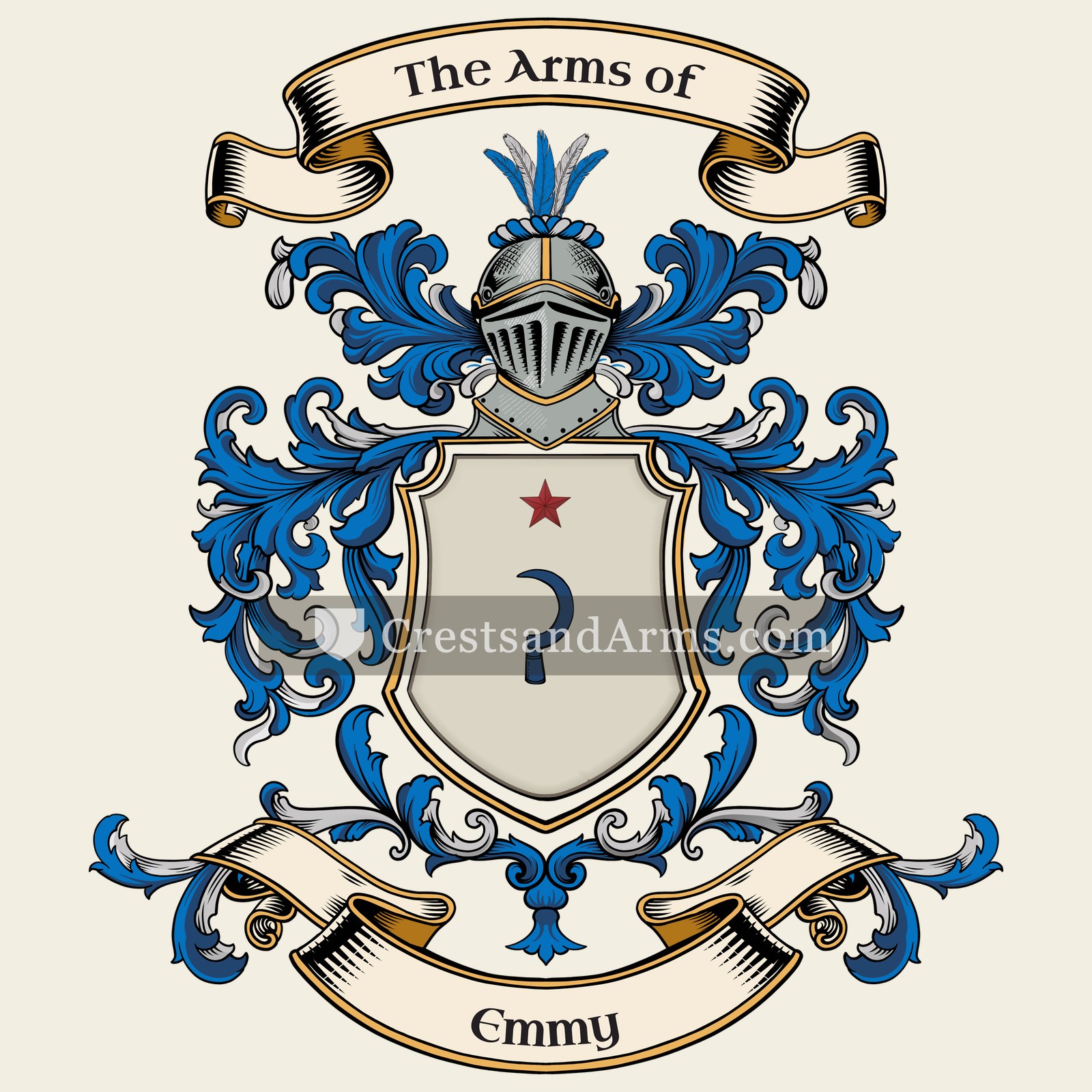
 sickleThe harvest, and the reaping of what was sown
 mulletThe third son, and a divine quality from above
 sickleThe harvest, and the reaping of what was sown
 mulletThe third son, and a divine quality from above