Map of Italy showing where the Emo arms are recorded
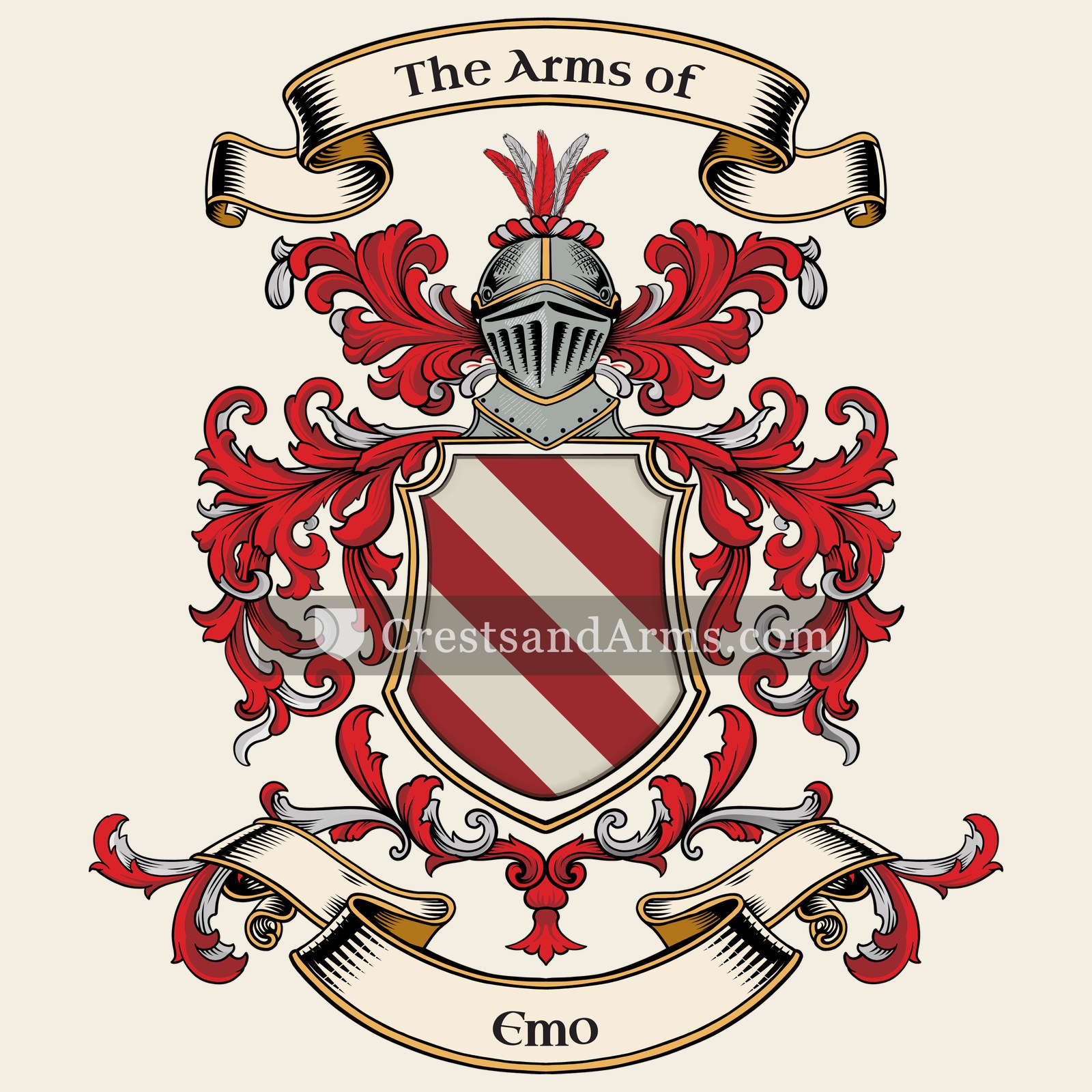
The Emo arms were recorded in Venice, c. 1775.
Venice ran on trade, and its great families were merchants before they were anything else. The city kept a formal list of its noble houses, and a name on that list carried arms as a matter of record.
This is where the arms were entered in the register. Families often moved to other parts of the country, so the same name can turn up in more than one region.
The body that granted and recorded arms in Italy in this period.
Alvise Giovanni Mocenigo
Sovereign of the period
Alvise Giovanni Mocenigo
1763–1778
Reigning in Italy when the Emo arms are first recorded.
How Arms Worked in Italy
In the Italian states, coats of arms were often used by noble families to show their status and history. These symbols were passed down through the generations to all legitimate male descendants. Younger branches of a family usually kept the original design but sometimes added small changes to distinguish their specific line from the main branch.
Granting authority
Various local rulers and city governments controlled the use of coats of arms across the different Italian states.
How they got arms
Families often assumed their own arms or received them as official grants from local lords, popes, or city councils.
Where arms were recorded
Arms were recorded in local city archives or private family books rather than in one single national register.
The family's standing
Recorded among the armigerous families of Venice.
Origin & History of the Emo Family in Italy
The Emo family stands as one of the most distinguished lineages in the history of the Venetian Republic. Long before the late eighteenth century, the family belonged to the ancient nobility of Venice, holding a prestigious position among the patrician class that governed the city. Their influence was built upon centuries of maritime trade, diplomacy, and military service, which allowed them to accumulate significant wealth and political power. By the time the family was firmly established in the records of 1775, they had already served the Republic for generations in high-ranking administrative roles. Their prominence was not merely a matter of status but a reflection of their deep integration into the complex social and economic fabric of Venice. Throughout their history, members of the Emo family were known for their commitment to the state, often acting as naval commanders and ambassadors who helped shape the destiny of the Venetian territories.
Emo Meaning & Related Branches
Root word
Aimo
Derived from the Germanic element haim meaning home or house.
This name
EmoAn Italian surname originating from a personal name signifying home or homeland.
also spelled
Emmow
Emmot
Emon
Documented Sources
J. B. Rietstap, Armorial Général, Gouda: G. B. van Goor Zonen, 1884–87
Muir, Edward, Civic Ritual in Renaissance Venice, 1981
Rösch, Gerhard, Der venezianische Adel bis zur Schließung des Großen Rates: Zur Genese einer Führungsschicht, 1989
Archivio di Stato di Venezia, Archivio Emo-Capodilista
Digital archive packCoat of arms PNG, gold border print PDF, vector SVG and the certificate of authenticity. Sent to your email in minutes.


 bendDefence, and the scarf of a commander
 bendDefence, and the scarf of a commander