Map of Italy showing where the Erbe arms are recorded
The Erbe arms were recorded in Vérone, c. 1775.
This is where the arms were entered in the register. Families often moved to other parts of the country, so the same name can turn up in more than one region.
The body that granted and recorded arms in Italy in this period.
Alvise Giovanni Mocenigo
Sovereign of the period
Alvise Giovanni Mocenigo
1763–1778
Reigning in Italy when the Erbe arms are first recorded.
How Arms Worked in Italy
In the Italian states, coats of arms were often used by noble families to show their status and history. These symbols were passed down through the generations to all legitimate male descendants. Younger branches of a family usually kept the original design but sometimes added small changes to distinguish their specific line from the main branch.
Granting authority
Various local rulers and city governments controlled the use of coats of arms across the different Italian states.
How they got arms
Families often assumed their own arms or received them as official grants from local lords, popes, or city councils.
Where arms were recorded
Arms were recorded in local city archives or private family books rather than in one single national register.
The family's standing
Recorded among the armigerous families of Italy.
Origin & History of the Erbe Family in Italy
The family name Erbe traces its roots in Italy to the historic city of Verona, where records confirm the family was well-established by 1775. The name itself is derived from the German word for inheritance, which suggests that the family likely moved into the Veneto region from German-speaking territories during a period of significant migration and trade. Settling in Verona placed the family at a major crossroads of European commerce, where they were positioned to participate in the vibrant economic life of the city. Over time, the family integrated into the local Italian culture while maintaining their distinct identity. Their presence in the city during the late eighteenth century reflects the broader movement of families across the Alps who sought new opportunities in the prosperous urban centers of Northern Italy.
Coat of Arms & Family Crest Details
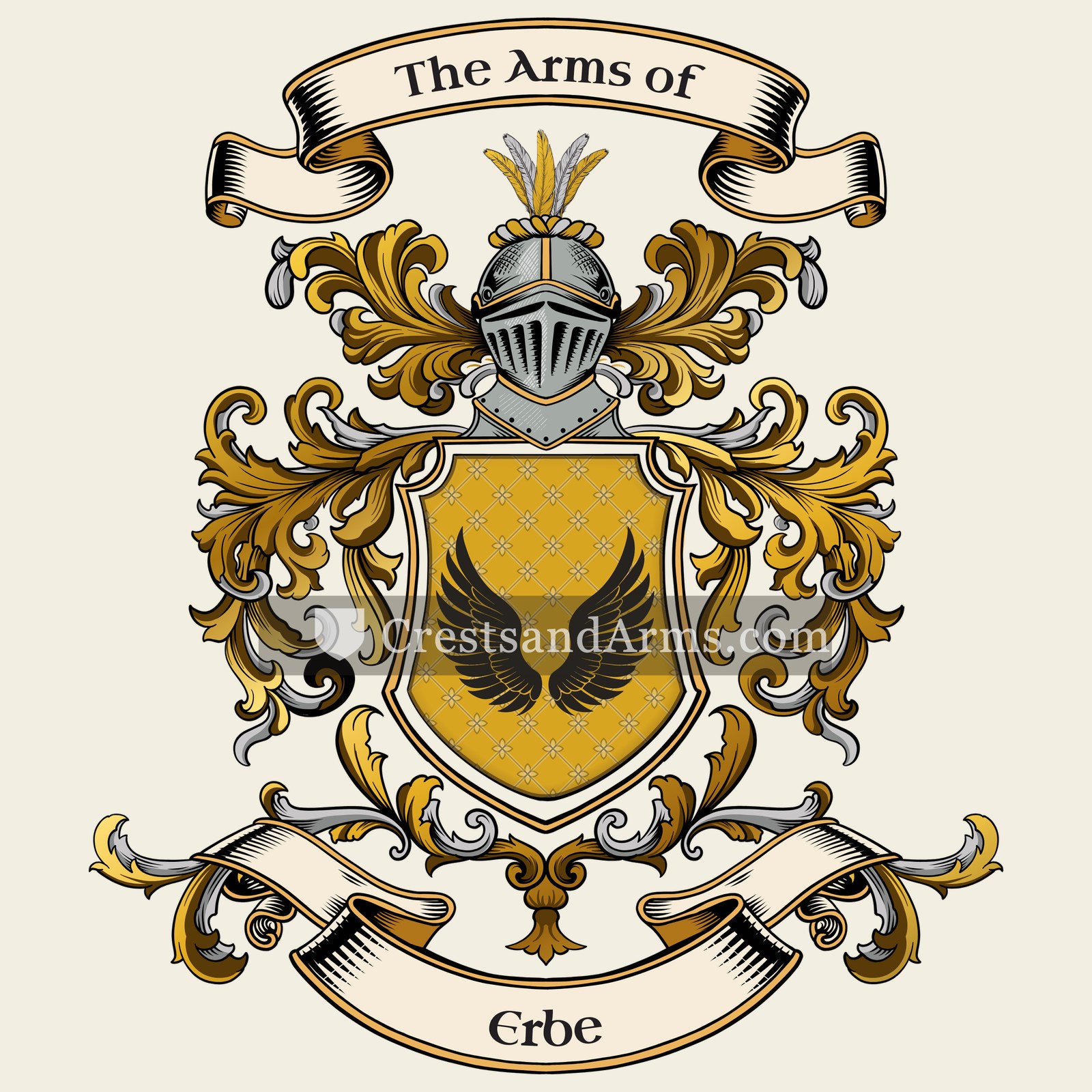
Symbols on this shield
vol / wingsSwiftness and protection
Colours
Gold (Or)Means: Generosity
Black (Sable)Means: Constancy
Historical info
Source
J. B. Rietstap, Armorial Général, Gouda: G. B. van Goor Zonen, 1884–87
Blazon (the actual original written record)
“D'or à un vol abaissé de sa., ch. d'un croiss. d'arg. C.: un buste de jeune homme, hab. aux armes de l'écu.”
FranceStrasbourg, c. 1663
Digital archive packCoat of arms PNG, gold border print PDF, vector SVG and the certificate of authenticity. Sent to your email in minutes.
Map of France showing where the Erbe arms are recorded
The Erbe arms were recorded in Strasbourg, c. 1663.
This is where the arms were entered in the register. Families often moved to other parts of the country, so the same name can turn up in more than one region.
The body that granted and recorded arms in France in this period.
Louis XIV of France
Sovereign of the period
Louis XIV of France
1643–1715
Reigning in Italy when the Erbe arms are first recorded.
How Arms Worked in France
In France, a coat of arms was a mark of honor that passed down through the male line to all legitimate descendants. Families often used the same shield without changes to show their shared heritage. If a branch wanted to stand out, they could add a small mark to their shield to show their specific place in the family tree.
Granting authority
The Juge d'armes de France acted as the official authority that regulated and verified coats of arms across the country.
How they got arms
Families typically inherited their arms from ancestors, though they could also receive them through royal grants or by proving their noble status.
Where arms were recorded
Coats of arms were officially recorded in the Armorial Général de France, which began its main collection in the year 1696.
The family's standing
Recorded among the armigerous families of France.
Origin & History of the Erbe Family in France
The family name Erbe has deep roots in the Alsace region of France, particularly within the city of Strasbourg. By the year 1663, records confirm that members of the Erbe family were already established residents in this area. During the seventeenth century, Strasbourg was a crossroads of culture and trade, sitting at the border of French and Germanic influences. Families like the Erbes often worked as skilled artisans or merchants who helped keep the city’s economy strong during a time of significant political change. Because Strasbourg was a free imperial city that eventually came under French control during this era, the Erbe family lived through a period of transition that shaped their identity and daily life. Their presence in the city archives from this time suggests they were well-integrated into the local community, contributing to the growth and stability of the region for generations.
Erbe Meaning & Related Branches
Root word
herba
Latin term referring to grass, vegetation, or green plants.
This name
ErbeDerived from a topographic or occupational name for someone who lived near or worked with herbs.
also spelled
Erbee
Erben
Erber
Documented Sources
J. B. Rietstap, Armorial Général, Gouda: G. B. van Goor Zonen, 1884–87
Archivio di Stato di Verona, Anagrafe storica della città di Verona
Cappelletti, Giuseppe, Storia della città di Verona, 1854
Da Persico, Giovanni Battista, Descrizione di Verona e della sua provincia, 1820
Digital archive packCoat of arms PNG, gold border print PDF, vector SVG and the certificate of authenticity. Sent to your email in minutes.


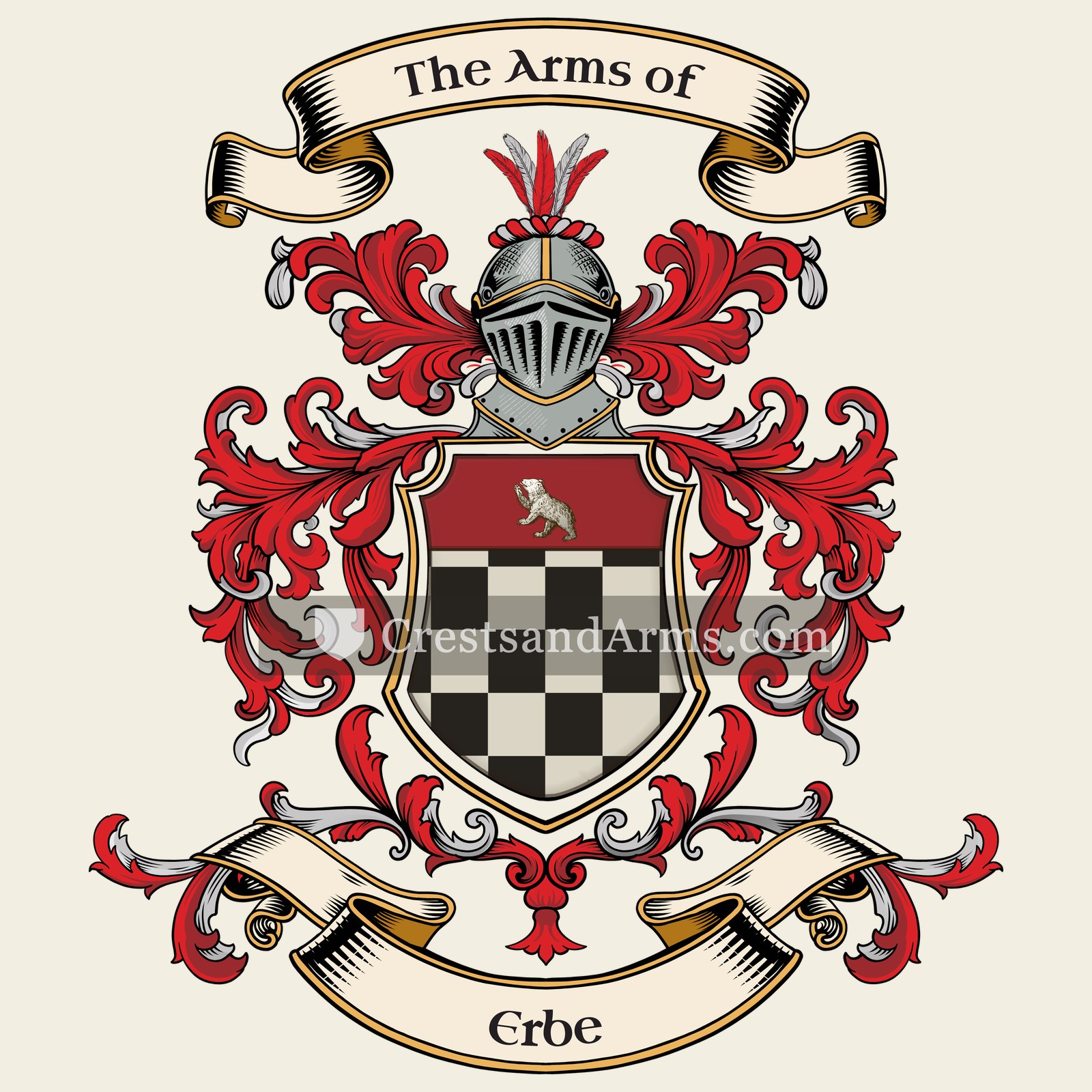
 chequyConstancy, and the counting-board
 chiefAuthority, wisdom and dominion
 bearStrength, cunning and protection of kin
 chequyConstancy, and the counting-board
 chiefAuthority, wisdom and dominion
 bearStrength, cunning and protection of kin


 vol / wingsSwiftness and protection