A record of documented arms, meaning and origin, researched for the Erdmann family lines. Documented in 2 countries.
Reg. 9528 · German, D–F
Coat of Arms & Family Crest Details
Symbols on this shield
mountThe ground held, and steadfastness upon it
stagPeace and harmony, and one who will not fight unprovoked
towerGrandeur and solidity, and a stronghold defended
Colours
Red (Gules)Means: Military strength
Black (Sable)Means: Constancy
Green (Vert)Means: Hope
Silver (Argent)Means: Peace and sincerity
Historical info
Source
J. B. Rietstap, Armorial Général, Gouda: G. B. van Goor Zonen, 1884–87
Blazon (the actual original written record)
“de gu. à un cerf élancé au nat., soutenu d'une terrasse de sin. Sur le tout de sa. à une tour d'arg., posée sur un tertre de sin. Deux cq. cour. C.: 1° l'aile, cont.; 1. d'or et de sa.; 2° trois pl. d'aut.: d'or, de sa. et de gu.; 1. d'or et de gu.”
Germanyc. 1765
Digital archive packCoat of arms PNG, gold border print PDF, vector SVG and the certificate of authenticity. Sent to your email in minutes.
Map of Germany showing where the Erdmann arms are recorded
The Erdmann arms were recorded in Germany, c. 1765.
Arms such as these were typically recorded in Bavaria.
Bavaria was a country of old landed families and walled market towns. Estates passed down the same line for centuries, and both the landowners and the leading townsmen kept arms, which is why so many Bavarian names sit in the registers.
This is where the arms were entered in the register. Families often moved to other parts of the country, so the same name can turn up in more than one region.
The body that granted and recorded arms in Germany in this period.
Francis I, Holy Roman Emperor
Sovereign of the period
Francis I, Holy Roman Emperor
1745–1765
Reigning in Germany when the Erdmann arms are first recorded.
How Arms Worked in Germany
In the Holy Roman Empire, coats of arms were often granted to individuals by the Emperor or his representatives. These arms were then passed down through the generations to all legitimate descendants of the original holder. Younger branches of a family usually kept the same shield design without needing to change it, as the arms belonged to the entire lineage.
Granting authority
The Holy Roman Emperor held the sole power to grant new coats of arms throughout his vast imperial territories.
How they got arms
Families typically obtained their coats of arms through a formal imperial grant or by proving their noble status to the authorities.
Where arms were recorded
These grants were officially recorded in the Imperial Chancery registers, which began keeping formal records of such honors during the Middle Ages.
The family's standing
Recorded among the armigerous families of Germany.
Origin & History of the Erdmann Family in Germany
The name Erdmann has deep roots in the German language, originating as a given name that eventually evolved into a hereditary surname. It is derived from the Old High German words "erd," meaning earth, and "man," meaning man or person. Historically, this name was often associated with people who worked the land or lived in rural farming communities. By the time members of the family were documented in Bavaria in 1765, the name had already become a well-established identifier for families living across various German-speaking regions. These early ancestors were likely part of the agrarian society that formed the backbone of the Bavarian economy during the eighteenth century. As the family grew, they moved through local villages and towns, leaving records in parish registers that tracked their births, marriages, and daily lives. This transition from a descriptive nickname to a formal family name reflects the broader social changes occurring in Germany as populations became more settled and record-keeping became more standardized.
Coat of Arms & Family Crest Details
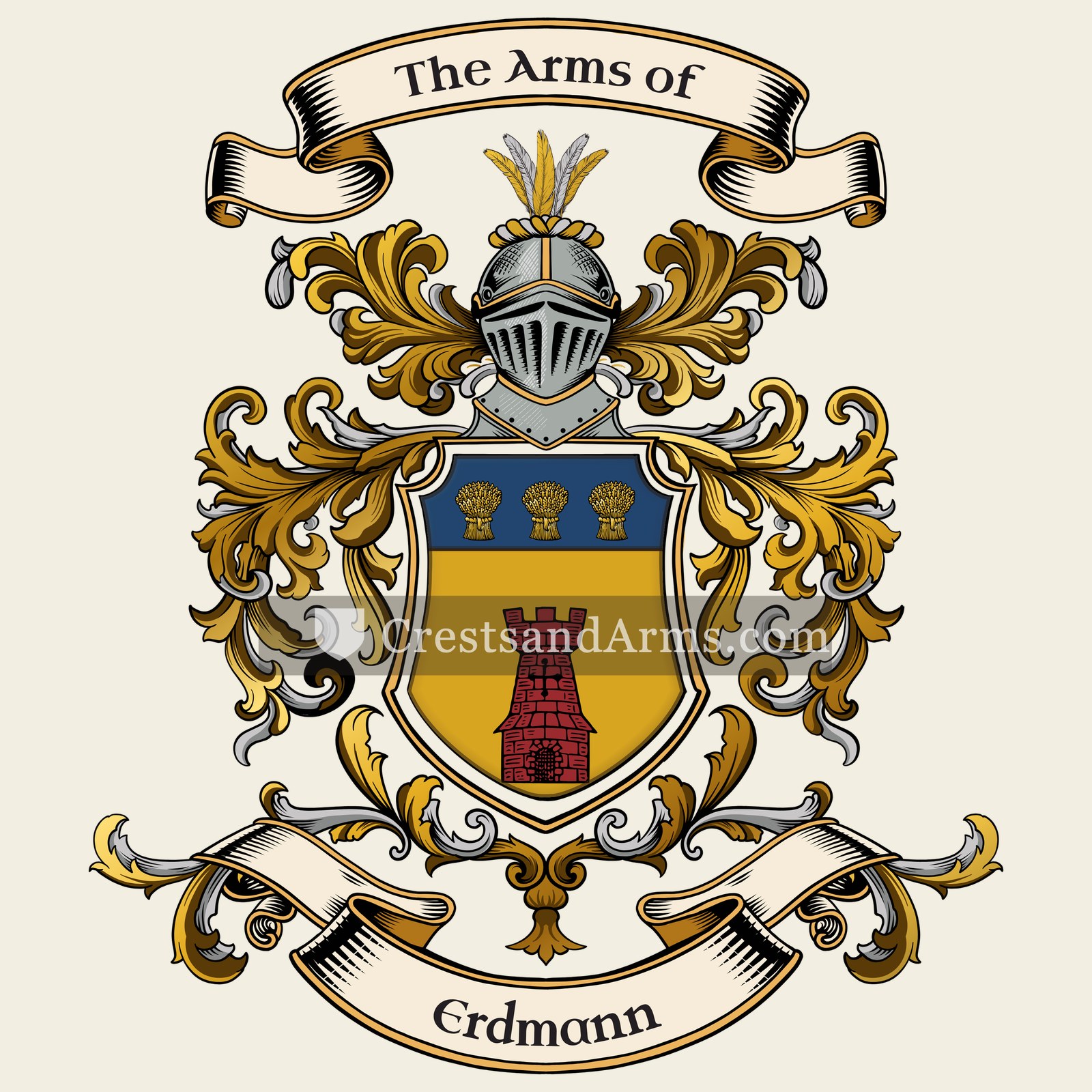
Symbols on this shield
chiefAuthority, wisdom and dominion
towerGrandeur and solidity, and a stronghold defended
wheatsheafPlenty, and the harvest of one's own labour
Colours
Gold (Or)Means: Generosity
Blue (Azure)Means: Loyalty and truth
Red (Gules)Means: Military strength
Historical info
Source
J. B. Rietstap, Armorial Général, Gouda: G. B. van Goor Zonen, 1884–87
Blazon (the actual original written record)
“D'or à une tour de gu., ouv. du champ; au chef d'azur, ch. de trois épis effeuillés d'or. Cq. cour. C.: un”
SwedenEsthonie, c. 1703
Digital archive packCoat of arms PNG, gold border print PDF, vector SVG and the certificate of authenticity. Sent to your email in minutes.
Map of Sweden showing where the Erdmann arms are recorded
The Erdmann arms were recorded in Esthonie, c. 1703.
Arms such as these were typically recorded in Stockholm.
Stockholm held the Swedish court and the House of Nobility, where every noble family's arms were entered and kept. Families ennobled for service registered there, which is why so many are recorded around the city.
This is where the arms were entered in the register. Families often moved to other parts of the country, so the same name can turn up in more than one region.
The body that granted and recorded arms in Sweden in this period.
Carl XII of Sweden
Sovereign of the period
Carl XII of Sweden
1697–1718
Reigning in Germany when the Erdmann arms are first recorded.
How Arms Worked in Sweden
In Sweden, a coat of arms belonged to a noble family as a whole rather than just one individual. These arms were passed down through the generations to all legitimate descendants. Younger branches of the family used the same shield without needing to change it. This system ensured that the entire lineage shared the same identity and status under the law.
Granting authority
The Riddarhuset, or House of Nobility, regulated all noble coats of arms in Sweden under royal authority.
How they got arms
Families received their coats of arms through royal grants of nobility which were then officially registered with the House.
Where arms were recorded
Coats of arms were officially recorded in the Swedish House of Nobility register starting in the year 1626.
The family's standing
Recorded among the armigerous families of Sweden.
Origin & History of the Erdmann Family in Sweden
The Erdmann family name first appeared in the historical records of Stockholm in 1703, marking the beginning of their documented presence in Sweden. During this period, the name was associated with individuals who likely arrived as part of the movement of skilled craftsmen and merchants from German-speaking regions into the Swedish capital. As Stockholm grew into a major hub of trade and administration during the Swedish Empire, families like the Erdmanns integrated into the urban social structure by working in specialized trades or civil service roles. By establishing themselves in the city at the start of the eighteenth century, they became part of the diverse population that helped shape the professional life of Stockholm. Their early history reflects the broader pattern of migration that brought new skills and cultural influences to Sweden during a time of significant political and economic change.
Erdmann Meaning & Related Branches
Root word
Hard-man
Derived from the Germanic elements hard meaning hardy or brave.
This name
ErdmannA name denoting a brave, hardy, or strong-willed individual.
also spelled
Erdman
Related arms
Erdmanvariant spelling
Albedylrecorded with Erdmann, same area
Löschern de Hertzfeldrecorded with Erdmann, same area
Taube de Carlörecorded with Erdmann, same area
Documented Sources
J. B. Rietstap, Armorial Général, Gouda: G. B. van Goor Zonen, 1884–87
Bahlow, Hans, Deutsches Namenlexikon: Familien- und Vornamen nach Ursprung und Sinn erklärt, 1967
Heintze, Albert, Die deutschen Familiennamen: geschichtlich, geographisch, sprachlich, 1903
Bayerisches Hauptstaatsarchiv, Kurbayern Hofkammer: Steuer- und Katasterwesen, 1765
Digital archive packCoat of arms PNG, gold border print PDF, vector SVG and the certificate of authenticity. Sent to your email in minutes.


 mountThe ground held, and steadfastness upon it
 stagPeace and harmony, and one who will not fight unprovoked
 towerGrandeur and solidity, and a stronghold defended
 mountThe ground held, and steadfastness upon it
 stagPeace and harmony, and one who will not fight unprovoked
 towerGrandeur and solidity, and a stronghold defended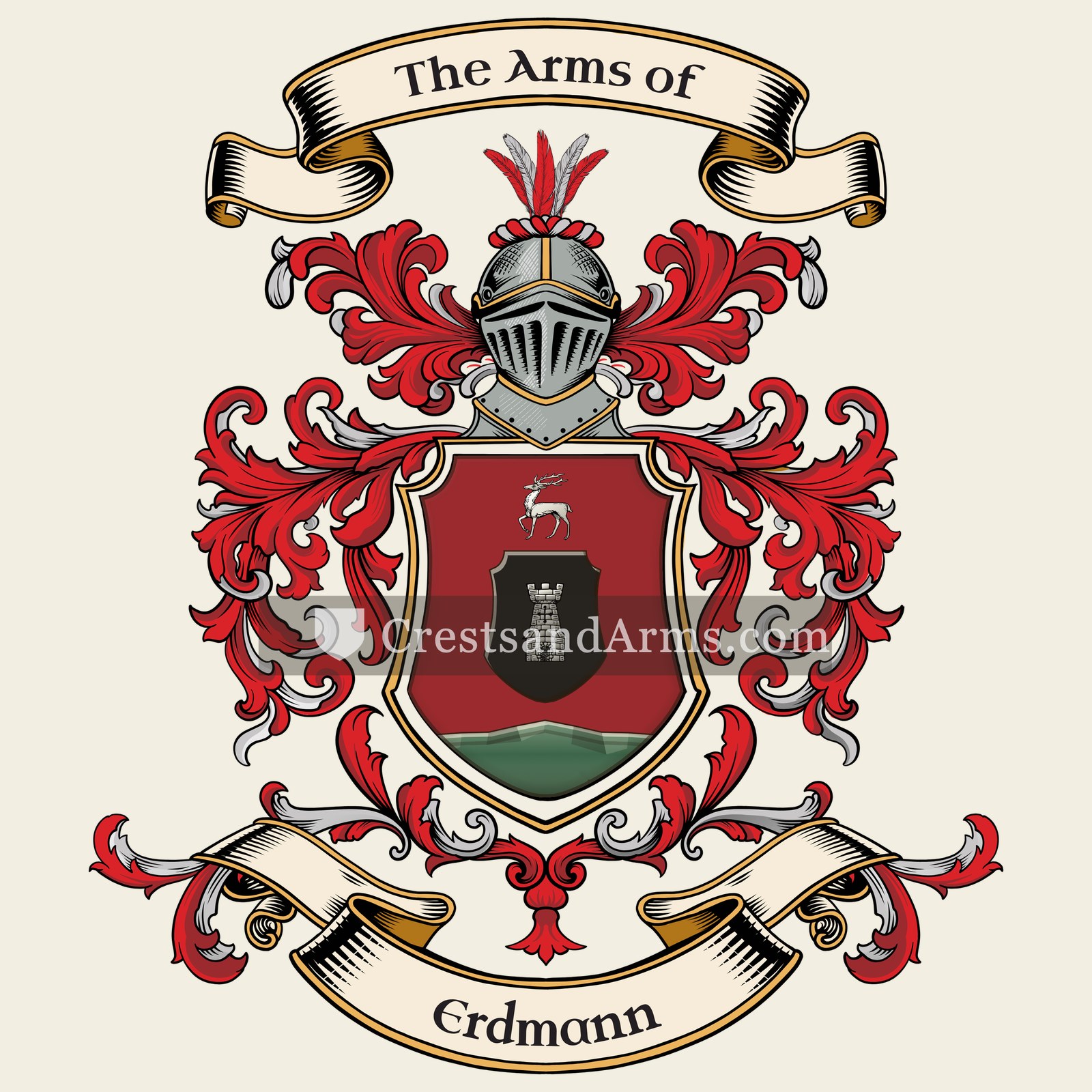


 chiefAuthority, wisdom and dominion
 wheatsheafPlenty, and the harvest of one's own labour