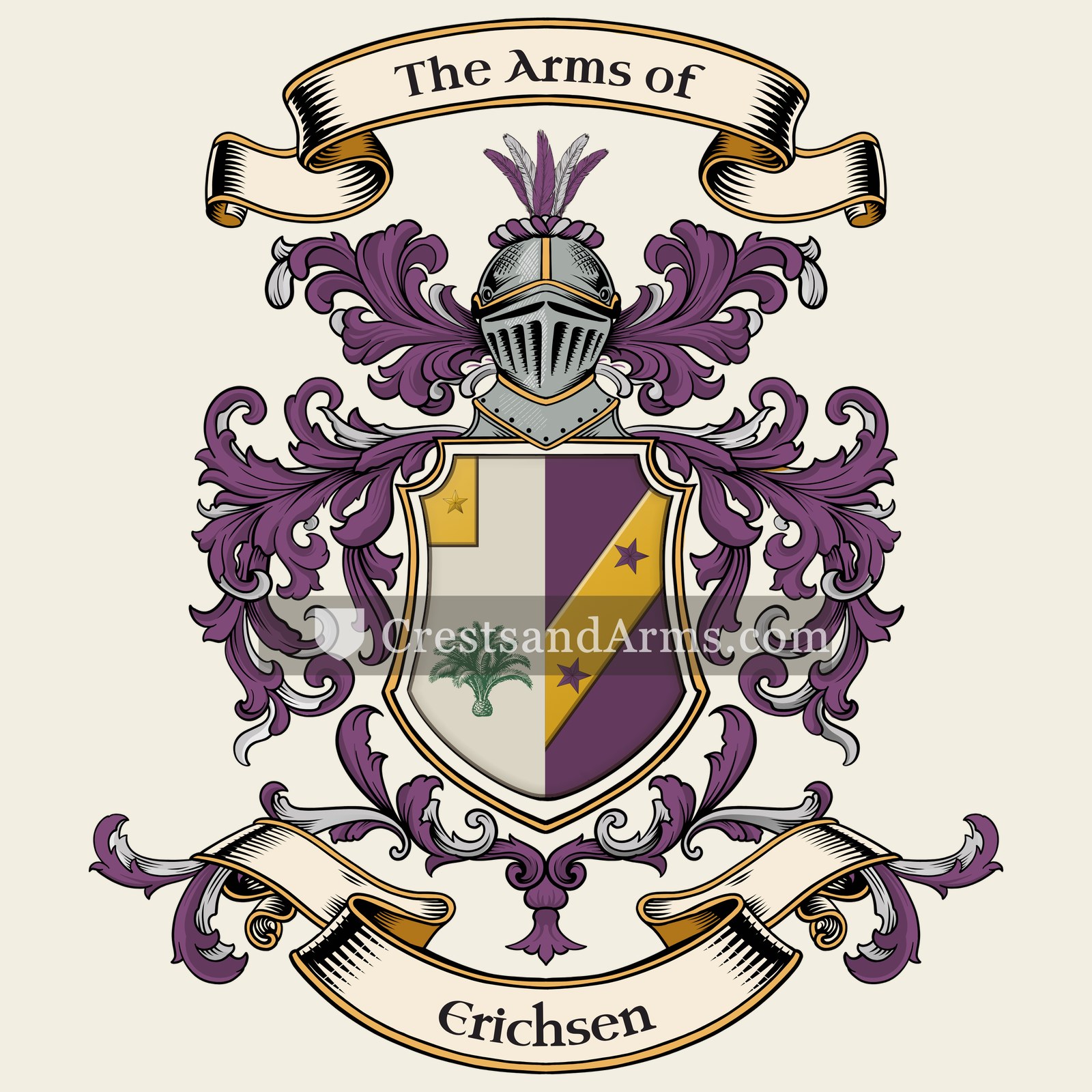
A record of documented arms, meaning and origin, researched for the Erichsen family of Sweden.
Reg. 5517 · Swedish, D–F
Coat of Arms & Family Crest Details
Symbols on this shield
cantonA mark of honour granted by the sovereign
palm treeVictory, and righteousness that flourishes
mulletThe third son, and a divine quality from above
Colours
Silver (Argent)Means: Peace and sincerity
Purple (Purpure)Means: Royal majesty
Gold (Or)Means: Generosity
Green (Vert)Means: Hope
Historical info
Source
J. B. Rietstap, Armorial Général, Gouda: G. B. van Goor Zonen, 1884–87
Blazon (the actual original written record)
“Parti: au 1 d'arg. à une étoile d'or, posée au canton dextre du chef; au 2 de pourpre à la barre d'arg., ch. de deux étoiles d'or. A un palmier de sin., br. sur le parti. Cq. cour. C.: un senestrochère arm., tenant une épée, posé sur le coude, le tout au nat.; entre un vol, d'arg. et de pourpre. L. d'arg. et de pourpre.”
SilesiaBrunswick · Silesia, c. 1700
Digital archive packCoat of arms PNG, gold border print PDF, vector SVG and the certificate of authenticity. Sent to your email in minutes.
Map of Sweden showing where the Erichsen arms are recorded
The Erichsen arms were recorded in Silesia, c. 1700.
Silesia was farming country in the east of the German lands, held in large estates by families who stayed put for generations. Owning land was what entitled a family to arms, so the region fills a good deal of the register.
This is where the arms were entered in the register. Families often moved to other parts of the country, so the same name can turn up in more than one region.
The body that granted and recorded arms in Sweden in this period.
Carl XII of Sweden
Sovereign of the period
Carl XII of Sweden
1697–1718
Reigning in Sweden when the Erichsen arms are first recorded.
How Arms Worked in Sweden
In Sweden, a coat of arms belonged to a noble family as a whole rather than just one individual. These arms were passed down through the generations to all legitimate descendants. Younger branches of the family used the same shield without needing to change it. This system ensured that the entire lineage shared the same identity and status under the law.
Granting authority
The Riddarhuset, or House of Nobility, regulated all noble coats of arms in Sweden under royal authority.
How they got arms
Families received their coats of arms through royal grants of nobility which were then officially registered with the House.
Where arms were recorded
Coats of arms were officially recorded in the Swedish House of Nobility register starting in the year 1626.
The family's standing
Recorded among the armigerous families of Silesia.
Origin & History of the Erichsen Family in Sweden
The surname Erichsen is a patronymic name, which means it was originally formed by combining a father’s given name with a suffix indicating descent. In this case, the name translates to "son of Erich." While the name is most commonly associated with Scandinavian regions, historical records confirm that families bearing this name were established in the region of Silesia by the early 1700s. During this period, Silesia was a crossroads of cultural exchange between German, Polish, and Czech populations. Families like the Erichsens were often part of the growing middle class, working as tradespeople, farmers, or local administrators. Because the region experienced frequent shifts in political borders and religious affiliations during the eighteenth century, these early family members likely adapted to changing social structures while maintaining their distinct identity through their inherited name.
Erichsen Meaning & Related Branches
Root word
Erik
Derived from the Old Norse name Eiríkr meaning sole ruler or monarch.
This name
ErichsenA patronymic surname meaning son of Erik.
also spelled
Erichson
Eriksen
Erikson
Erickson
Related arms
Erichsonvariant spelling
Eriksenvariant spelling
Documented Sources
J. B. Rietstap, Armorial Général, Gouda: G. B. van Goor Zonen, 1884–87
Bahlow, Hans, Deutsches Namenlexikon: Familien- und Vornamen nach Ursprung und Sinn erklärt, 1967
Heintze, Albert, Die deutschen Familiennamen: geschichtlich, geographisch, sprachlich, 1903
Archiwum Państwowe we Wrocławiu (State Archives in Wrocław), Akta stanu cywilnego (Civil Registration Records)
Digital archive packCoat of arms PNG, gold border print PDF, vector SVG and the certificate of authenticity. Sent to your email in minutes.


 cantonA mark of honour granted by the sovereign
 palm treeVictory, and righteousness that flourishes
 mulletThe third son, and a divine quality from above
 cantonA mark of honour granted by the sovereign
 palm treeVictory, and righteousness that flourishes
 mulletThe third son, and a divine quality from above