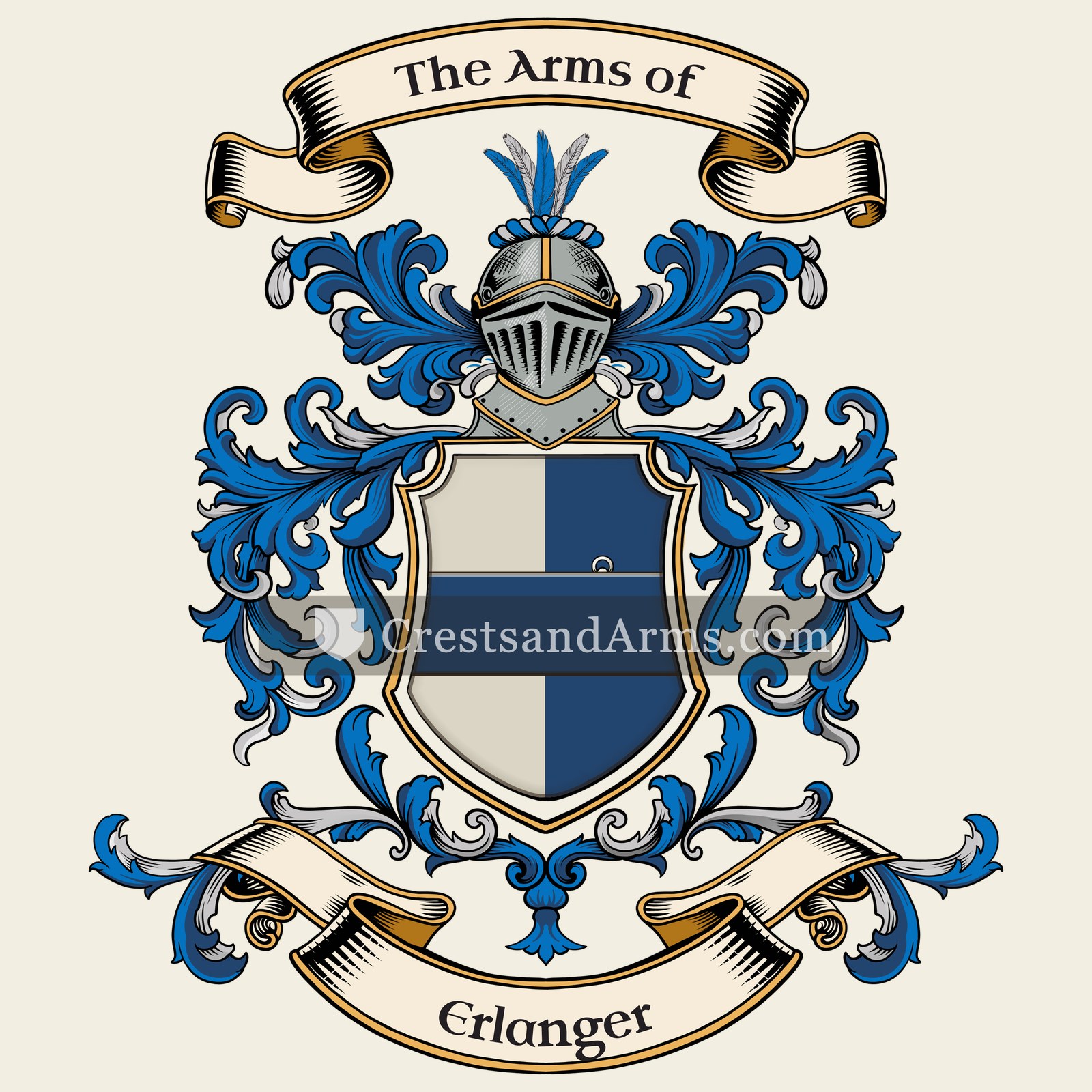
A record of documented arms, meaning and origin, researched for the Erlanger family of Germany.
Reg. 9499 · German, D–F
Coat of Arms & Family Crest Details
Symbols on this shield
fessThe military belt, and readiness to serve
roundelA coin, and one who has been to the crusades
anchorHope, and steadfastness in trouble
Colours
Silver (Argent)Means: Peace and sincerity
Blue (Azure)Means: Loyalty and truth
Historical info
Source
J. B. Rietstap, Armorial Général, Gouda: G. B. van Goor Zonen, 1884–87
Blazon (the actual original written record)
“Parti: au 1 d'arg. à la fasce d'azur, acc. de deux tourt. du même, 1 en chef et 1 en p.; au 2 d'azur à une ancre d'arg. Cq. cour. C.: une ancre d'arg., entre un vol aux armes du 1. L. d'arg et d'azur. D.: RAST ICH, SO ROST ICH.”
GermanyFrancfort s, c. 1859
Digital archive packCoat of arms PNG, gold border print PDF, vector SVG and the certificate of authenticity. Sent to your email in minutes.
Map of Germany showing where the Erlanger arms are recorded
The Erlanger arms were recorded in Francfort s, c. 1859.
This is where the arms were entered in the register. Families often moved to other parts of the country, so the same name can turn up in more than one region.
The body that granted and recorded arms in Germany in this period.
Frederick William IV of Prussia
Sovereign of the period
Frederick William IV of Prussia
1840–1861
Reigning in Germany when the Erlanger arms are first recorded.
How Arms Worked in Germany
Prussian heraldry was strictly tied to social rank and noble status rather than being a free choice for every citizen. These symbols were treated as permanent family property that moved through the generations to all legitimate heirs. If a family branch wanted to change their design to stand out, they had to apply for official permission to alter their specific version of the shield.
Granting authority
The Prussian Heroldsamt acted as the central state office that managed and strictly controlled all noble titles and coats of arms.
How they got arms
Families usually obtained their arms through formal royal grants or by proving their long-standing noble status to the state authorities.
Where arms were recorded
All official coats of arms were kept in the rolls of the Prussian Heroldsamt, which functioned from 1706 until 1918.
The family's standing
Recorded among the armigerous families of Germany.
Origin & History of the Erlanger Family in Germany
The family name Erlanger is a toponymic surname, which means it was originally derived from a specific geographic location. The name identifies individuals who hailed from the town of Erlangen in the region of Franconia, located in modern-day Germany. During the medieval period, it was common for people moving to new cities to be identified by their place of origin, leading to the adoption of the name as a family identifier. By the mid-19th century, members of the family had established a significant presence in Frankfurt, a major financial and cultural hub. This relocation allowed the family to integrate into the burgeoning commercial networks of the era, where they became recognized for their contributions to banking and trade. Their transition from a regional identity rooted in a small Bavarian town to a prominent position in Frankfurt reflects the broader patterns of migration and social mobility that defined European family histories during the 1800s.
Erlanger Meaning & Related Branches
Root word
Erlangen
A city in Bavaria derived from the name Erlang.
This name
ErlangerA habitational name for someone who originated from the town of Erlangen.
also spelled
Erlang
Erlangere
Erlangar
Documented Sources
J. B. Rietstap, Armorial Général, Gouda: G. B. van Goor Zonen, 1884–87
Bahlow, Hans, Deutsches Namenlexikon: Familien- und Vornamen nach Ursprung und Sinn erklärt, 1967
Heintze, Albert, Die deutschen Familiennamen: geschichtlich, geographisch, sprachlich, 1903
Institut für Stadtgeschichte Frankfurt am Main, Bestand Magistratssachen: Bürgeraufnahmen und Einwanderungslisten, 1859
Digital archive packCoat of arms PNG, gold border print PDF, vector SVG and the certificate of authenticity. Sent to your email in minutes.


 fessThe military belt, and readiness to serve
 roundelA coin, and one who has been to the crusades
 anchorHope, and steadfastness in trouble
 fessThe military belt, and readiness to serve
 roundelA coin, and one who has been to the crusades
 anchorHope, and steadfastness in trouble