A record of documented arms, meaning and origin, researched for the Ernst family lines. Documented in 3 countries.
Reg. 6935 · Belgian, D–F
Coat of Arms & Family Crest Details
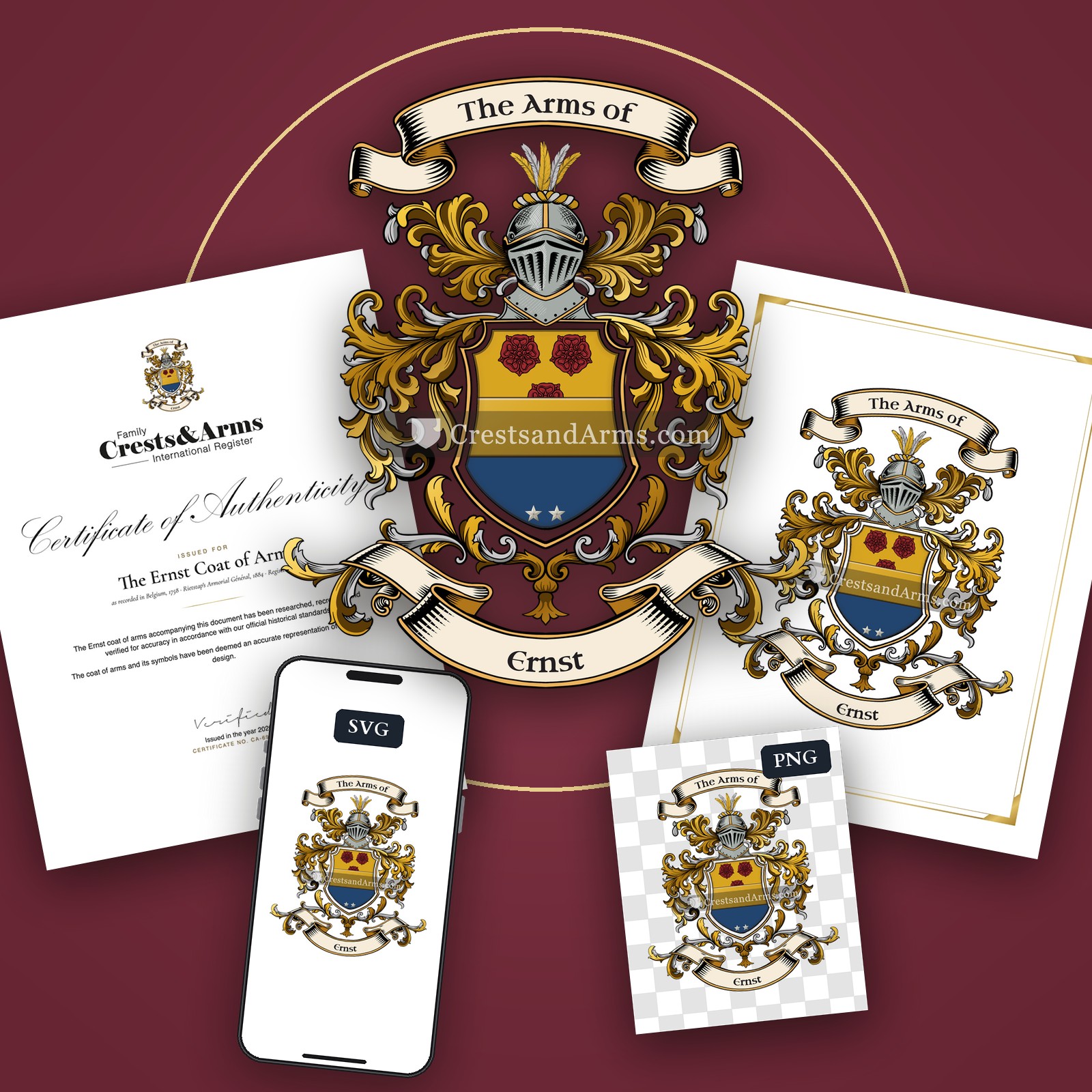
Symbols on this shield
fessThe military belt, and readiness to serve
roseThe seventh son, and beauty with grace
anchorHope, and steadfastness in trouble
mulletThe third son, and a divine quality from above
Colours
Gold (Or)Means: Generosity
Blue (Azure)Means: Loyalty and truth
Red (Gules)Means: Military strength
Silver (Argent)Means: Peace and sincerity
Historical info
Source
J. B. Rietstap, Armorial Général, Gouda: G. B. van Goor Zonen, 1884–87
Blazon (the actual original written record)
“Coupé: au 1 d'or à trois roses de gu., bout. d'or; au 2 d'azur à deux ancres sans trabes d'arg., passées en saut. et accostées en chef de deux étoiles du même. A la fasce d'or, br. sur le coupé et ch. de quatre barres de gu. Deux cq. cour. C.: 1º une rose de l'écu; entre deux prob. d'or, ornées chacune dans son embouchure d'une rose pareille; l. d'or et de gu.; 2º une ancre d'arg., en pal, br. sur deux drapeaux d'azur passés en saut.; l. d'arg. et d'azur.”
BelgiumLuxemb, c. 1758
Digital archive packCoat of arms PNG, gold border print PDF, vector SVG and the certificate of authenticity. Sent to your email in minutes.
Map of Belgium showing where the Ernst arms are recorded
The Ernst arms were recorded in Luxemb, c. 1758.
This is where the arms were entered in the register. Families often moved to other parts of the country, so the same name can turn up in more than one region.
The body that granted and recorded arms in Belgium in this period.
Francis I, Holy Roman Emperor
Sovereign of the period
Francis I, Holy Roman Emperor
1745–1765
Reigning in Belgium when the Ernst arms are first recorded.
How Arms Worked in Belgium
In Belgium, a coat of arms is considered personal property that is passed down through the male line to legitimate descendants. Families often use the same shield design across generations to show their shared heritage. If a branch of the family wants to change the design, they must apply for an official update to their specific version of the arms.
Granting authority
The Conseil héraldique is the official body that regulates and approves all coats of arms in Belgium.
How they got arms
Families obtain their coats of arms through formal royal grants or by confirming their historical right to use existing designs.
Where arms were recorded
All approved coats of arms are officially recorded in the public registers of the Conseil héraldique since 1844.
The family's standing
Recorded among the armigerous families of Belgium.
Origin & History of the Ernst Family in Belgium
The family name Ernst has deep roots in the border regions between modern-day Belgium and Luxembourg, where it emerged as a descriptor of character rather than a specific place. In the Germanic languages, the name is derived from the word for serious, earnest, or resolute, suggesting that early ancestors were known for their steady and reliable nature within their local communities. By 1758, records confirm that members of the family were well-established in the Luxembourg area, which at that time was part of the broader administrative networks of the Southern Netherlands. These early generations lived through a period of significant political transition as the region shifted between various European powers. Because the family was situated in a crossroads of trade and culture, they likely participated in the agricultural and merchant life that defined the Meuse river valley. Over time, the name spread from these rural hubs into the growing towns of Belgium, carried by families who maintained their identity through local parish records and community service.
Coat of Arms & Family Crest Details
Symbols on this shield
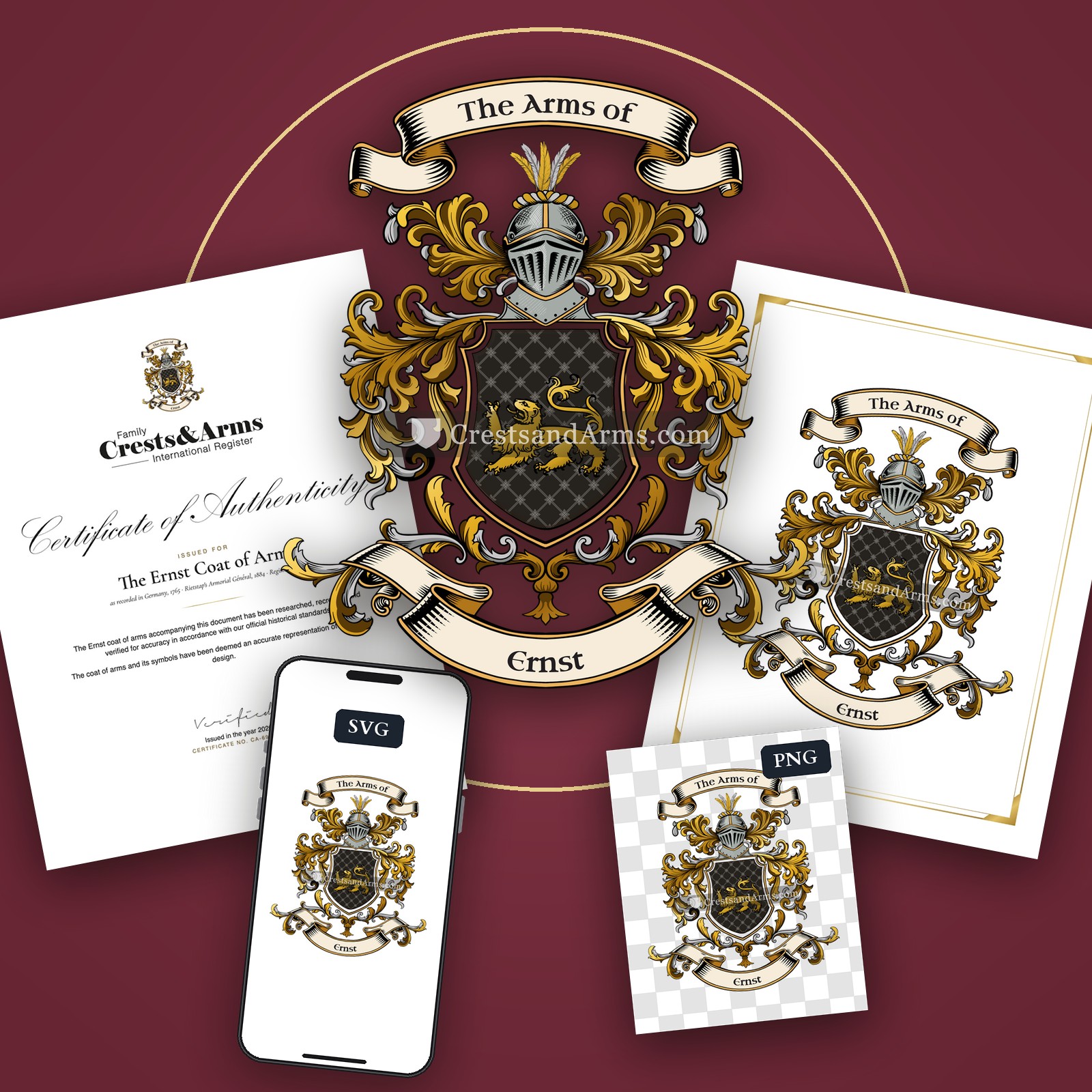
lionCourage, strength and royalty
Colours
Black (Sable)Means: Constancy
Gold (Or)Means: Generosity
Historical info
Source
J. B. Rietstap, Armorial Général, Gouda: G. B. van Goor Zonen, 1884–87
Blazon (the actual original written record)
“De sa. au lion d'or, tenant de sa patte dextre une masse d'armes du même et de sa sen. un bouclier ovale d'arg. C.: le lion, iss.”
GermanyNördlingen Bav, c. 1765
Digital archive packCoat of arms PNG, gold border print PDF, vector SVG and the certificate of authenticity. Sent to your email in minutes.
Map of Germany showing where the Ernst arms are recorded
The Ernst arms were recorded in Nördlingen Bav, c. 1765.
This is where the arms were entered in the register. Families often moved to other parts of the country, so the same name can turn up in more than one region.
The body that granted and recorded arms in Germany in this period.
Francis I, Holy Roman Emperor
Sovereign of the period
Francis I, Holy Roman Emperor
1745–1765
Reigning in Belgium when the Ernst arms are first recorded.
How Arms Worked in Germany
In the Holy Roman Empire, coats of arms were often granted to individuals by the Emperor or his representatives. These arms were then passed down through the generations to all legitimate descendants of the original holder. Younger branches of a family usually kept the same shield design without needing to change it, as the arms belonged to the entire lineage.
Granting authority
The Holy Roman Emperor held the sole power to grant new coats of arms throughout his vast imperial territories.
How they got arms
Families typically obtained their coats of arms through a formal imperial grant or by proving their noble status to the authorities.
Where arms were recorded
These grants were officially recorded in the Imperial Chancery registers, which began keeping formal records of such honors during the Middle Ages.
The family's standing
Recorded among the armigerous families of Germany.
Origin & History of the Ernst Family in Germany
The surname Ernst has deep roots in the German language, originating as a given name that evolved into a family name during the Middle Ages. The name is derived from the Old High German word *ernust*, which translates to seriousness, vigor, or steadfastness. In the context of German history, such names were often chosen to reflect the desired character traits of a person or to honor the legacy of early Germanic leaders. By the time the family was documented in the free imperial city of Nördlingen in 1765, the name had already been established for centuries across various German-speaking regions. Families living in cities like Nördlingen during the eighteenth century were often part of a growing middle class of craftsmen or merchants. This period was a time of significant social change, and the presence of the Ernst family in such a prominent trade hub suggests they were integrated into the local civic life of the Holy Roman Empire.
Coat of Arms & Family Crest Details
Symbols on this shield
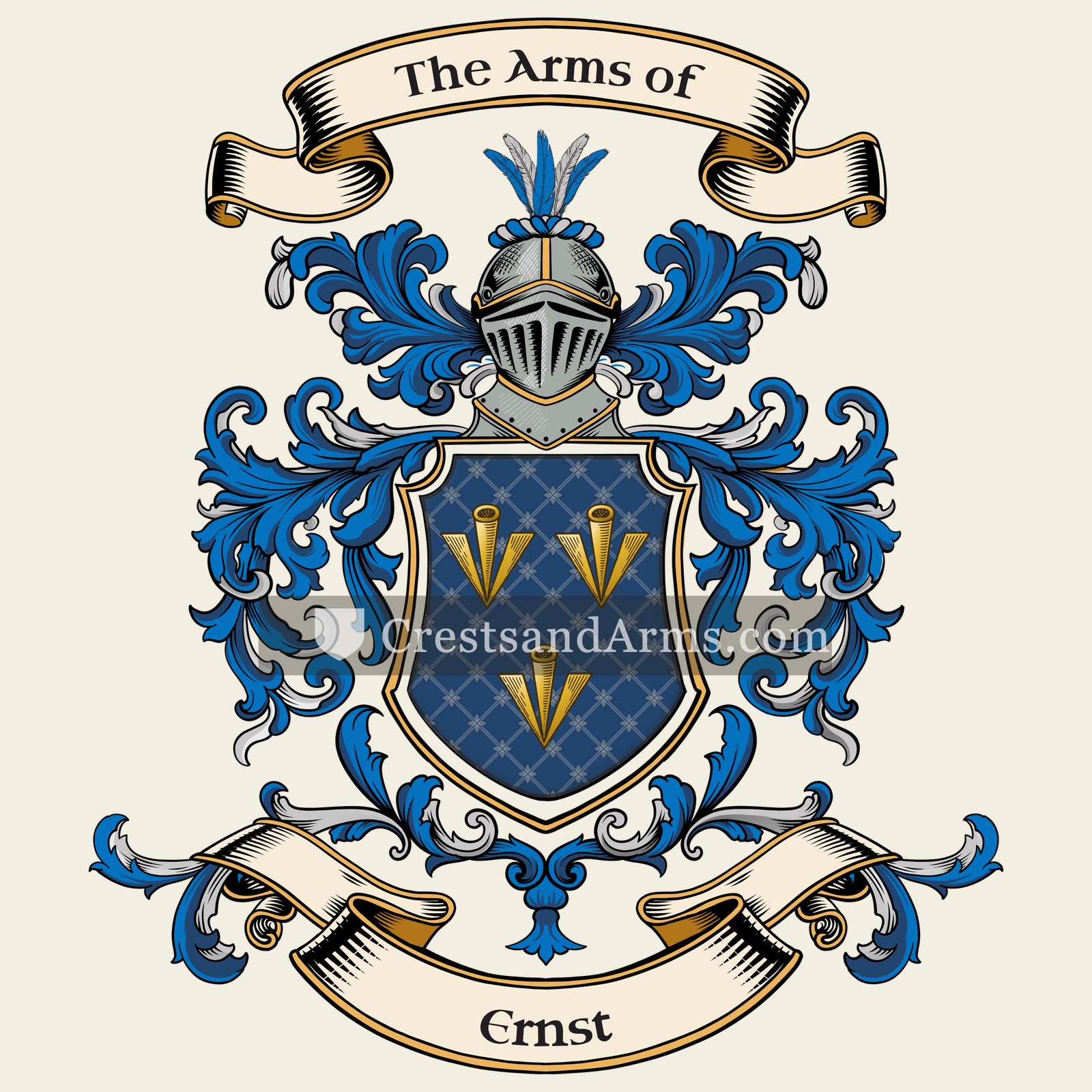
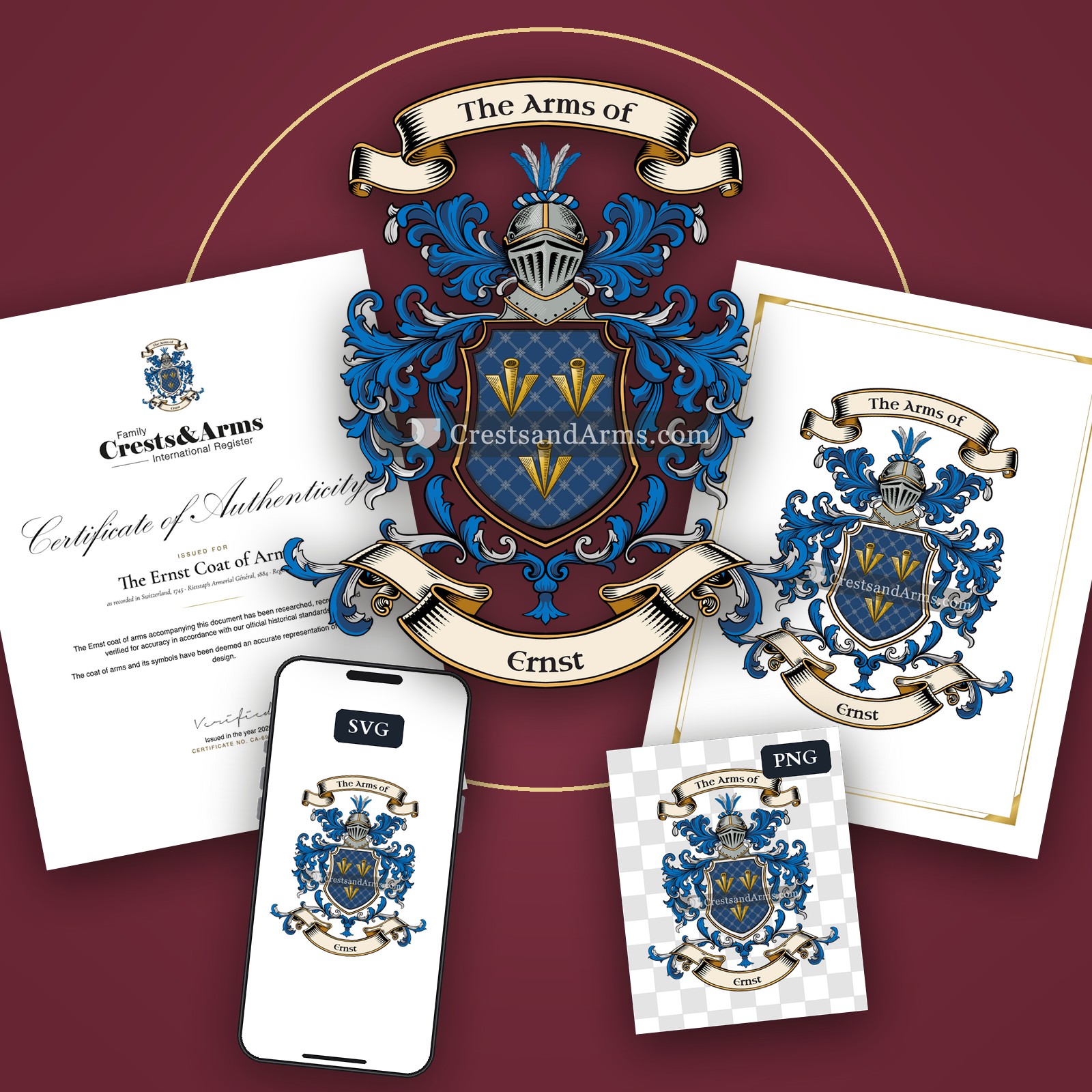
arrowReadiness for battle, and affliction endured
Colours
Blue (Azure)Means: Loyalty and truth
Gold (Or)Means: Generosity
Historical info
Source
J. B. Rietstap, Armorial Général, Gouda: G. B. van Goor Zonen, 1884–87
Blazon (the actual original written record)
“D'azur à un faisceau de trois flèches d'or, arm. et empennées d'arg. C.: le faisceau de flèches. L. d'or et d'azur.”
SwitzerlandBâle, c. 1745
Digital archive packCoat of arms PNG, gold border print PDF, vector SVG and the certificate of authenticity. Sent to your email in minutes.
Map of Switzerland showing where the Ernst arms are recorded
The Ernst arms were recorded in Bâle, c. 1745.
This is where the arms were entered in the register. Families often moved to other parts of the country, so the same name can turn up in more than one region.
The body that granted and recorded arms in Switzerland in this period.
How Arms Worked in Switzerland
In Switzerland, coats of arms were not restricted to the nobility and were often adopted by common citizens and families. These symbols were passed down through generations to show family identity. When branches of a family grew, they often changed small details of the design to distinguish their own line from the original group.
Granting authority
Cantonal and civic authorities managed the use of coats of arms within their specific regions and local jurisdictions.
How they got arms
Families typically assumed their own coats of arms based on local custom rather than receiving them from a central monarch.
Where arms were recorded
Arms were recorded in various cantonal and civic registers starting from the fourteenth century throughout the Swiss region.
The family's standing
Recorded among the armigerous families of Switzerland.
Origin & History of the Ernst Family in Switzerland
The family name Ernst has deep roots in the German-speaking regions of Europe, where it originated as a descriptive term meaning serious, earnest, or resolute. By the mid-eighteenth century, the name was well-established in the city of Basel, Switzerland. Records from 1745 confirm that members of the Ernst family were active participants in the local community during this period. At that time, Basel was a major center for trade and intellectual growth, and families like the Ernsts often held roles in the city's guilds or merchant networks. The name reflects a cultural emphasis on reliability and sincerity, traits that were highly valued in the civic life of Swiss cities during the Enlightenment. Over the generations, these families became woven into the social fabric of the region, contributing to the steady development of Basel as a hub of Swiss commerce and culture.
Ernst Meaning & Related Branches
Root word
ernust
Old Germanic word meaning serious, resolute, or vigorous.
This name
ErnstA surname denoting a person who is earnest, sincere, or serious in nature.
also spelled
Ernste
Erneste
Related arms
Jagersimilar arms
Keckermannsimilar arms
Khistler (von) und Löwenthurnsimilar arms
Ernestvariant spelling
Documented Sources
J. B. Rietstap, Armorial Général, Gouda: G. B. van Goor Zonen, 1884–87
Baudouin, Michel. Dictionnaire des noms de famille en Belgique. 1996
Debrabandere, Frans. Woordenboek van de familienamen in België en Noord-Frankrijk. 2003
Archives de l'État à Arlon, Registres paroissiaux du Luxembourg
Digital archive packCoat of arms PNG, gold border print PDF, vector SVG and the certificate of authenticity. Sent to your email in minutes.


 fessThe military belt, and readiness to serve
 roseThe seventh son, and beauty with grace
 anchorHope, and steadfastness in trouble
 mulletThe third son, and a divine quality from above
 fessThe military belt, and readiness to serve
 roseThe seventh son, and beauty with grace
 anchorHope, and steadfastness in trouble
 mulletThe third son, and a divine quality from above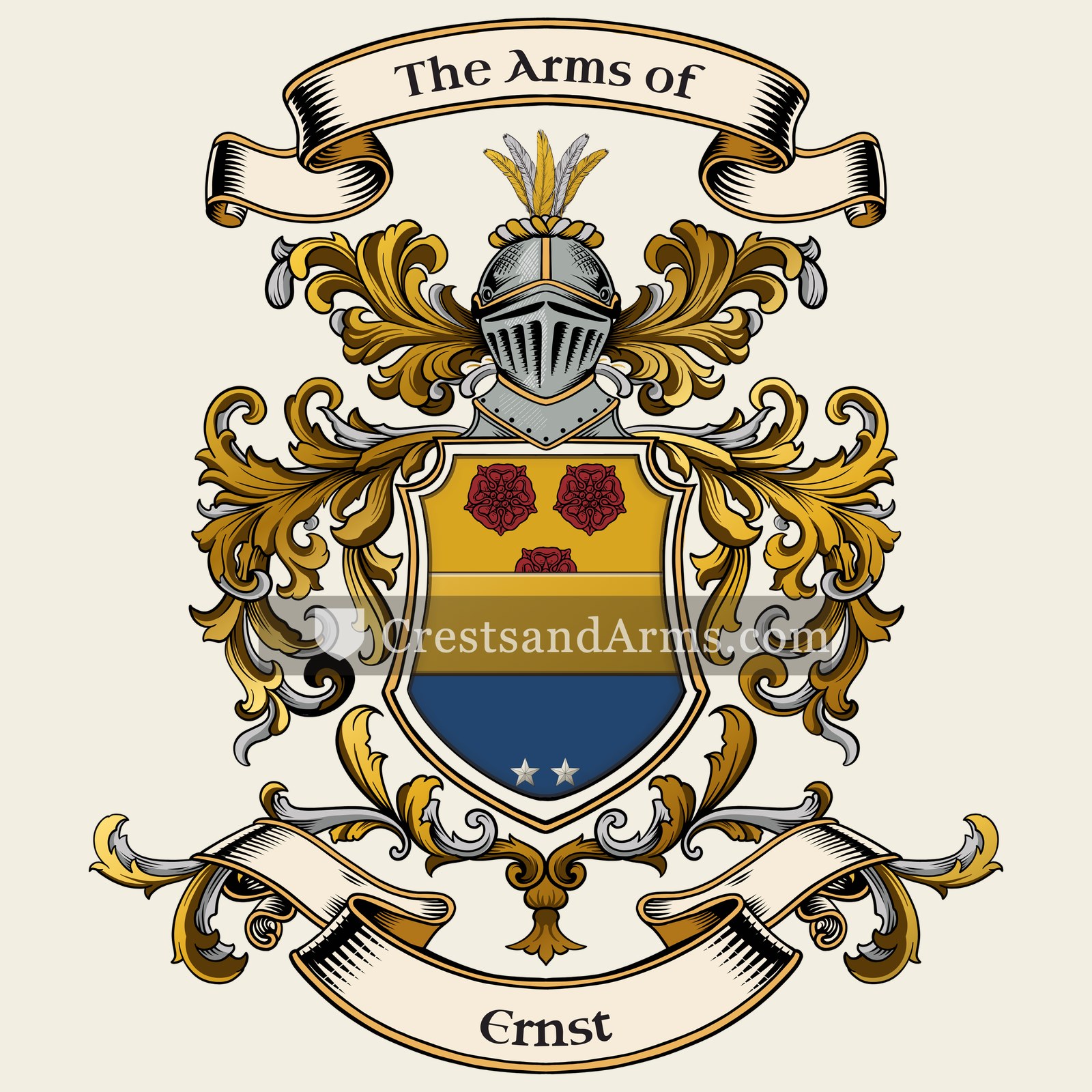


 lionCourage, strength and royalty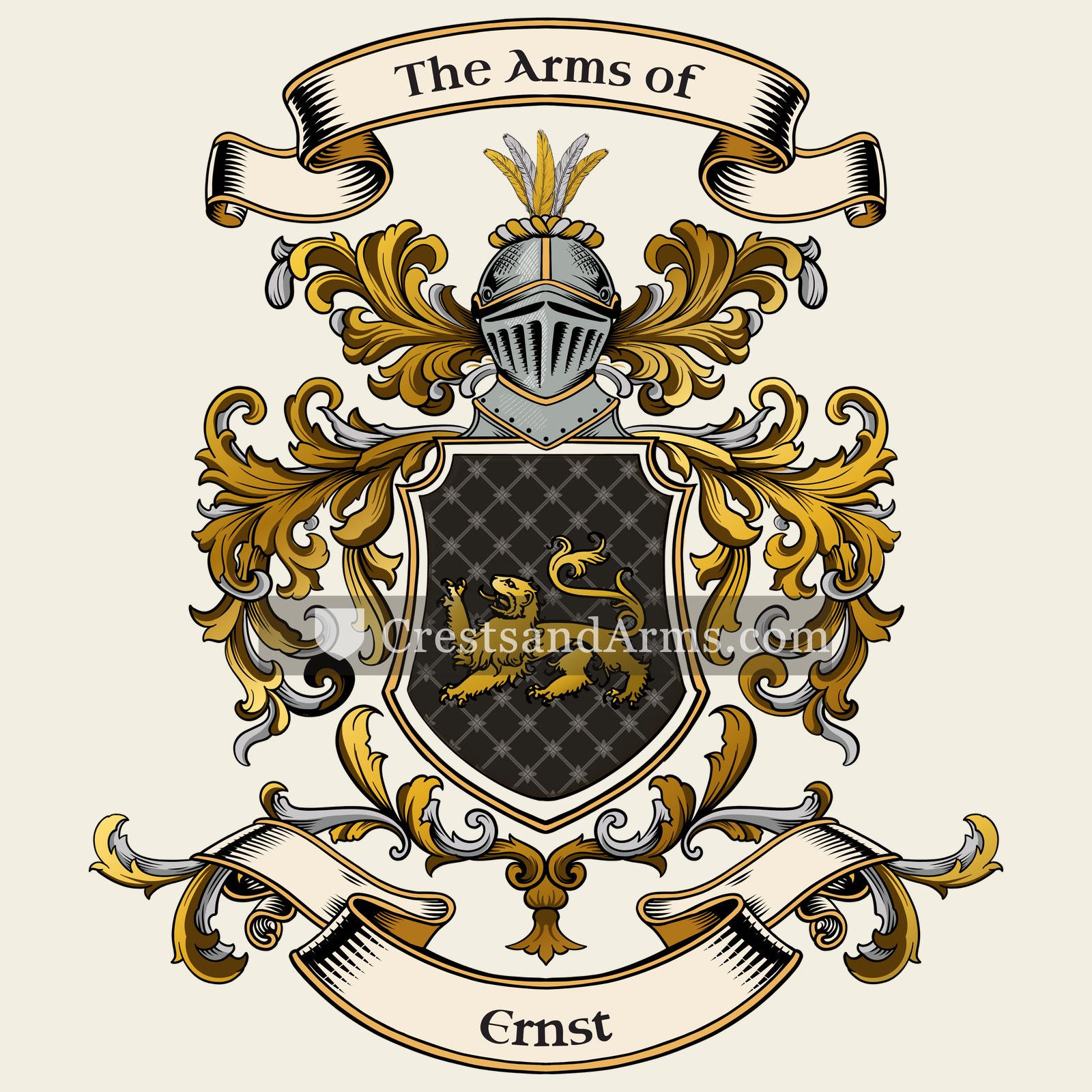

 arrowReadiness for battle, and affliction endured