Map of Britain showing where the Errington arms are recorded
The Errington arms were recorded in Northumberland, c. 1662.
Northumberland was border country facing Scotland, raided and fought over for three hundred years. Families held their land in return for defending it, and a defending household carried a shield.
This is where the arms were entered in the register. Families often moved to other parts of the country, so the same name can turn up in more than one region.
The body that granted and recorded arms in Britain in this period.
Charles II of England
Sovereign of the period
Charles II of England
1660–1685
Reigning in Britain when the Errington arms are first recorded.
How Arms Worked in Britain
English heraldry allowed arms to be shared by all legitimate descendants of the original owner. These symbols were treated as personal property that moved through the generations to all children. While the eldest son kept the original design, other family members could use the same shield without needing to change it or register their own unique versions.
Granting authority
The College of Arms in London has regulated the use of coats of arms throughout England and Wales since 1484.
How they got arms
Families typically obtained their coats of arms through a formal grant from the Crown or by proving their ancient right to them.
Where arms were recorded
All official coats of arms are recorded in the registers kept at the College of Arms, which date back to the fifteenth century.
The family's standing
Recorded among the armigerous families of Northumberland.
Origin & History of the Errington Family in Britain
The Errington family name finds its deep roots in the rugged landscape of Northumberland, a county in Northern England known for its long history of border conflicts. By the middle of the seventeenth century, the family had firmly established itself within this region, as evidenced by records confirming their presence there in 1662. The name itself is locational, likely derived from the village of Errington, which sits near the historic Roman fortification of Hadrian’s Wall. During this era, families in Northumberland often lived in fortified stone houses known as bastles to protect themselves from raids. The Erringtons were part of the local gentry who managed land and played a significant role in the social and political life of the borderlands. Their survival and growth in such a challenging environment suggest that they were resilient people who adapted well to the shifting power dynamics of Northern Britain.
Coat of Arms & Family Crest Details
Symbols on this shield
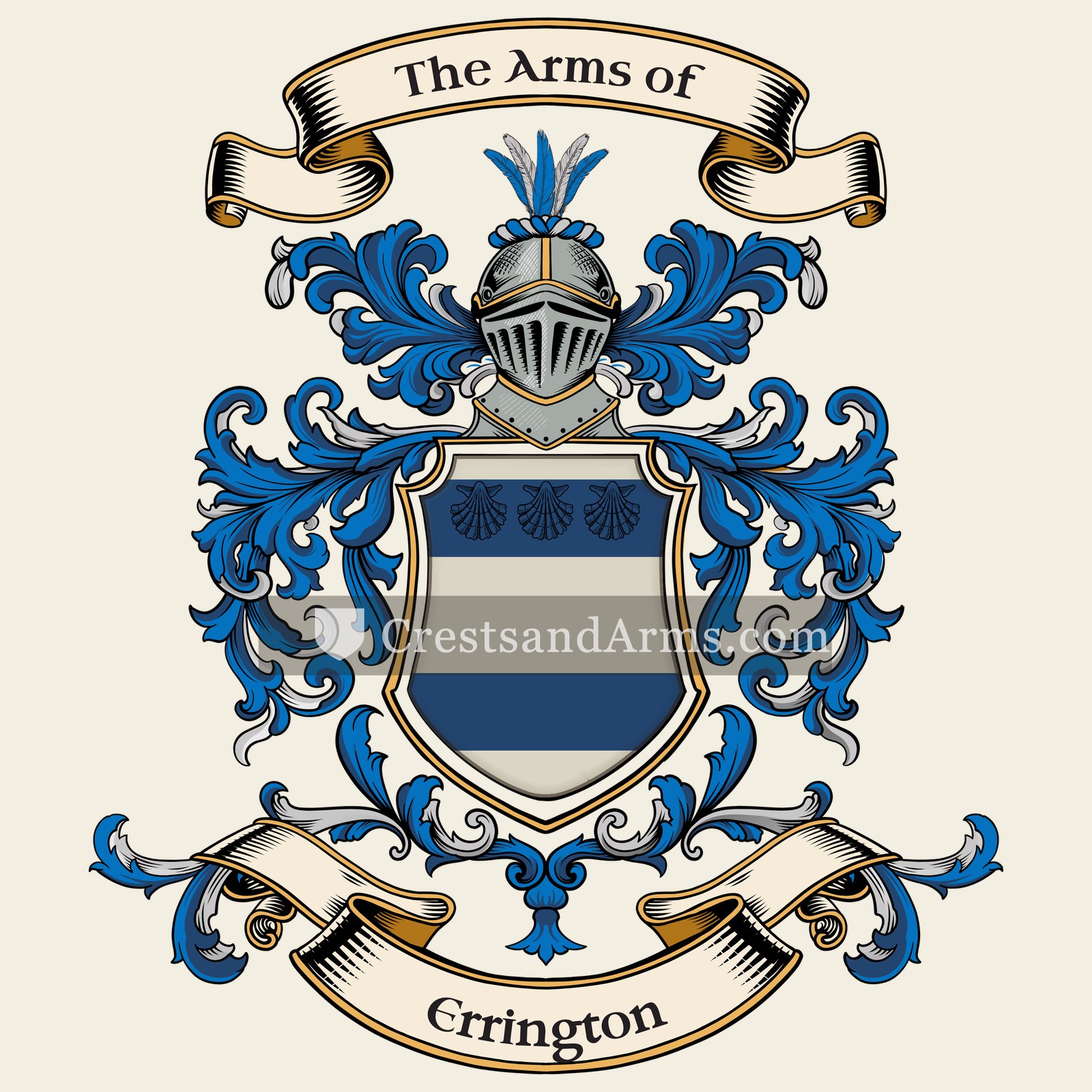
escallopThe pilgrim's shell, and a long journey made
Colours
Silver (Argent)Means: Peace and sincerity
Blue (Azure)Means: Loyalty and truth
Historical info
Source
Sir Bernard Burke, The General Armory of England, Scotland, Ireland and Wales, London: Harrison & Sons, 1884
Blazon (the actual original written record)
“Ar. two bars, in chief three escallops az”
NorthumberlandErrington · Northumberland, c. 1620
Digital archive packCoat of arms PNG, gold border print PDF, vector SVG and the certificate of authenticity. Sent to your email in minutes.
Map of England showing where the Errington arms are recorded
The Errington arms were recorded in Northumberland, c. 1620.
Northumberland was border country facing Scotland, raided and fought over for three hundred years. Families held their land in return for defending it, and a defending household carried a shield.
This is where the arms were entered in the register. Families often moved to other parts of the country, so the same name can turn up in more than one region.
The body that granted and recorded arms in England in this period.
James VI and I
Sovereign of the period
James VI and I
1603–1625
Reigning in Britain when the Errington arms are first recorded.
How Arms Worked in England
English heraldry allowed arms to be shared by all legitimate descendants of the original owner. These symbols were treated as personal property that moved through the generations to all children. While the eldest son kept the original design, other family members could use the same shield without needing to change it or register their own unique versions.
Granting authority
The College of Arms in London has regulated the use of coats of arms throughout England and Wales since 1484.
How they got arms
Families typically obtained their coats of arms through a formal grant from the Crown or by proving their ancient right to them.
Where arms were recorded
All official coats of arms are recorded in the registers kept at the College of Arms, which date back to the fifteenth century.
The family's standing
Recorded among the armigerous families of Northumberland.
Origin & History of the Errington Family in England
The Errington family name originates from the northern reaches of England, specifically within the rugged landscape of Northumberland. The name is locative, meaning it was derived from the small township of Errington located near the village of Bingfield. By the early 17th century, the family had firmly established itself in this region, with records confirming their presence by 1620. During this era, the Erringtons were part of the landed gentry who managed estates and played active roles in local governance. Their history is deeply tied to the borderlands, a territory often shaped by shifting political loyalties and the challenges of living near the Scottish frontier. As the family grew, they spread across the county, becoming influential figures in the social and economic life of northern England for generations.
Errington Meaning & Related Branches
Root word
Eofor
An Old English term meaning wild boar.
This name
ErringtonDerived from a place name meaning the settlement of the boar people.
also spelled
Erington
Erryngton
Related arms
Cointinsimilar arms
Stanleysimilar arms
Stanley de Grange-Gormansimilar arms
Stanley-Massey-Stanleysimilar arms
Documented Sources
J. B. Rietstap, Armorial Général, Gouda: G. B. van Goor Zonen, 1884–87
Hodgson, John. A History of Northumberland. 1827
The National Archives, Kew. State Papers Domestic: Charles II. SP 29
Digital archive packCoat of arms PNG, gold border print PDF, vector SVG and the certificate of authenticity. Sent to your email in minutes.


 bendDefence, and the scarf of a commander
 stagPeace and harmony, and one who will not fight unprovoked
 bendDefence, and the scarf of a commander
 stagPeace and harmony, and one who will not fight unprovoked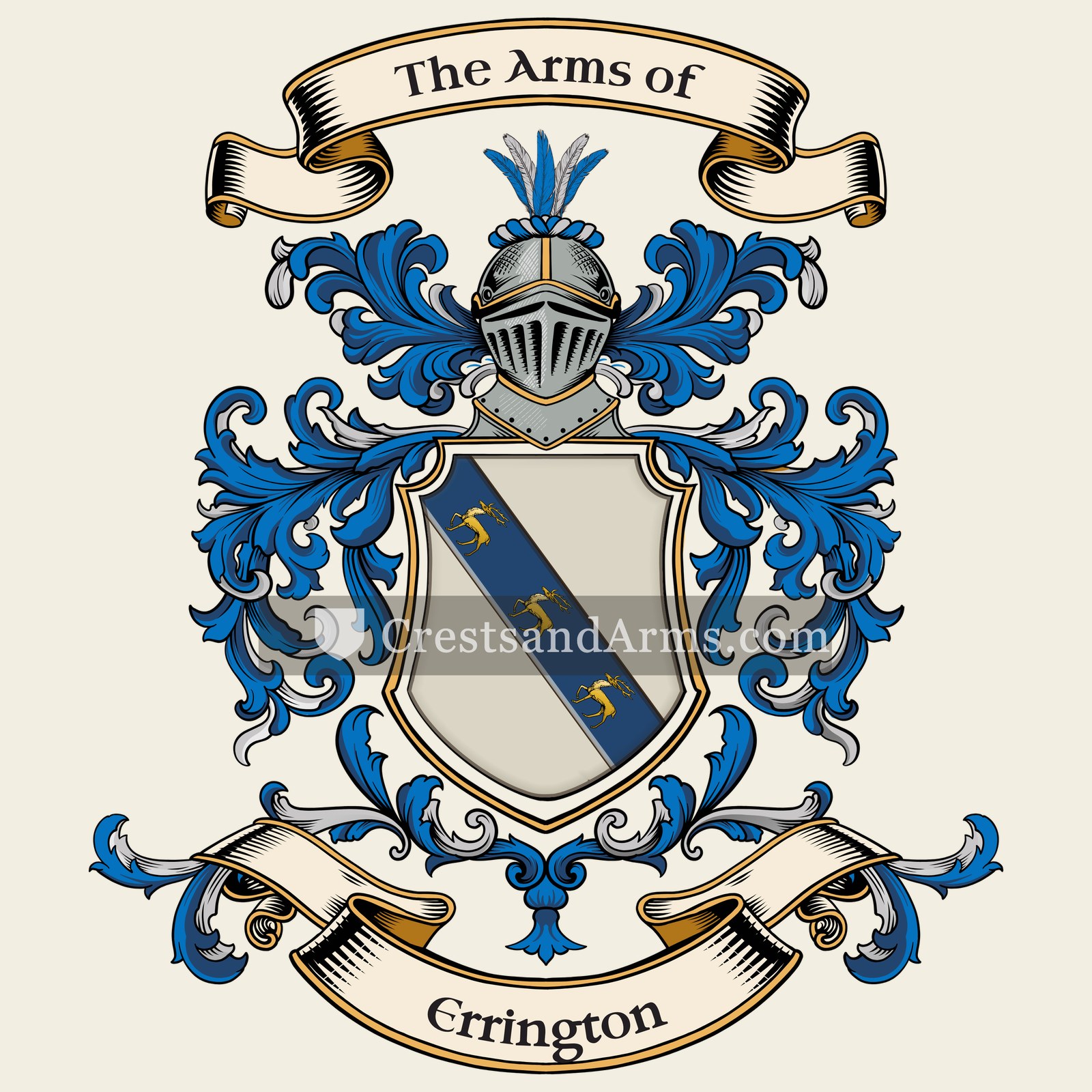


 escallopThe pilgrim's shell, and a long journey made