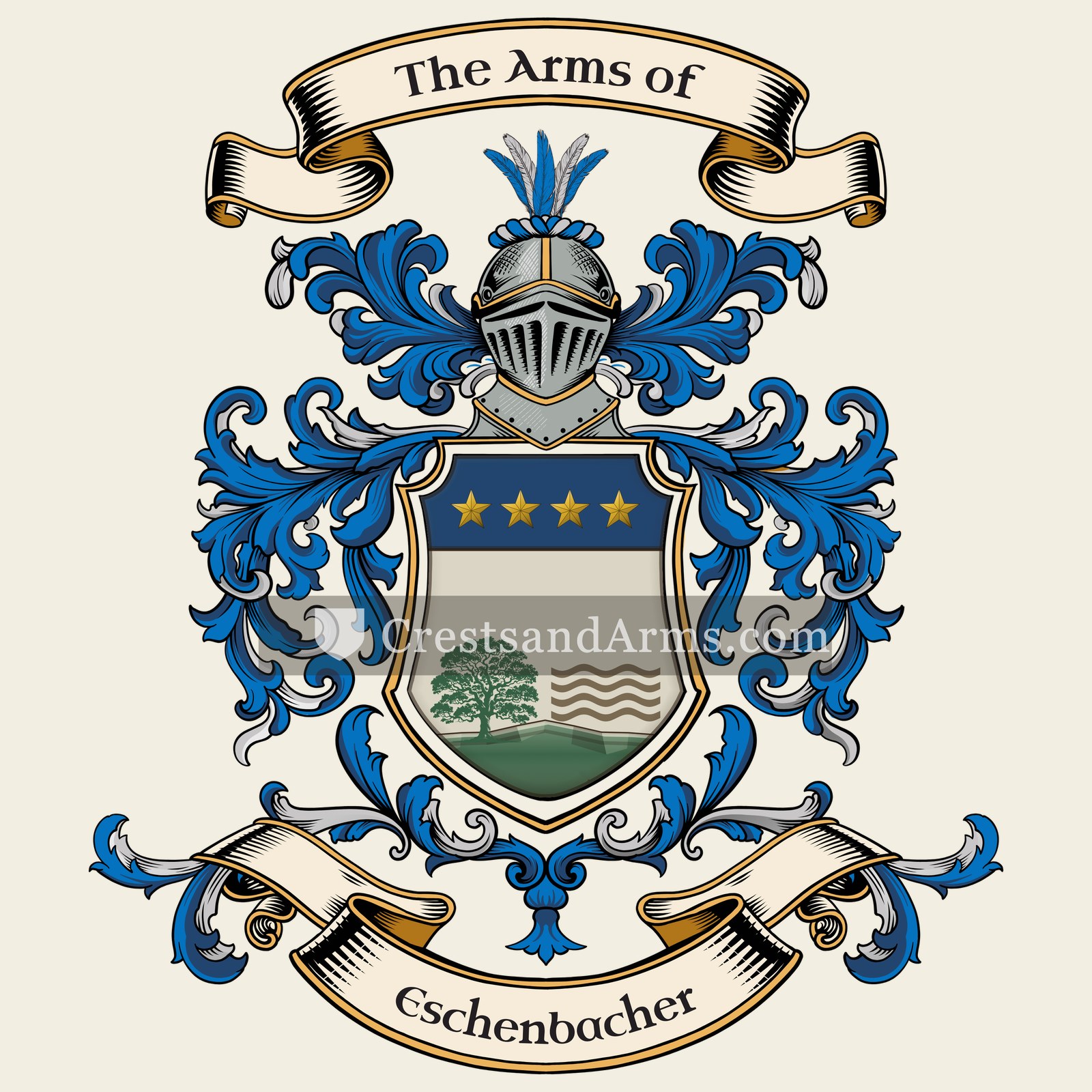
A record of documented arms, meaning and origin, researched for the Eschenbacher family of Austria.
Reg. 0695 · Austrian, D–F
Coat of Arms & Family Crest Details
Symbols on this shield
mountThe ground held, and steadfastness upon it
chiefAuthority, wisdom and dominion
treeLife, endurance and deep roots
riverThe bounds of a land, and life carried through it
mulletThe third son, and a divine quality from above
Colours
Silver (Argent)Means: Peace and sincerity
Blue (Azure)Means: Loyalty and truth
Green (Vert)Means: Hope
Gold (Or)Means: Generosity
Historical info
Source
J. B. Rietstap, Armorial Général, Gouda: G. B. van Goor Zonen, 1884–87
Blazon (the actual original written record)
“D'arg. à un frêne de sin., posé sur une terrasse du même, traversée d'une rivière au nat., en bande; au chef d'azur, ch. de quatre étoiles rangées d'or. Deux cq. cour. C.: 1° et 2° un bras arm., tenant une bombe. L.: à dextre d'or et d'azur, à sen. d'arg. et d'azur.”
Austriac. 1851
Digital archive packCoat of arms PNG, gold border print PDF, vector SVG and the certificate of authenticity. Sent to your email in minutes.
Map of Austria showing where the Eschenbacher arms are recorded
The Eschenbacher arms were recorded in Austria, c. 1851.
Arms such as these were typically recorded in Tyrol.
Tyrol was mountain country in western Austria, where the valleys were held by families who had been there a very long time. Old tenure counted for more than money, and old families carried arms.
This is where the arms were entered in the register. Families often moved to other parts of the country, so the same name can turn up in more than one region.
Region
Tyrol
First recorded
1851
Granting Authority for the Eschenbacher Arms
Imperial and Royal chancery
Sodacan · CC BY-SA 3.0
The body that granted and recorded arms in Austria in this period.
Franz Joseph I of Austria
Sovereign of the period
Franz Joseph I of Austria
1848–1916
Reigning in Austria when the Eschenbacher arms are first recorded.
How Arms Worked in Austria
Austrian coats of arms were often linked directly to noble titles granted by the Emperor. These symbols belonged to the entire family line rather than just one individual. When a family grew, new branches kept the original design without needing to change it. This system allowed all members of a noble house to share the same identity across many generations.
Granting authority
The Imperial and Royal chancery managed all heraldic matters and controlled the official granting of arms throughout the Austrian lands.
How they got arms
Families typically received their arms through a formal imperial decree that often accompanied the elevation of a person to noble status.
Where arms were recorded
Official records of these grants were kept in the Imperial Register of Nobility which began its formal documentation process in 1453.
The family's standing
Recorded among the armigerous families of Austria.
Origin & History of the Eschenbacher Family in Austria
The family name Eschenbacher is a topographical surname, which means it was originally used to identify people based on the landscape where they lived. The name is rooted in the German word "Esche," meaning ash tree, combined with the suffix "bacher," which refers to someone who lived near a stream or brook. This suggests that the earliest ancestors of the family likely settled in a valley or near a woodland area characterized by ash trees and running water. By the mid-19th century, records confirm that the family was well-established in the Tyrol region of the Alps. Living in this rugged mountain environment required the family to be resilient and adaptable to the changing seasons. Over time, as family members moved from these rural areas into growing towns, the name served as a permanent link to their ancestral connection with the natural landscape of Central Europe.
Eschenbacher Meaning & Related Branches
Root word
Esche
A deciduous tree belonging to the olive family.
This name
EschenbacherRefers to someone who lived near a stream or brook by an ash tree.
also spelled
Eschenbach
Eshenbaker
Related arms
Eschenbachvariant spelling
Documented Sources
J. B. Rietstap, Armorial Général, Gouda: G. B. van Goor Zonen, 1884–87
Bahlow, Hans. Deutsches Namenlexikon: Familien- und Vornamen nach Ursprung und Sinn erklärt. 1967
Heintze, Albert. Die deutschen Familiennamen: geschichtlich, geographisch, sprachlich. 1903
Tiroler Landesarchiv. Standesbücher der Pfarreien in Tirol. 1851
Digital archive packCoat of arms PNG, gold border print PDF, vector SVG and the certificate of authenticity. Sent to your email in minutes.


 mountThe ground held, and steadfastness upon it
 chiefAuthority, wisdom and dominion
 treeLife, endurance and deep roots
 riverThe bounds of a land, and life carried through it
 mulletThe third son, and a divine quality from above
 mountThe ground held, and steadfastness upon it
 chiefAuthority, wisdom and dominion
 treeLife, endurance and deep roots
 riverThe bounds of a land, and life carried through it
 mulletThe third son, and a divine quality from above