Map of Germany showing where the Esh arms are recorded
The Esh arms were recorded in Westphalia, c. 1765.
Westphalia was a land of small estates and fortified farmhouses in western Germany. Its families were numerous and not especially rich, but each held its own ground, and holding ground was what brought arms.
This is where the arms were entered in the register. Families often moved to other parts of the country, so the same name can turn up in more than one region.
The body that granted and recorded arms in Germany in this period.
Francis I, Holy Roman Emperor
Sovereign of the period
Francis I, Holy Roman Emperor
1745–1765
Reigning in Germany when the Esh arms are first recorded.
How Arms Worked in Germany
In the Holy Roman Empire, coats of arms were often granted to individuals by the Emperor or his representatives. These arms were then passed down through the generations to all legitimate descendants of the original holder. Younger branches of a family usually kept the same shield design without needing to change it, as the arms belonged to the entire lineage.
Granting authority
The Holy Roman Emperor held the sole power to grant new coats of arms throughout his vast imperial territories.
How they got arms
Families typically obtained their coats of arms through a formal imperial grant or by proving their noble status to the authorities.
Where arms were recorded
These grants were officially recorded in the Imperial Chancery registers, which began keeping formal records of such honors during the Middle Ages.
The family's standing
Recorded among the armigerous families of Westphalia.
Origin & History of the Esh Family in Germany
The family name Esh has deep roots in the Westphalia region of Germany, where records confirm members of the family were living as early as 1765. In the German language, the word "Esch" refers to a specific type of communal farmland that was common in the northwestern parts of the country. Historically, this term described a field that was fertilized with manure from livestock and used for growing crops like rye or barley. Families who lived near or worked these specific plots of land often adopted the name to identify their place of residence within the village. As the family grew and moved throughout the region, the name evolved slightly in spelling, but it remained tied to the agricultural traditions and the rural landscape of Westphalia. This connection to the land suggests that the early ancestors were likely farmers who played a vital role in the local economy and community life of the eighteenth century.
Coat of Arms & Family Crest Details
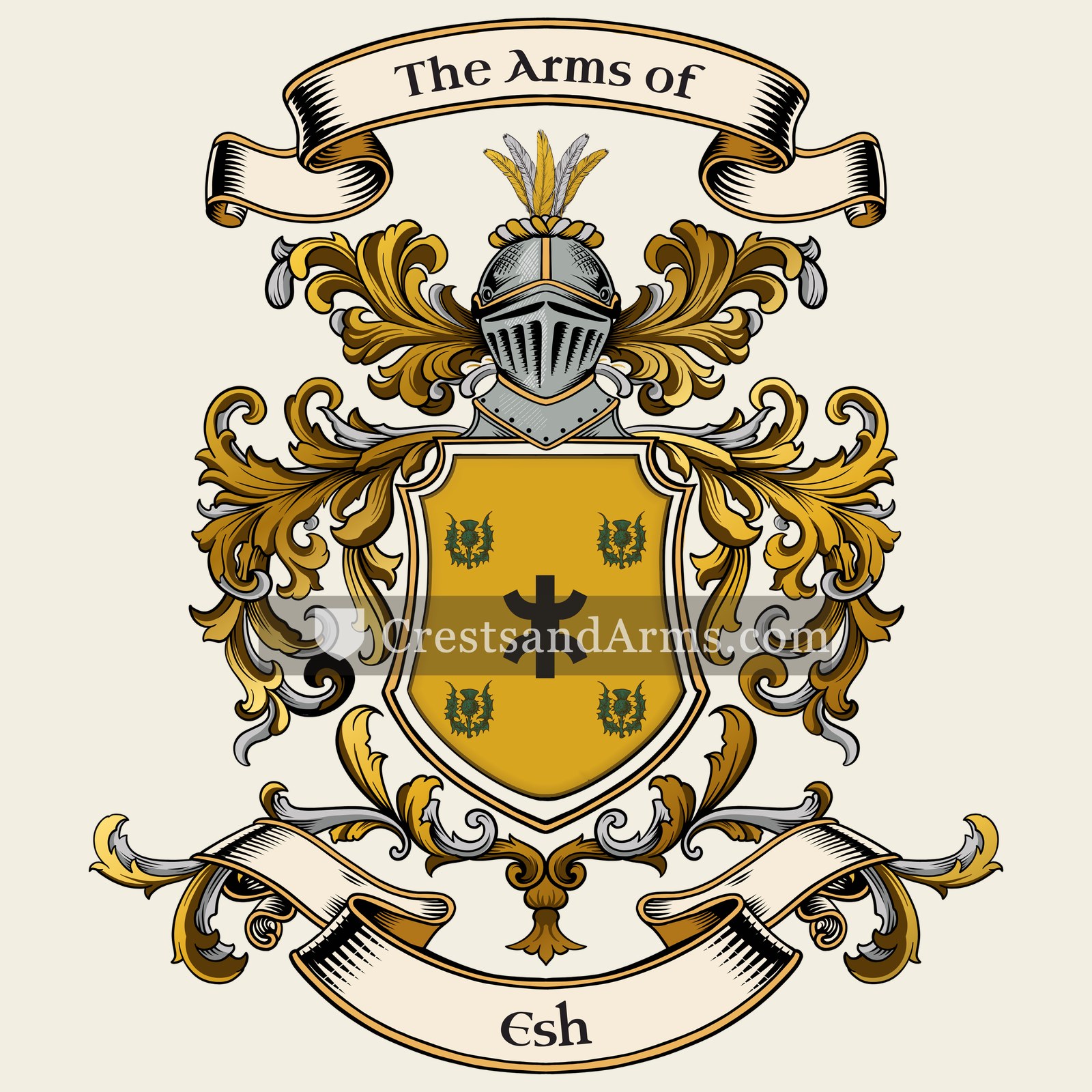
Symbols on this shield
millrind / fer de molineThe mill's iron, and the grinding of grain
plant thistleDefiance, and the defence of Scotland
Colours
Gold (Or)Means: Generosity
Black (Sable)Means: Constancy
Green (Vert)Means: Hope
Historical info
Source
J. B. Rietstap, Armorial Général, Gouda: G. B. van Goor Zonen, 1884–87
Blazon (the actual original written record)
“D'or à un fer-de-moulin de sa., cant. de quatre chardons fleuris de sin.”
LorraineLorraine, c. 1596
Digital archive packCoat of arms PNG, gold border print PDF, vector SVG and the certificate of authenticity. Sent to your email in minutes.
Map of France showing where the Esh arms are recorded
The Esh arms were recorded in Lorraine, c. 1596.
Lorraine sat on the border between France and the German lands, and border country bred soldiers. Families here held small estates and served in arms, and a fighting man was exactly the sort who carried a shield of his own.
This is where the arms were entered in the register. Families often moved to other parts of the country, so the same name can turn up in more than one region.
The body that granted and recorded arms in France in this period.
Henry IV of France
Sovereign of the period
Henry IV of France
1589–1610
Reigning in Germany when the Esh arms are first recorded.
How Arms Worked in France
In France, a coat of arms was a mark of honor that passed down through the male line to all legitimate descendants. Families often used the same shield without changes to show their shared heritage. If a branch wanted to stand out, they could add a small mark to their shield to show their specific place in the family tree.
Granting authority
The Juge d'armes de France acted as the official authority that regulated and verified coats of arms across the country.
How they got arms
Families typically inherited their arms from ancestors, though they could also receive them through royal grants or by proving their noble status.
Where arms were recorded
Coats of arms were officially recorded in the Armorial Général de France, which began its main collection in the year 1696.
The family's standing
Recorded among the armigerous families of Lorraine.
Origin & History of the Esh Family in France
The history of the Esh family in France is deeply rooted in the cultural landscape of the Lorraine region during the late sixteenth century. By 1596, records confirm that members of the family were established within this territory, which served as a vital crossroads between French and Germanic influences. During this era, the region was a duchy characterized by a mix of rural traditions and a growing administrative structure. Families like the Esh clan often lived in small, tight-knit communities where they contributed to the local agricultural economy and the social fabric of the countryside. Because Lorraine was a frequent site of political shifts and border changes, the family likely navigated a complex environment that required them to adapt to new legal and social standards. Their presence in the historical record at this time suggests they were part of the foundational population that helped shape the identity of the region before the major conflicts of the seventeenth century altered the lives of everyone living in the area.
Esh Meaning & Related Branches
Root word
Asch
Derived from the Germanic word for an ash tree.
This name
EshA topographic name for someone who lived near an ash tree or an ash forest.
also spelled
Escher
Esh
Documented Sources
J. B. Rietstap, Armorial Général, Gouda: G. B. van Goor Zonen, 1884–87
Bahlow, Hans, Deutsches Namenlexikon: Familien- und Vornamen nach Ursprung und Sinn erklärt, 1967
Udolph, Jürgen, Namenkunde: Erforschung und Erklärung der Namen, 2005
Landesarchiv Nordrhein-Westfalen, Kirchenbücher der Westfälischen Gemeinden
Digital archive packCoat of arms PNG, gold border print PDF, vector SVG and the certificate of authenticity. Sent to your email in minutes.


 cross symbolChristian faith and service
 escallopThe pilgrim's shell, and a long journey made
 cross symbolChristian faith and service
 escallopThe pilgrim's shell, and a long journey made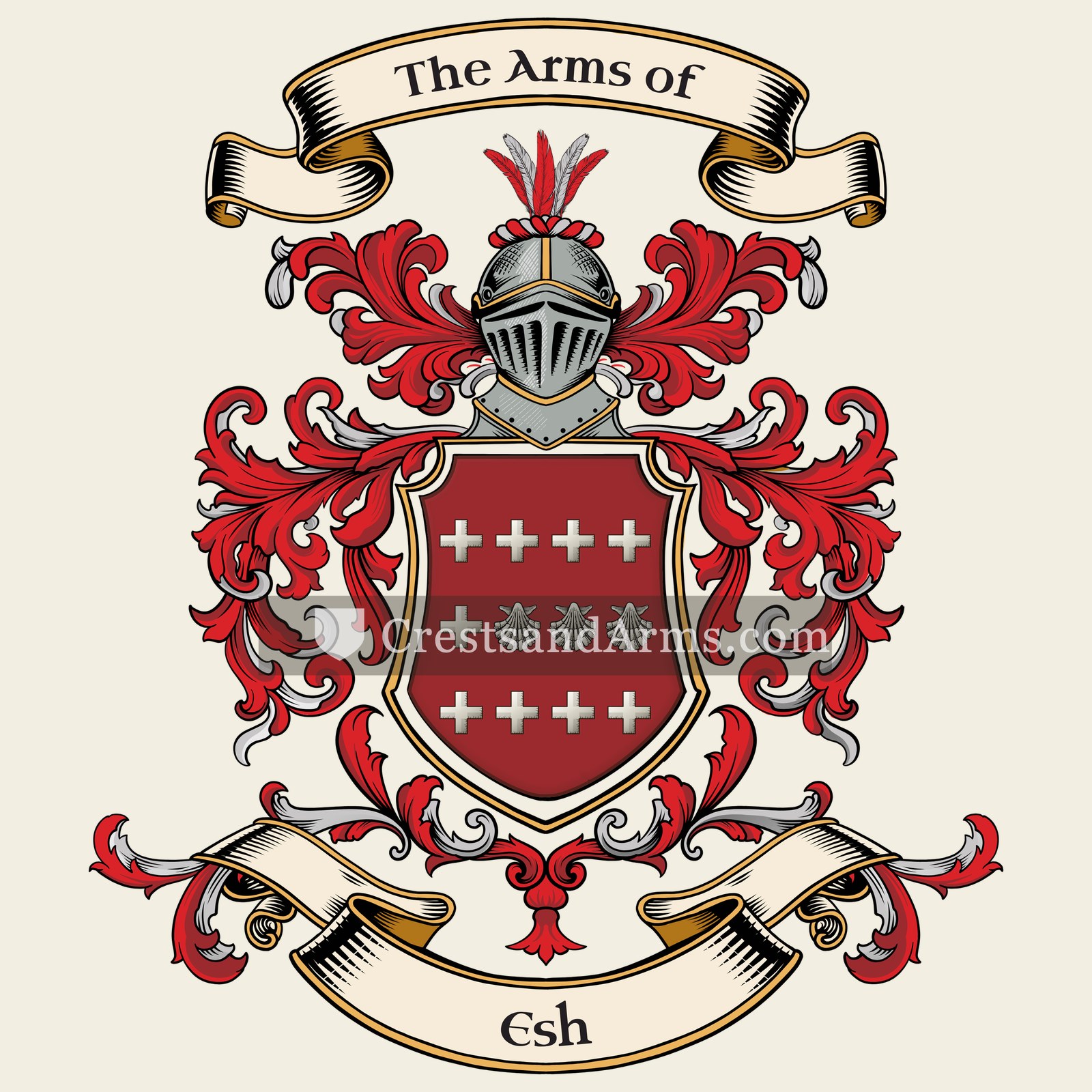


 millrind / fer de molineThe mill's iron, and the grinding of grain
 plant thistleDefiance, and the defence of Scotland