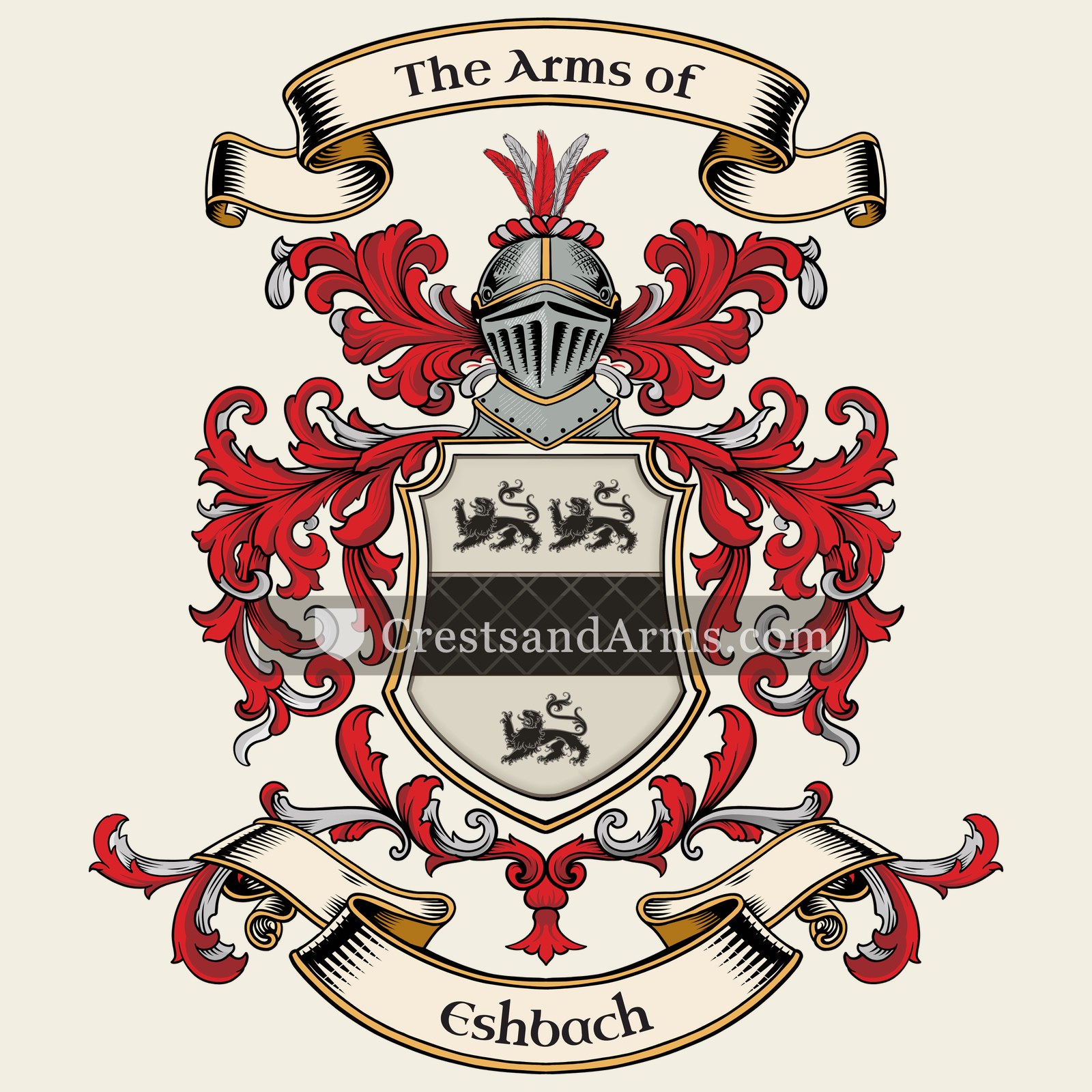
A record of documented arms, meaning and origin, researched for the Eshbach family of France.
Reg. 4002 · French, D–F
Coat of Arms & Family Crest Details
Symbols on this shield
fessThe military belt, and readiness to serve
lionCourage, strength and royalty
Colours
Silver (Argent)Means: Peace and sincerity
Black (Sable)Means: Constancy
Historical info
Source
J. B. Rietstap, Armorial Général, Gouda: G. B. van Goor Zonen, 1884–87
Blazon (the actual original written record)
“D'arg. à la fasce de sa., acc. de trois têtes de lion du même, cour. d'or. C.: une hure de sanglier de sa., défendue d'arg., languée de gu., le boutoir d'arg.”
AlsaceBreisgau · Alsace, c. 1663
Digital archive packCoat of arms PNG, gold border print PDF, vector SVG and the certificate of authenticity. Sent to your email in minutes.
Map of France showing where the Eshbach arms are recorded
The Eshbach arms were recorded in Alsace, c. 1663.
Alsace lay between France and the German lands and belonged to both at different times. Its families held small estates and served whichever side ruled, and men who served in arms carried arms of their own.
This is where the arms were entered in the register. Families often moved to other parts of the country, so the same name can turn up in more than one region.
The body that granted and recorded arms in France in this period.
Louis XIV of France
Sovereign of the period
Louis XIV of France
1643–1715
Reigning in France when the Eshbach arms are first recorded.
How Arms Worked in France
In France, a coat of arms was a mark of honor that passed down through the male line to all legitimate descendants. Families often used the same shield without changes to show their shared heritage. If a branch wanted to stand out, they could add a small mark to their shield to show their specific place in the family tree.
Granting authority
The Juge d'armes de France acted as the official authority that regulated and verified coats of arms across the country.
How they got arms
Families typically inherited their arms from ancestors, though they could also receive them through royal grants or by proving their noble status.
Where arms were recorded
Coats of arms were officially recorded in the Armorial Général de France, which began its main collection in the year 1696.
The family's standing
Recorded among the armigerous families of Alsace.
Origin & History of the Eshbach Family in France
The family name Eshbach originates from the German-speaking regions of Europe, specifically the area known as Alsace. Historical records confirm that members of the family were living in this region by 1663. The name itself is topographical, meaning it was likely derived from the landscape where the family first settled. It is composed of the German words "Esche," meaning ash tree, and "Bach," meaning a stream or brook. This suggests that the earliest ancestors probably lived near a small creek lined with ash trees. Over time, families with this name became well-established in the rural communities of the Upper Rhine Valley, where they worked primarily as farmers and craftsmen. As the population grew, many individuals carrying the name eventually migrated to other parts of Europe and eventually to North America in search of new opportunities.
Eshbach Meaning & Related Branches
Root word
Eschbach
Germanic roots meaning ash tree and brook or stream.
This name
EshbachA topographic name for someone who lived near a stream lined with ash trees.
also spelled
Eschback
Eshbach
Eshbak
Documented Sources
J. B. Rietstap, Armorial Général, Gouda: G. B. van Goor Zonen, 1884–87
Bahlow, Hans. Deutsches Namenlexikon: Familien- und Vornamen nach Ursprung und Sinn erklärt. 1967
Brechenmacher, Josef Karlmann. Etymologisches Wörterbuch der deutschen Familiennamen. 1957
Archives départementales du Bas-Rhin, Registres paroissiaux et d'état civil
Digital archive packCoat of arms PNG, gold border print PDF, vector SVG and the certificate of authenticity. Sent to your email in minutes.


 fessThe military belt, and readiness to serve
 lionCourage, strength and royalty
 fessThe military belt, and readiness to serve
 lionCourage, strength and royalty