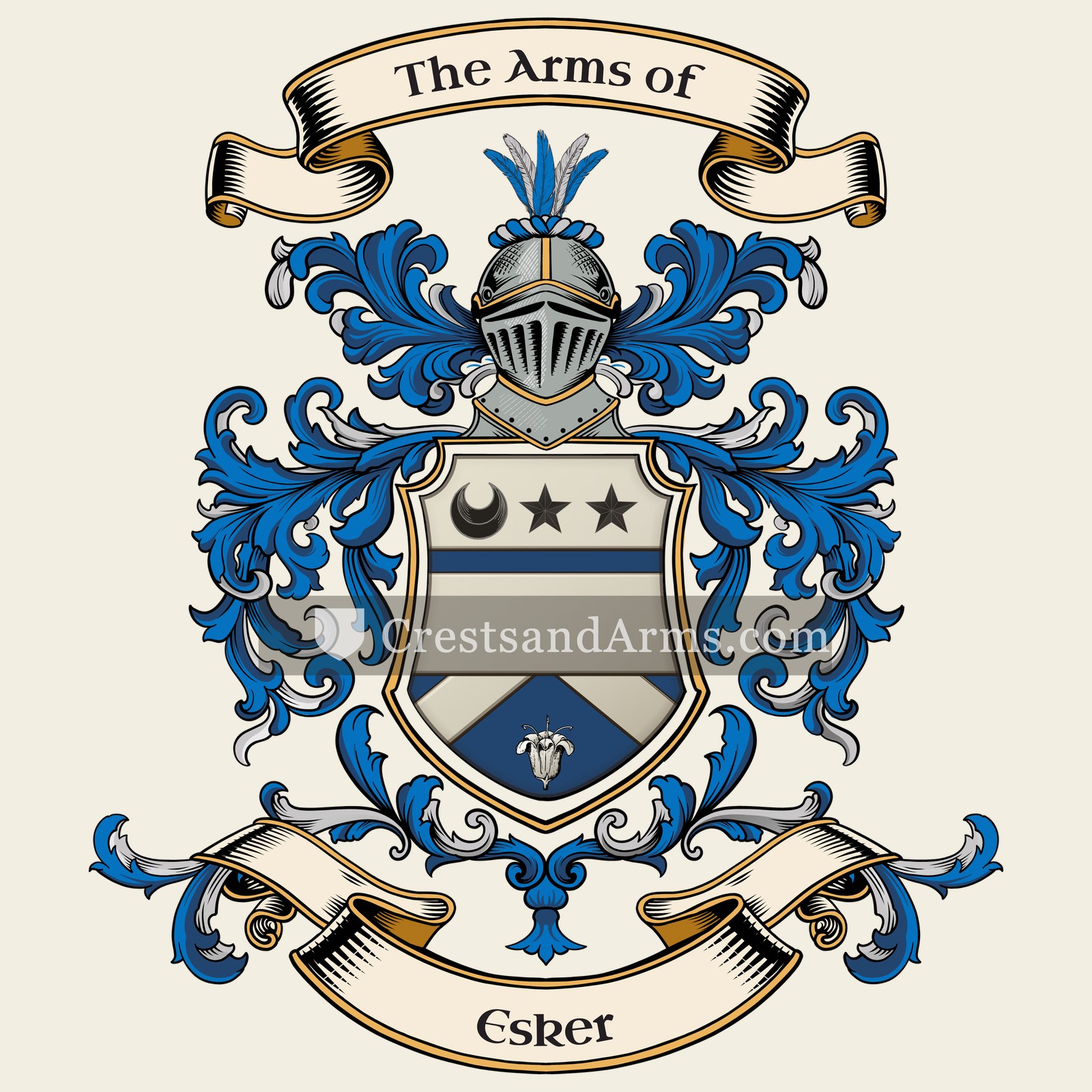
A record of documented arms, meaning and origin, researched for the Esker family of France.
Reg. 6184 · French, D–F
Coat of Arms & Family Crest Details
Symbols on this shield
chevronProtection, and faithful service completed
chiefAuthority, wisdom and dominion
lilyPurity and the promise of resurrection
crescentHonour by the sovereign, and the second son
mulletThe third son, and a divine quality from above
Colours
Blue (Azure)Means: Loyalty and truth
Silver (Argent)Means: Peace and sincerity
Historical info
Source
J. B. Rietstap, Armorial Général, Gouda: G. B. van Goor Zonen, 1884–87
Blazon (the actual original written record)
“D'azur au chev., acc. en p. d'un lis de jardin tigé et feuillé, le tout d'arg.; au chef d'azur, soutenu d'une divise d'arg. et ch. d'un croiss. du même, entre deux étoiles aussi d'arg.”
FranceToulouse, c. 1663
Digital archive packCoat of arms PNG, gold border print PDF, vector SVG and the certificate of authenticity. Sent to your email in minutes.
Map of France showing where the Esker arms are recorded
The Esker arms were recorded in Toulouse, c. 1663.
This is where the arms were entered in the register. Families often moved to other parts of the country, so the same name can turn up in more than one region.
The body that granted and recorded arms in France in this period.
Louis XIV of France
Sovereign of the period
Louis XIV of France
1643–1715
Reigning in France when the Esker arms are first recorded.
How Arms Worked in France
In France, a coat of arms was a mark of honor that passed down through the male line to all legitimate descendants. Families often used the same shield without changes to show their shared heritage. If a branch wanted to stand out, they could add a small mark to their shield to show their specific place in the family tree.
Granting authority
The Juge d'armes de France acted as the official authority that regulated and verified coats of arms across the country.
How they got arms
Families typically inherited their arms from ancestors, though they could also receive them through royal grants or by proving their noble status.
Where arms were recorded
Coats of arms were officially recorded in the Armorial Général de France, which began its main collection in the year 1696.
The family's standing
Recorded among the armigerous families of France.
Origin & History of the Esker Family in France
The surname Esker carries a rich history that traces back to the vibrant cultural landscape of seventeenth-century France. By 1663, records confirm that family members were firmly established in the city of Toulouse, a major hub of trade and intellectual life in the Languedoc region. During this era, the name likely emerged from the linguistic traditions of southern France, potentially reflecting the local Occitan dialect or the specific geographical features of the area. Families in Toulouse at this time were often deeply involved in the guilds and merchant classes that defined the city’s economy. As the family navigated the social shifts of the late 1600s, they contributed to the local community through their professional roles and daily lives in the shadow of the city’s historic cathedrals. This early presence in such a prominent urban center suggests that the family was well-integrated into the fabric of French society long before the name spread to other parts of the world.
Esker Meaning & Related Branches
Root word
Eschier
Old French term referring to a person who guards or watches.
This name
EskerA topographic or occupational name derived from a sentinel or someone living near a lookout point.
also spelled
Esquer
Esker
Documented Sources
J. B. Rietstap, Armorial Général, Gouda: G. B. van Goor Zonen, 1884–87
Archives départementales de la Haute-Garonne, Registres paroissiaux et d'état civil de Toulouse, 1663
Wolff, Philippe, Histoire de Toulouse, 1974
Digital archive packCoat of arms PNG, gold border print PDF, vector SVG and the certificate of authenticity. Sent to your email in minutes.


 chevronProtection, and faithful service completed
 chiefAuthority, wisdom and dominion
 lilyPurity and the promise of resurrection
 crescentHonour by the sovereign, and the second son
 mulletThe third son, and a divine quality from above
 chevronProtection, and faithful service completed
 chiefAuthority, wisdom and dominion
 lilyPurity and the promise of resurrection
 crescentHonour by the sovereign, and the second son
 mulletThe third son, and a divine quality from above