Map of France showing where the Esparza arms are recorded
The Esparza arms were recorded in Navarre, c. 1663.
Navarre was mountain country straddling the Pyrenees, with a strong class of small independent landholders. A great many households counted as gentry there, and each needed a shield to be told apart.
This is where the arms were entered in the register. Families often moved to other parts of the country, so the same name can turn up in more than one region.
The body that granted and recorded arms in France in this period.
Louis XIV of France
Sovereign of the period
Louis XIV of France
1643–1715
Reigning in France when the Esparza arms are first recorded.
How Arms Worked in France
In France, a coat of arms was a mark of honor that passed down through the male line to all legitimate descendants. Families often used the same shield without changes to show their shared heritage. If a branch wanted to stand out, they could add a small mark to their shield to show their specific place in the family tree.
Granting authority
The Juge d'armes de France acted as the official authority that regulated and verified coats of arms across the country.
How they got arms
Families typically inherited their arms from ancestors, though they could also receive them through royal grants or by proving their noble status.
Where arms were recorded
Coats of arms were officially recorded in the Armorial Général de France, which began its main collection in the year 1696.
The family's standing
Recorded among the armigerous families of Navarre.
Origin & History of the Esparza Family in France
The surname Esparza originates from the Basque region of northern Spain, specifically taking its name from the town of Esparza located in the historical Kingdom of Navarre. In the Basque language, the name is derived from the words "ezpaba" and "artza," which together describe a place characterized by an abundance of esparto grass or a rocky, rugged terrain. By the mid-17th century, families bearing this name were well-established in the Navarrese landscape, where they lived as part of the local agrarian society. These early ancestors were deeply connected to the mountain valleys of the Pyrenees, where they maintained their family identity through generations of regional life. As the family grew, members began to migrate from these rural settlements into larger administrative centers, carrying the name across the Iberian Peninsula and eventually into the Americas.
Esparza Meaning & Related Branches
Root word
aspar
A Basque term referring to a broom or a type of shrub.
This name
EsparzaA topographic name for someone who lived near a place where broom plants grew.
also spelled
Esparsa
Esparxa
Related arms
Medranorecorded with Esparza, same area
Mergelinarecorded with Esparza, same area
Mirandarecorded with Esparza, same area
Documented Sources
J. B. Rietstap, Armorial Général, Gouda: G. B. van Goor Zonen, 1884–87
Mikel Belasko, Diccionario etimológico de los nombres de los pueblos, villas y ciudades de Navarra, 1999
Endika de Mogrobejo, Diccionario hispano-americano de heráldica, onomástica y genealogía, 1995
Archivo General de Navarra, Sección de Procesos Judiciales, 1663
Digital archive packCoat of arms PNG, gold border print PDF, vector SVG and the certificate of authenticity. Sent to your email in minutes.


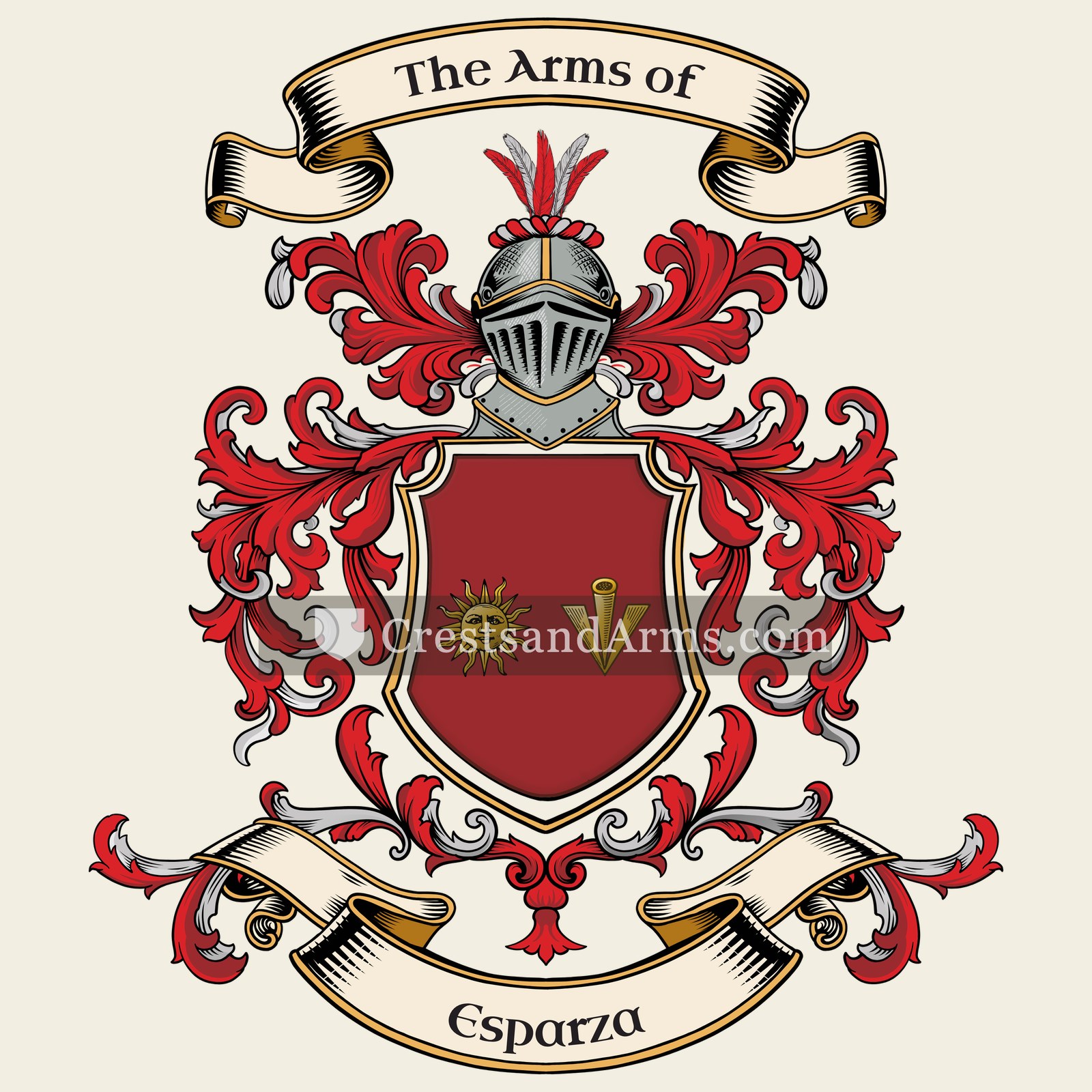
 sunGlory, splendour and the source of life
 arrowReadiness for battle, and affliction endured
 sunGlory, splendour and the source of life
 arrowReadiness for battle, and affliction endured