Map of Belgium showing where the Espin arms are recorded
The Espin arms were recorded in Tournaisis, c. 1737.
This is where the arms were entered in the register. Families often moved to other parts of the country, so the same name can turn up in more than one region.
The body that granted and recorded arms in Belgium in this period.
Charles VI, Holy Roman Emperor
Sovereign of the period
Charles VI, Holy Roman Emperor
1711–1740
Reigning in Belgium when the Espin arms are first recorded.
How Arms Worked in Belgium
In Belgium, a coat of arms is considered personal property that is passed down through the male line to legitimate descendants. Families often use the same shield design across generations to show their shared heritage. If a branch of the family wants to change the design, they must apply for an official update to their specific version of the arms.
Granting authority
The Conseil héraldique is the official body that regulates and approves all coats of arms in Belgium.
How they got arms
Families obtain their coats of arms through formal royal grants or by confirming their historical right to use existing designs.
Where arms were recorded
All approved coats of arms are officially recorded in the public registers of the Conseil héraldique since 1844.
The family's standing
Recorded among the armigerous families of Belgium.
Origin & History of the Espin Family in Belgium
The family name Espin has deep roots in the region of Tournaisis, a historic area in modern-day Belgium that was once a crossroads of cultural and political influence. Records confirm that members of the family were established in this territory by 1737, living during a time when the region was transitioning between different European powers. The name itself likely evolved from local dialects and geographic descriptions, as families in this part of the Low Countries often took names based on the landscape or their specific trade. Living in Tournaisis meant the family was part of a vibrant community known for its textile production and strategic importance. Over the generations, these early ancestors helped shape the local social fabric by participating in the agricultural and civic life of the province. Their presence in the 18th century highlights a long tradition of stability and regional identity that defines the early history of the Espin name in Belgium.
Coat of Arms & Family Crest Details
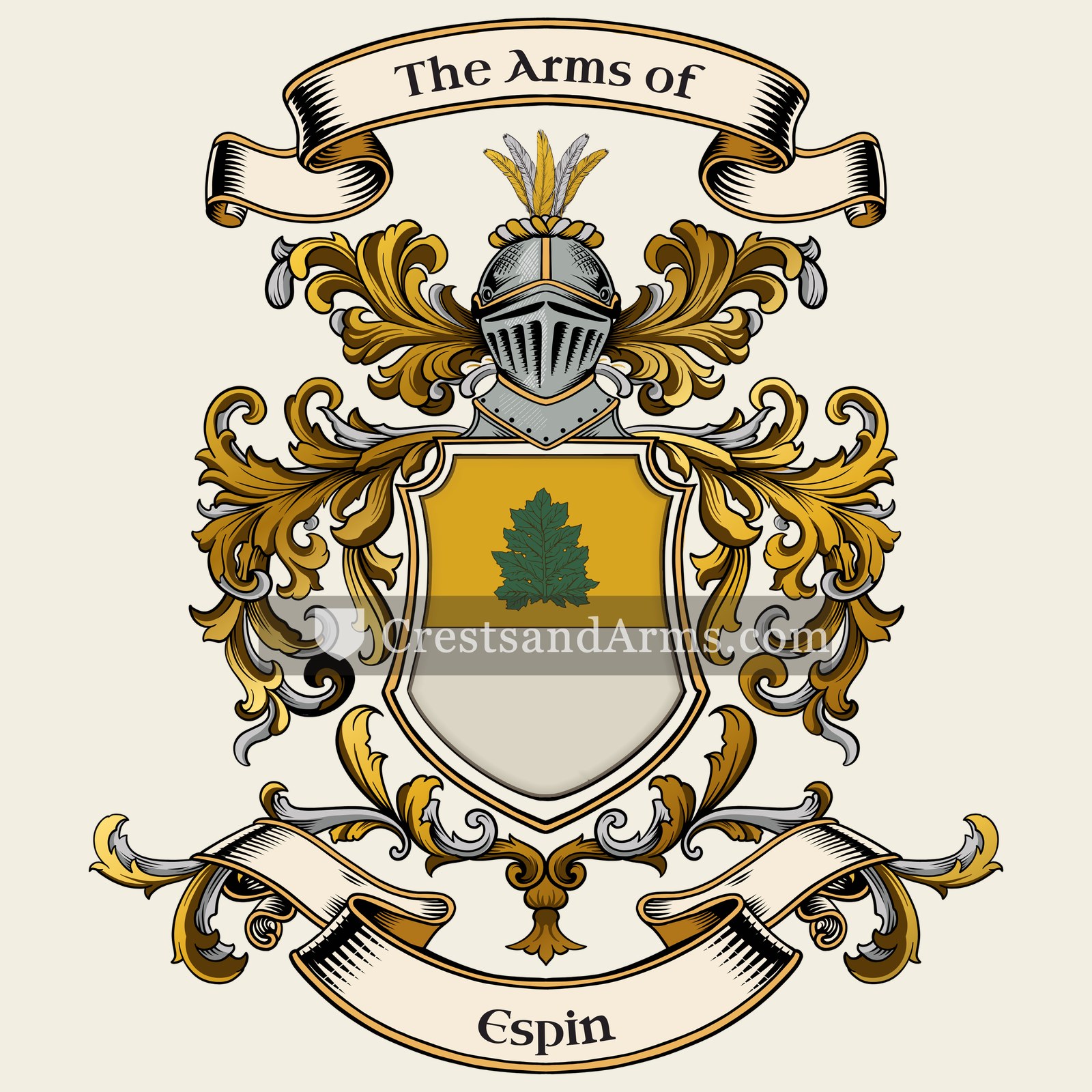
Symbols on this shield
chequyConstancy, and the counting-board
leafHappiness and abundance
Colours
Gold (Or)Means: Generosity
Silver (Argent)Means: Peace and sincerity
Green (Vert)Means: Hope
Red (Gules)Means: Military strength
Historical info
Source
J. B. Rietstap, Armorial Général, Gouda: G. B. van Goor Zonen, 1884–87
Blazon (the actual original written record)
“Coupé: au 1 d'or à une épine de sin. (en forme de tau); au 2 échiq. d'arg. et de gu.”
SpainMurcie, c. 1722
Digital archive packCoat of arms PNG, gold border print PDF, vector SVG and the certificate of authenticity. Sent to your email in minutes.
Map of Spain showing where the Espin arms are recorded
The Espin arms were recorded in Murcie, c. 1722.
This is where the arms were entered in the register. Families often moved to other parts of the country, so the same name can turn up in more than one region.
The body that granted and recorded arms in Spain in this period.
Philip V of Spain
Sovereign of the period
Philip V of Spain
1714–1724
Reigning in Belgium when the Espin arms are first recorded.
How Arms Worked in Spain
In Spain, a coat of arms was considered a form of property that belonged to the entire family line. These arms were passed down from a father to all his children equally. Younger branches of the family usually kept the original design without needing to add any special marks to distinguish their specific line.
Granting authority
The Cronista Rey de Armas was the official body that regulated and granted coats of arms throughout Spain.
How they got arms
Families often obtained their arms through royal grants or by proving their noble status to the official heraldic authority.
Where arms were recorded
Coats of arms were officially recorded in the registers of the Cronista Rey de Armas starting in 1496.
The family's standing
Recorded among the armigerous families of Spain.
Origin & History of the Espin Family in Spain
The surname Espin is deeply rooted in the geography of southeastern Spain, particularly within the region of Murcia. The name is derived from the Spanish word espino, which refers to a hawthorn bush or a place where thorny shrubs grow. This suggests that the family likely originated as people who lived near a prominent landmark or a specific patch of wild vegetation. By the early 18th century, records confirm that the Espin family was well-established in Murcia, a city known for its rich agricultural history and complex irrigation systems developed during the medieval period. Families like the Espins were often part of the local social fabric that managed these lands, contributing to the growth of the region through farming and trade. As the family settled into their community, they became part of the local administrative life, leaving behind traces in baptismal and marriage registers that document their steady presence in the Spanish countryside.
Espin Meaning & Related Branches
Root word
spina
Latin term meaning thorn or prickle.
This name
EspinA topographic name for someone who lived near a thorn bush or a thorny thicket.
also spelled
Espyn
Espine
Documented Sources
J. B. Rietstap, Armorial Général, Gouda: G. B. van Goor Zonen, 1884–87
Archives de l'État à Tournai, Registres paroissiaux du Tournaisis, 1737
Dion, R., Histoire des frontières de France, 1947
Rolland, P., Histoire de Tournai, 1956
Digital archive packCoat of arms PNG, gold border print PDF, vector SVG and the certificate of authenticity. Sent to your email in minutes.


 bendDefence, and the scarf of a commander
 bendDefence, and the scarf of a commander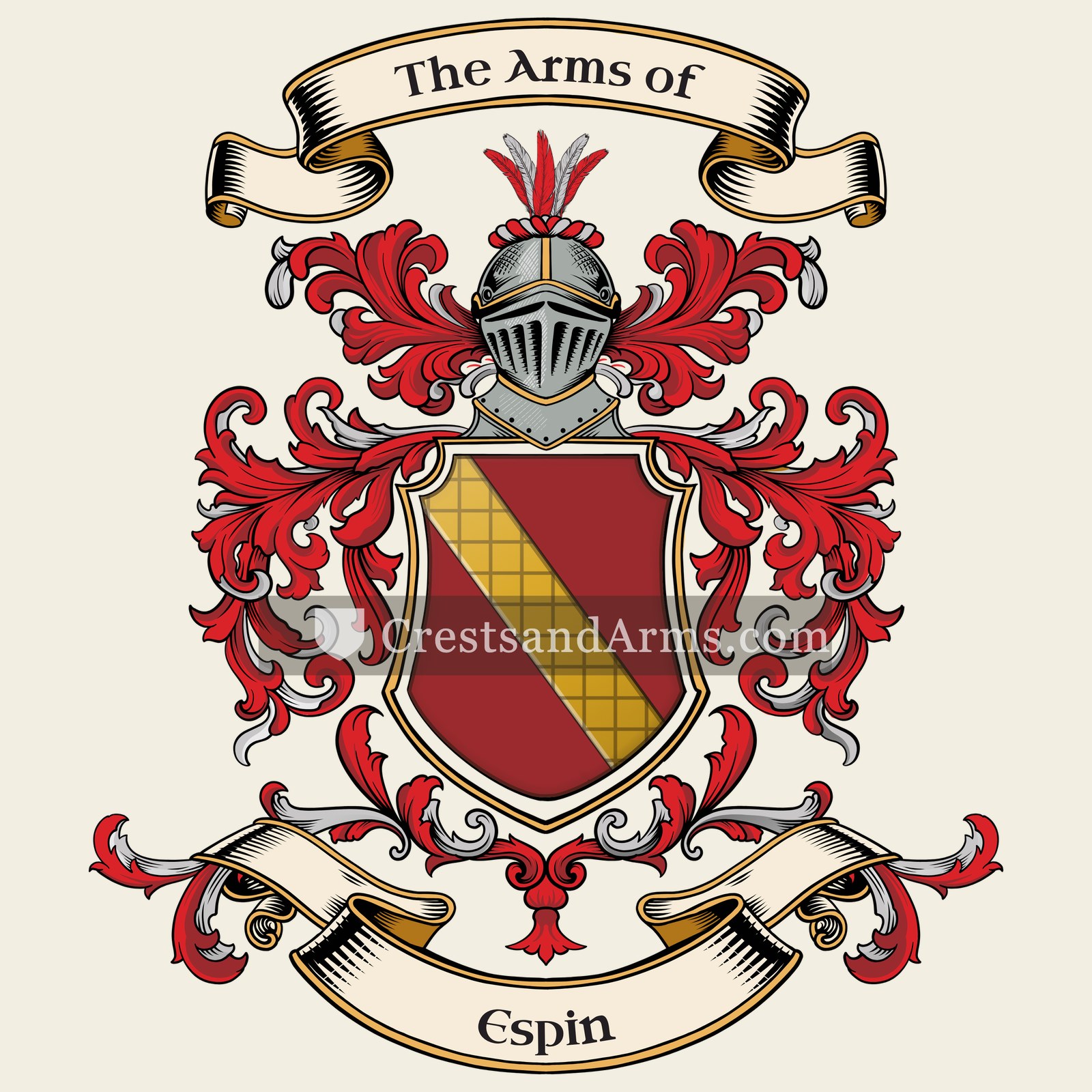


 chequyConstancy, and the counting-board
 leafHappiness and abundance