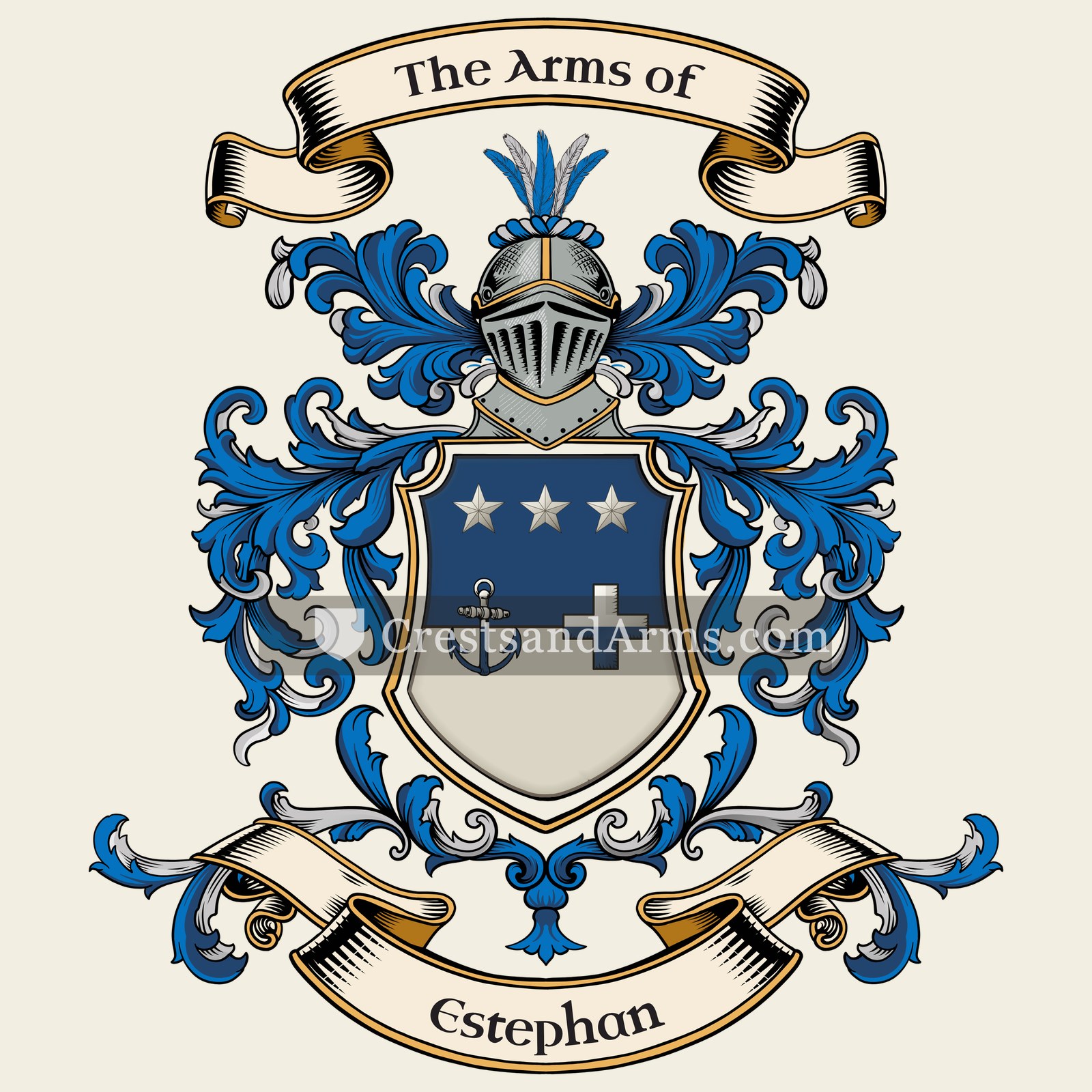
A record of documented arms, meaning and origin, researched for the Estephan family of Austria.
Reg. 9138 · Austrian, D–F
Coat of Arms & Family Crest Details
Symbols on this shield
cross symbolChristian faith and service
saltireResolution, and St Andrew's cross
anchorHope, and steadfastness in trouble
mulletThe third son, and a divine quality from above
Colours
Blue (Azure)Means: Loyalty and truth
Silver (Argent)Means: Peace and sincerity
Historical info
Source
J. B. Rietstap, Armorial Général, Gouda: G. B. van Goor Zonen, 1884–87
Blazon (the actual original written record)
“Coupé d'azur sur arg.; à une ancre en barre et une croix latine en bande, passées en saut., br. sur le tout, de l'un en l'autre; acc. en chef de trois étoiles mal-ordonnées d'arg. C.: un vol, l'aile dextre d'azur, ch. d'une croix latine d'arg., l'aile sen. d'arg., ch. d'une ancre d'azur.”
AustriaReichersberg Aut, c. 1772
Digital archive packCoat of arms PNG, gold border print PDF, vector SVG and the certificate of authenticity. Sent to your email in minutes.
Map of Austria showing where the Estephan arms are recorded
The Estephan arms were recorded in Reichersberg Aut, c. 1772.
This is where the arms were entered in the register. Families often moved to other parts of the country, so the same name can turn up in more than one region.
Region
Reichersberg Aut
Town
Reichersberg Aut
First recorded
1772
Granting Authority for the Estephan Arms
Imperial and Royal chancery
Sodacan · CC BY-SA 3.0
The body that granted and recorded arms in Austria in this period.
Joseph II, Holy Roman Emperor
Sovereign of the period
Joseph II, Holy Roman Emperor
1765–1790
Reigning in Austria when the Estephan arms are first recorded.
How Arms Worked in Austria
Austrian coats of arms were often linked directly to noble titles granted by the Emperor. These symbols belonged to the entire family line rather than just one individual. When a family grew, new branches kept the original design without needing to change it. This system allowed all members of a noble house to share the same identity across many generations.
Granting authority
The Imperial and Royal chancery managed all heraldic matters and controlled the official granting of arms throughout the Austrian lands.
How they got arms
Families typically received their arms through a formal imperial decree that often accompanied the elevation of a person to noble status.
Where arms were recorded
Official records of these grants were kept in the Imperial Register of Nobility which began its formal documentation process in 1453.
The family's standing
Recorded among the armigerous families of Austria.
Origin & History of the Estephan Family in Austria
The surname Estephan carries a rich history that traces back to the linguistic roots of the name Stephen, which originates from the Greek word *stephanos*, meaning crown or garland. By the late 18th century, records confirm that members of the family were firmly established in the town of Reichersberg, located in the Upper Austrian region. During this period, Reichersberg was a center of religious and agricultural life, dominated by the historic Augustinian monastery that influenced the local community. Families living in this area were often tied to the land or the administrative functions of the church, and the presence of the Estephan name suggests they were part of this stable, rural society. Over time, the name evolved through local dialects and regional record-keeping practices, eventually solidifying into the spelling used today. This transition from a common given name to a formal family surname reflects the broader European trend of identifying lineages through fixed hereditary names during the late 1700s.
Related Branches & Arms
Root word
Stephanos
Greek word meaning crown or garland.
This name
EstephanA variant of Stephen, signifying one who is crowned with victory or honor.
also spelled
Stefan
Steffan
Stephen
Documented Sources
J. B. Rietstap, Armorial Général, Gouda: G. B. van Goor Zonen, 1884–87
Oberösterreichisches Landesarchiv, Pfarrmatriken der Pfarre Reichersberg, 1772
Heimatverein Reichersberg, Reichersberg: Geschichte und Gegenwart, 1995
Digital archive packCoat of arms PNG, gold border print PDF, vector SVG and the certificate of authenticity. Sent to your email in minutes.


 cross symbolChristian faith and service
 saltireResolution, and St Andrew's cross
 anchorHope, and steadfastness in trouble
 mulletThe third son, and a divine quality from above
 cross symbolChristian faith and service
 saltireResolution, and St Andrew's cross
 anchorHope, and steadfastness in trouble
 mulletThe third son, and a divine quality from above