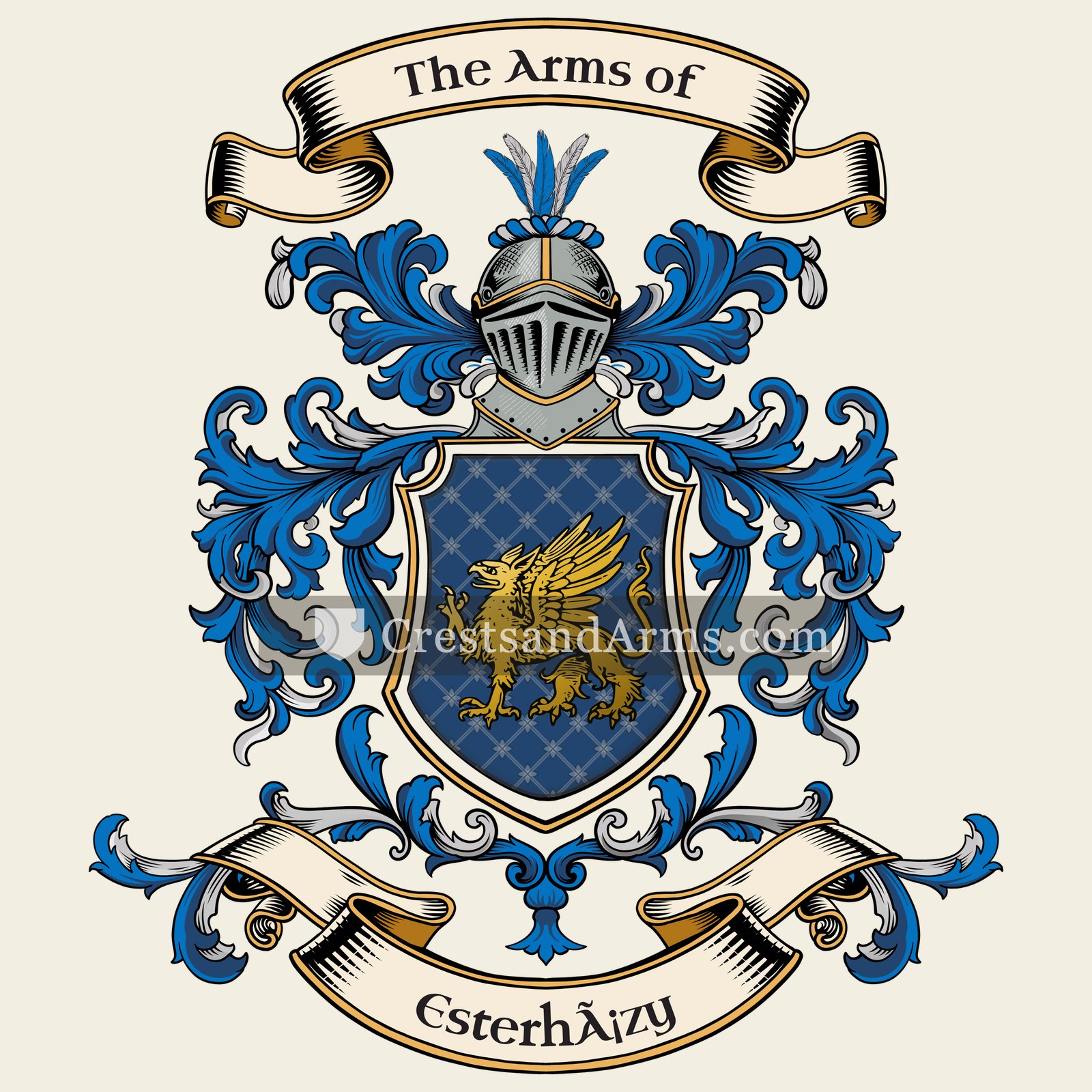
A record of documented arms, meaning and origin, researched for the Esterházy family of Austria.
Reg. 8461 · Austrian, D–F
Coat of Arms & Family Crest Details
Symbols on this shield
griffinValour and vigilance, guarding great treasure
Colours
Blue (Azure)Means: Loyalty and truth
Gold (Or)Means: Generosity
Historical info
Source
J. B. Rietstap, Armorial Général, Gouda: G. B. van Goor Zonen, 1884–87
Blazon (the actual original written record)
“D'azur à un griffon cour., soutenu d'une couronne, le tout d'or, tenant de sa patte dextre un sabre d'arg., garni d'or, et de sa sen. une branche de rosier feuillée de sin., fleurie de trois pièces de gu. C.: le griffon, iss.”
Austriac. 1772
Digital archive packCoat of arms PNG, gold border print PDF, vector SVG and the certificate of authenticity. Sent to your email in minutes.
Map of Austria showing where the Esterházy arms are recorded
The Esterházy arms were recorded in Austria, c. 1772.
Arms such as these were typically recorded in Tyrol.
Tyrol was mountain country in western Austria, where the valleys were held by families who had been there a very long time. Old tenure counted for more than money, and old families carried arms.
This is where the arms were entered in the register. Families often moved to other parts of the country, so the same name can turn up in more than one region.
Region
Tyrol
First recorded
1772
Granting Authority for the Esterházy Arms
Imperial and Royal chancery
Sodacan · CC BY-SA 3.0
The body that granted and recorded arms in Austria in this period.
Joseph II, Holy Roman Emperor
Sovereign of the period
Joseph II, Holy Roman Emperor
1765–1790
Reigning in Austria when the Esterházy arms are first recorded.
How Arms Worked in Austria
Austrian coats of arms were often linked directly to noble titles granted by the Emperor. These symbols belonged to the entire family line rather than just one individual. When a family grew, new branches kept the original design without needing to change it. This system allowed all members of a noble house to share the same identity across many generations.
Granting authority
The Imperial and Royal chancery managed all heraldic matters and controlled the official granting of arms throughout the Austrian lands.
How they got arms
Families typically received their arms through a formal imperial decree that often accompanied the elevation of a person to noble status.
Where arms were recorded
Official records of these grants were kept in the Imperial Register of Nobility which began its formal documentation process in 1453.
The family's standing
Recorded among the armigerous families of Austria.
Origin & History of the Esterházy Family in Austria
The history of the Esterházy family begins in the region of Tyrol, where early ancestors were documented as living in the year 1772. While the family later became famous for their immense influence in Hungary, their roots trace back to these mountainous lands. The name itself is thought to have evolved from the older family name Zerhas, which was linked to landholdings and local administrative roles. Over several generations, the family moved from their original home in the west toward the eastern territories of the Habsburg Empire. They gradually rose in status by serving as loyal officials and military leaders for the crown. This transition from regional landowners in Tyrol to powerful aristocrats in the Hungarian plains defined their legacy for centuries.
Esterházy Meaning & Related Branches
Root word
Eszter
A Hungarian form of the name Esther meaning star.
This name
EsterházyDerived from the Hungarian word for the star-shaped plant, the aster.
also spelled
Esterhasi
Esterhazi
Documented Sources
J. B. Rietstap, Armorial Général, Gouda: G. B. van Goor Zonen, 1884–87
Esterházy, Pál, Az Esterházy család története, 1901
Iványi, Béla, Az Esterházy-család története a XVII. században, 1941
Magyar Nemzeti Levéltár (Hungarian National Archives), Esterházy család hercegi ágának levéltára (Archives of the Princely Branch of the Esterházy Family)
Digital archive packCoat of arms PNG, gold border print PDF, vector SVG and the certificate of authenticity. Sent to your email in minutes.


 griffinValour and vigilance, guarding great treasure
 griffinValour and vigilance, guarding great treasure