Map of France showing where the Etienne arms are recorded
The Etienne arms were recorded in Lorraine, c. 1663.
Lorraine sat on the border between France and the German lands, and border country bred soldiers. Families here held small estates and served in arms, and a fighting man was exactly the sort who carried a shield of his own.
This is where the arms were entered in the register. Families often moved to other parts of the country, so the same name can turn up in more than one region.
The body that granted and recorded arms in France in this period.
Louis XIV of France
Sovereign of the period
Louis XIV of France
1643–1715
Reigning in France when the Etienne arms are first recorded.
How Arms Worked in France
In France, a coat of arms was a mark of honor that passed down through the male line to all legitimate descendants. Families often used the same shield without changes to show their shared heritage. If a branch wanted to stand out, they could add a small mark to their shield to show their specific place in the family tree.
Granting authority
The Juge d'armes de France acted as the official authority that regulated and verified coats of arms across the country.
How they got arms
Families typically inherited their arms from ancestors, though they could also receive them through royal grants or by proving their noble status.
Where arms were recorded
Coats of arms were officially recorded in the Armorial Général de France, which began its main collection in the year 1696.
The family's standing
Recorded among the armigerous families of Lorraine.
Origin & History of the Etienne Family in France
The surname Etienne originates from the ancient Greek name Stephanos, which translates to crown or garland. In France, the name evolved into a common given name before eventually becoming a hereditary surname during the Middle Ages. By the mid-17th century, the family established a notable presence in the Lorraine region, a territory then defined by its complex political status between the French Kingdom and the Holy Roman Empire. Records from 1663 confirm that members of the Etienne family were settled in this area, living through a period of significant transition as the region moved toward deeper integration with France. Because Lorraine was a crossroads for trade and migration, the family likely lived in a society that valued agricultural labor and local craftsmanship. This historical context suggests that the early Etienne family members were part of the hardworking rural population that formed the backbone of the French provinces during the reign of King Louis XIV.
Coat of Arms & Family Crest Details
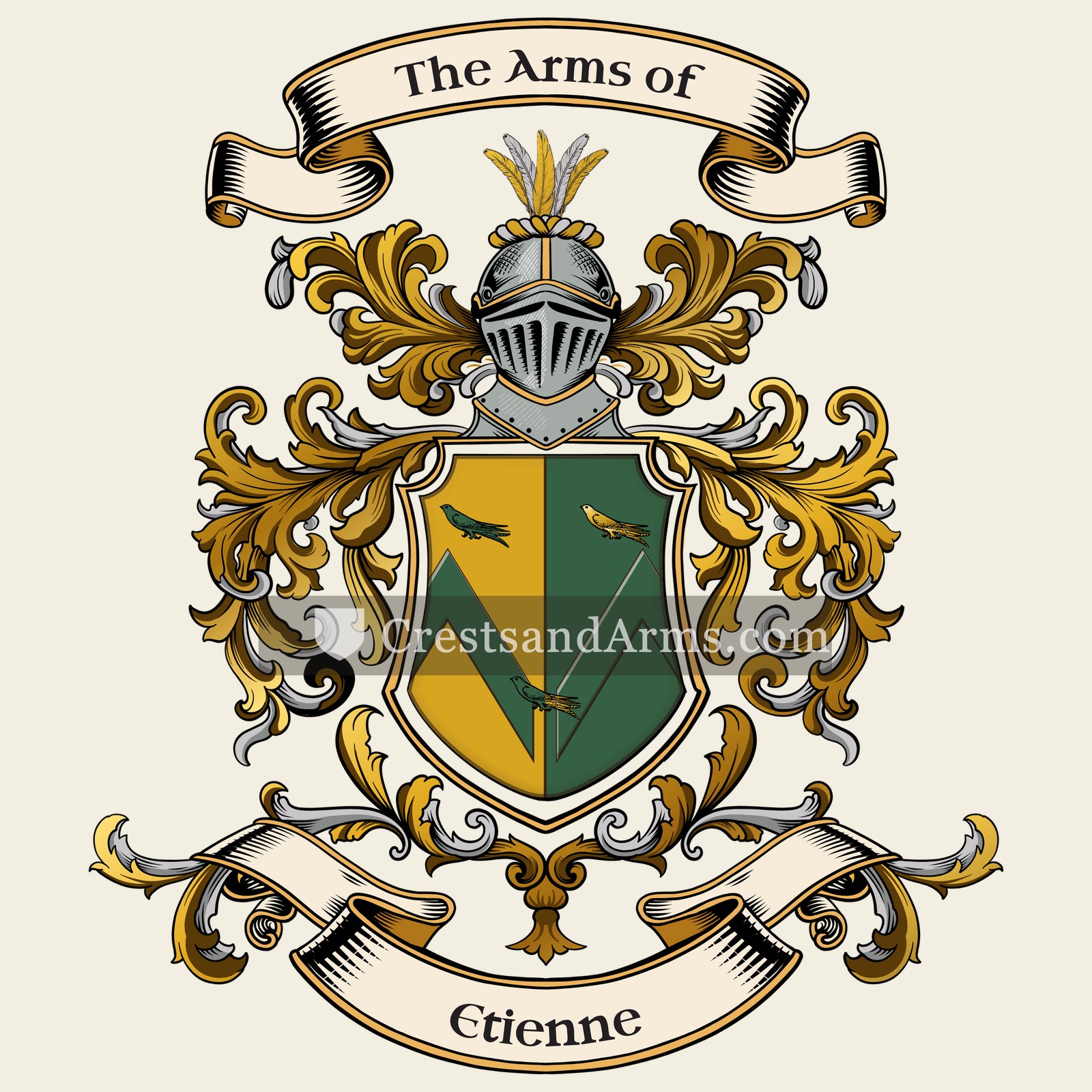
Symbols on this shield
chevronProtection, and faithful service completed
martletA younger son, who must win his own land
Colours
Gold (Or)Means: Generosity
Green (Vert)Means: Hope
Historical info
Source
Sir Bernard Burke, The General Armory of England, Scotland, Ireland and Wales, London: Harrison & Sons, 1884
Blazon (the actual original written record)
“Per pale or and vert a chev. betw. three Cornish choughs counterchanged”
GuernseyGuernsey, c. 1688
Digital archive packCoat of arms PNG, gold border print PDF, vector SVG and the certificate of authenticity. Sent to your email in minutes.
The body that granted and recorded arms in Guernsey in this period.
James II of England
Sovereign of the period
James II of England
1685–1688
Reigning in France when the Etienne arms are first recorded.
How Arms Worked in Guernsey
Arms in the Channel Islands were granted and recorded by the College of Arms in London, under the same law of arms as England. They could be used by all legitimate descendants of the original owner: the eldest son kept the original design, and other family members used the same shield without registering a version of their own.
Granting authority
The College of Arms in London has regulated the use of coats of arms for Guernsey and the other Channel Islands since 1484.
How they got arms
Families typically obtained their coats of arms through a formal grant from the Crown or by proving their ancient right to them.
Where arms were recorded
All official coats of arms are recorded in the registers kept at the College of Arms, which date back to the fifteenth century.
The family's standing
Recorded among the armigerous families of Guernsey.
Origin & History of the Etienne Family in Guernsey
The Etienne family name has deep roots in the island of Guernsey, where members of the lineage were officially documented as residents by 1688. The name itself is a French variation of Stephen, which translates to crown or garland. During the late 17th century, the island served as a unique cultural bridge between England and France, allowing families like the Etiennes to maintain strong connections to their continental heritage while living under the British Crown. Historical records from this period suggest that the family was likely integrated into the island's tight-knit maritime and agricultural communities. Because Guernsey was a strategic location for trade and defense, the Etiennes would have navigated a life defined by the shifting political tides of the English Channel. Their presence in the parish records of the late 1600s confirms that they were among the established families who helped shape the local customs and social fabric of the island during a time of significant transition.
Etienne Meaning & Related Branches
Root word
Stephanos
Greek word meaning crown or garland.
This name
EtienneA French form of Stephen, signifying one who is crowned with victory.
also spelled
Etien
Etyen
Related arms
Stonesimilar arms
Documented Sources
J. B. Rietstap, Armorial Général, Gouda: G. B. van Goor Zonen, 1884–87
Dauzat, Albert, Dictionnaire étymologique des noms et prénoms de France, 1951
Archives départementales de Meurthe-et-Moselle, Registres paroissiaux et d'état civil, 1663
Lebel, Paul, Les noms de personnes en France, 1946
Digital archive packCoat of arms PNG, gold border print PDF, vector SVG and the certificate of authenticity. Sent to your email in minutes.


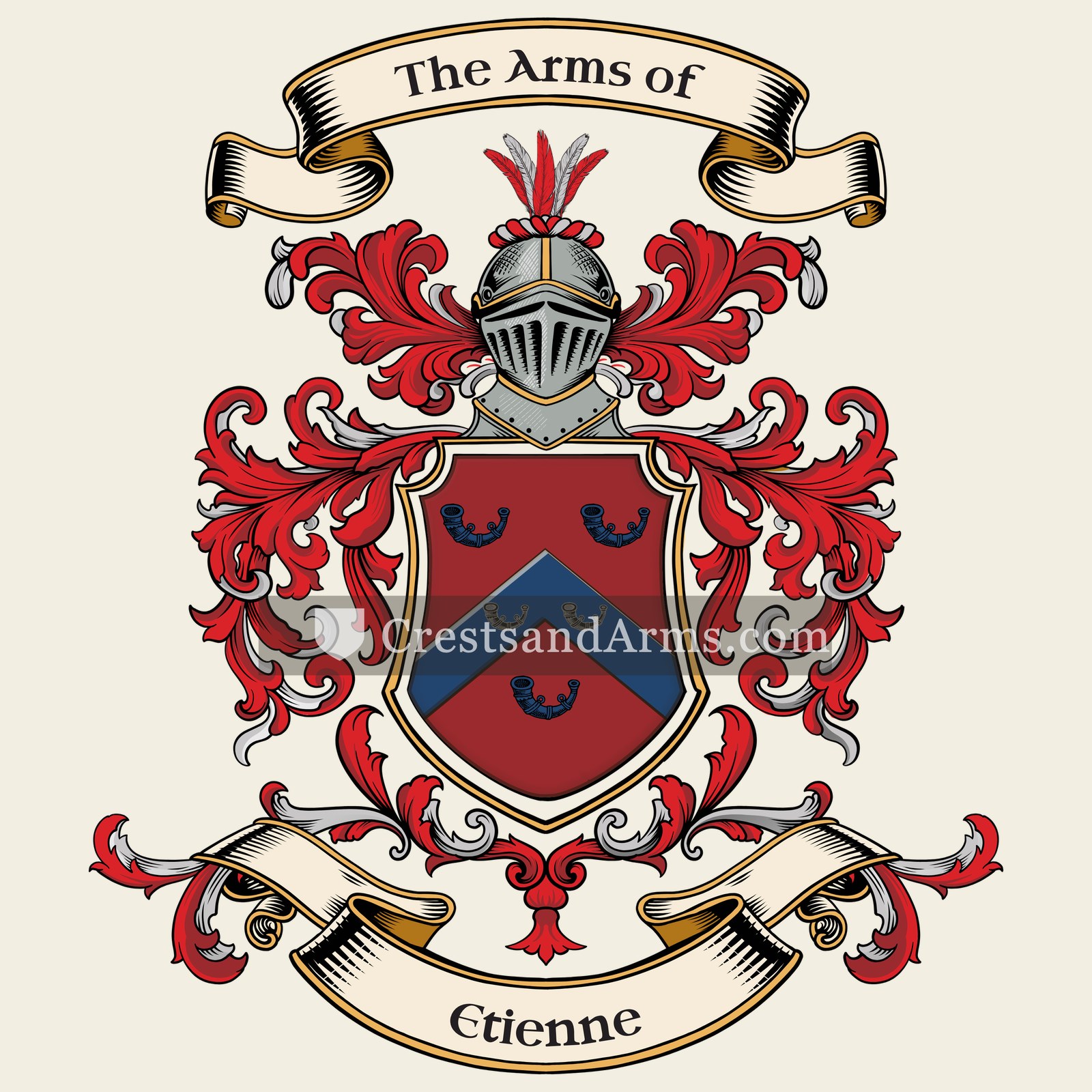
 chevronProtection, and faithful service completed
 hunting horn stringedOne who delights in the chase
 chevronProtection, and faithful service completed
 hunting horn stringedOne who delights in the chase


 martletA younger son, who must win his own land