A record of documented arms, meaning and origin, researched for the Eugene family lines. Documented in 2 countries.
Reg. 7834 · German, D–F
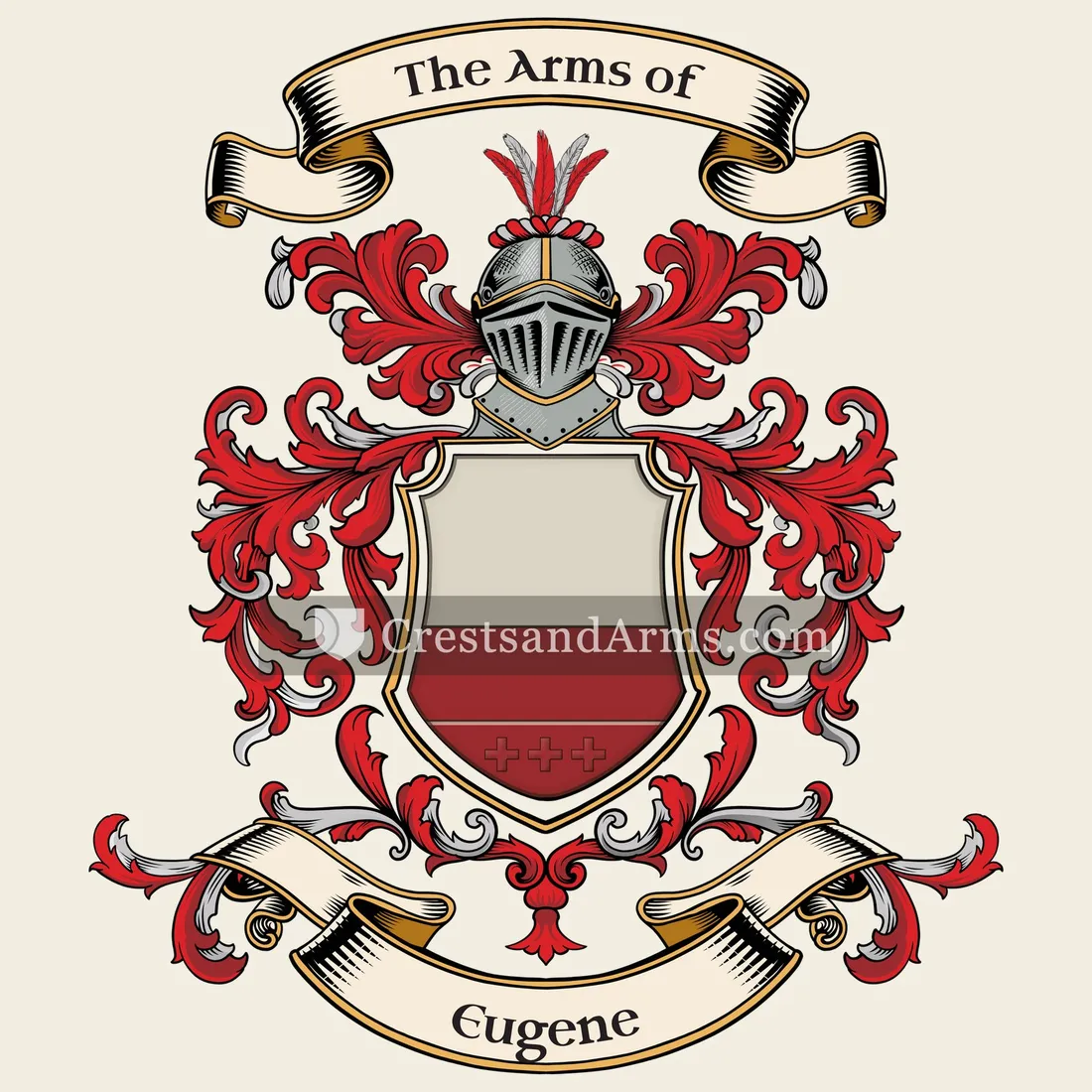
Meaning of the Eugene family crest colors & symbols
Symbols on this shield
cross symbolChristian faith and service
Colours
Silver (Argent)Means: Peace and sincerity
Red (Gules)Means: Military strength
Historical info
Source
J. B. Rietstap, Armorial Général, Gouda: G. B. van Goor Zonen, 1884–87
Blazon (the actual original written record)
“Coupé d'arg. sur gu., le gu. br. par trois créneaux sur l'arg., chaque créneau sommé d'une croisette de gu. C.: une tête et col de chien braque aux armes de l'écu.”
GermanySchwäbisch-Hall Wurt, c. 1765
Digital archive packCoat of arms PNG, gold border print PDF, vector SVG and the certificate of authenticity. Sent to your email in minutes.
Map of Germany showing where the Eugene arms are recorded
The Eugene arms were recorded in Schwäbisch-Hall Wurt, c. 1765.
This is where the arms were entered in the register. Families often moved to other parts of the country, so the same name can turn up in more than one region.
The body that granted and recorded arms in Germany in this period.
Francis I, Holy Roman Emperor
Sovereign of the period
Francis I, Holy Roman Emperor
1745–1765
Reigning in Germany when the Eugene arms are first recorded.
How Arms Worked in Germany
In the Holy Roman Empire, coats of arms were often granted to individuals by the Emperor or his representatives. These arms were then passed down through the generations to all legitimate descendants of the original holder. Younger branches of a family usually kept the same shield design without needing to change it, as the arms belonged to the entire lineage.
Granting authority
The Holy Roman Emperor held the sole power to grant new coats of arms throughout his vast imperial territories.
How they got arms
Families typically obtained their coats of arms through a formal imperial grant or by proving their noble status to the authorities.
Where arms were recorded
These grants were officially recorded in the Imperial Chancery registers, which began keeping formal records of such honors during the Middle Ages.
The family's standing
Recorded among the armigerous families of Germany.
Origin & History of the Eugene Family in Germany
The family name Eugene has deep roots in the historical landscape of southwestern Germany, particularly within the region of Swabia. By the mid-18th century, records confirm that members of the family were established residents of the free imperial city of Schwäbisch Hall. During this era, Schwäbisch Hall was a center of trade and salt production, which likely provided a stable environment for families to settle and grow. The name itself is derived from the Greek word eugenes, meaning well-born or noble, and it gained popularity in German-speaking lands through its association with historical figures and religious traditions. Families living in this region during the 1760s were often part of a tight-knit community defined by local guilds and civic duties. As the family established their presence in this bustling town, they became part of the broader social fabric of the Holy Roman Empire, navigating the changing political and economic conditions of the time.
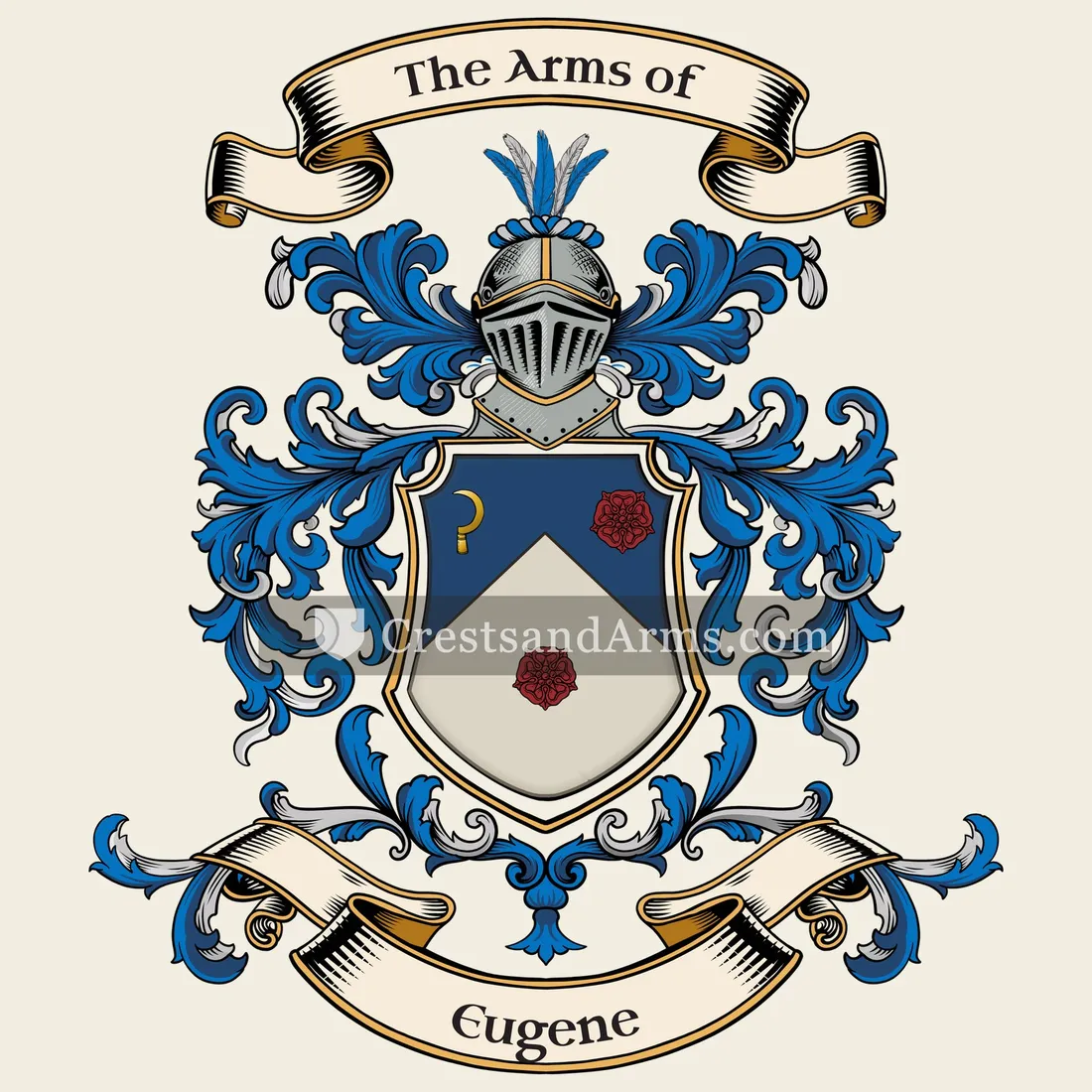
Meaning of the Eugene family crest colors & symbols
Symbols on this shield
sickleThe harvest, and the reaping of what was sown
roseThe seventh son, and beauty with grace
Colours
Blue (Azure)Means: Loyalty and truth
Silver (Argent)Means: Peace and sincerity
Gold (Or)Means: Generosity
Red (Gules)Means: Military strength
Historical info
Source
J. B. Rietstap, Armorial Général, Gouda: G. B. van Goor Zonen, 1884–87
Blazon (the actual original written record)
“D'azur à une herse de labour triangulaire d'or; le champ chapé-ployé d'arg., à deux roses de gu. Cq. cour. C.: un lion iss. d'azur, cour. d'or, entre un vol d'arg., chaque aile ch. d'une rose de gu.; ou: un lion iss. d'or, cour. du même, posé de front; entre un vol, coupé ait. d'azur et de gu., chaque aile ch. d'une rose d'arg., br. sur le coupé. L.: à dextre d'or et d'azur, à sen. d'arg. et de gu.”
Austriac. 1772
Digital archive packCoat of arms PNG, gold border print PDF, vector SVG and the certificate of authenticity. Sent to your email in minutes.
Map of Austria showing where the Eugene arms are recorded
The Eugene arms were recorded in Austria, c. 1772.
Arms such as these were typically recorded in Tyrol.
Tyrol was mountain country in western Austria, where the valleys were held by families who had been there a very long time. Old tenure counted for more than money, and old families carried arms.
This is where the arms were entered in the register. Families often moved to other parts of the country, so the same name can turn up in more than one region.
Region
Tyrol
First recorded
1772
Granting Authority for the Eugene Arms
Imperial and Royal chancery
Sodacan · CC BY-SA 3.0
The body that granted and recorded arms in Austria in this period.
Joseph II, Holy Roman Emperor
Sovereign of the period
Joseph II, Holy Roman Emperor
1765–1790
Reigning in Germany when the Eugene arms are first recorded.
How Arms Worked in Austria
Austrian coats of arms were often linked directly to noble titles granted by the Emperor. These symbols belonged to the entire family line rather than just one individual. When a family grew, new branches kept the original design without needing to change it. This system allowed all members of a noble house to share the same identity across many generations.
Granting authority
The Imperial and Royal chancery managed all heraldic matters and controlled the official granting of arms throughout the Austrian lands.
How they got arms
Families typically received their arms through a formal imperial decree that often accompanied the elevation of a person to noble status.
Where arms were recorded
Official records of these grants were kept in the Imperial Register of Nobility which began its formal documentation process in 1453.
The family's standing
Recorded among the armigerous families of Austria.
Origin & History of the Eugene Family in Austria
The family name Eugene traces its roots in Austria to the mountainous region of Tyrol, where records confirm the presence of family members as early as 1772. During this period, Tyrol was a vital crossroads for trade and cultural exchange within the Habsburg Empire. Families living in this area often took names that reflected their connection to local traditions or the influence of the Catholic Church, which played a central role in daily life. Because the region was geographically isolated by the Alps, families like the Eugenes often maintained strong ties to their specific valleys and villages for generations. The name likely evolved through local dialects as it was recorded in parish registers and tax documents during the late eighteenth century. These early ancestors were likely involved in the agricultural or artisanal work that defined the Tyrolean economy, helping to establish the family as a stable part of the local community before the political shifts of the nineteenth century.
Eugene Meaning & Related Branches
Root word
Eugenios
Derived from the Greek word meaning well-born or noble.
This name
EugeneA name signifying someone of noble birth or high social standing.
Documented Sources
J. B. Rietstap, Armorial Général, Gouda: G. B. van Goor Zonen, 1884–87
Stadtarchiv Schwäbisch Hall, Bürgerbuch der Stadt Schwäbisch Hall (1700–1800)
Kretschmer, Ernst, Geschichte der Stadt Schwäbisch Hall, 1950
Bahlow, Hans, Deutsches Namenlexikon: Familien- und Vornamen nach Ursprung und Sinn erklärt, 1967
Digital archive packCoat of arms PNG, gold border print PDF, vector SVG and the certificate of authenticity. Sent to your email in minutes.


 cross symbolChristian faith and service
 cross symbolChristian faith and service


 sickleThe harvest, and the reaping of what was sown
 roseThe seventh son, and beauty with grace