Map of Britain showing where the Eustace arms are recorded
The Eustace arms were recorded in Britain, c. 1700.
Arms such as these were typically recorded in Kent.
Kent sits between London and the short crossing to Europe, and the trade passing through made it wealthy. Merchant families bought land with that money, and it was landowners who took coats of arms.
This is where the arms were entered in the register. Families often moved to other parts of the country, so the same name can turn up in more than one region.
The body that granted and recorded arms in Britain in this period.
William III of England
Sovereign of the period
William III of England
1694–1702
Reigning in Britain when the Eustace arms are first recorded.
How Arms Worked in Britain
English heraldry allowed arms to be shared by all legitimate descendants of the original owner. These symbols were treated as personal property that moved through the generations to all children. While the eldest son kept the original design, other family members could use the same shield without needing to change it or register their own unique versions.
Granting authority
The College of Arms in London has regulated the use of coats of arms throughout England and Wales since 1484.
How they got arms
Families typically obtained their coats of arms through a formal grant from the Crown or by proving their ancient right to them.
Where arms were recorded
All official coats of arms are recorded in the registers kept at the College of Arms, which date back to the fifteenth century.
The family's standing
Recorded among the armigerous families of Britain.
Origin & History of the Eustace Family in Britain
The surname Eustace originates from the ancient Greek name Eustathios, which translates to mean stable or fruitful. Following the Norman Conquest of 1066, the name was introduced to Britain by settlers from France who held it in high regard due to Saint Eustace, a popular figure in medieval religious tradition. By the time the name became established in the English landscape, it was often used as a given name before evolving into a hereditary surname. Families bearing this name were well-documented in the county of Kent by the early 1700s, where they integrated into the local agricultural and mercantile communities. These early ancestors likely lived as tenant farmers or tradespeople, contributing to the steady growth of the region during a period of significant social and economic change in England. Through the passing of generations, the name remained a consistent marker of identity for these Kentish families as they navigated the transition from rural life into the modern era.
Meaning of the Eustace family crest colors & symbols
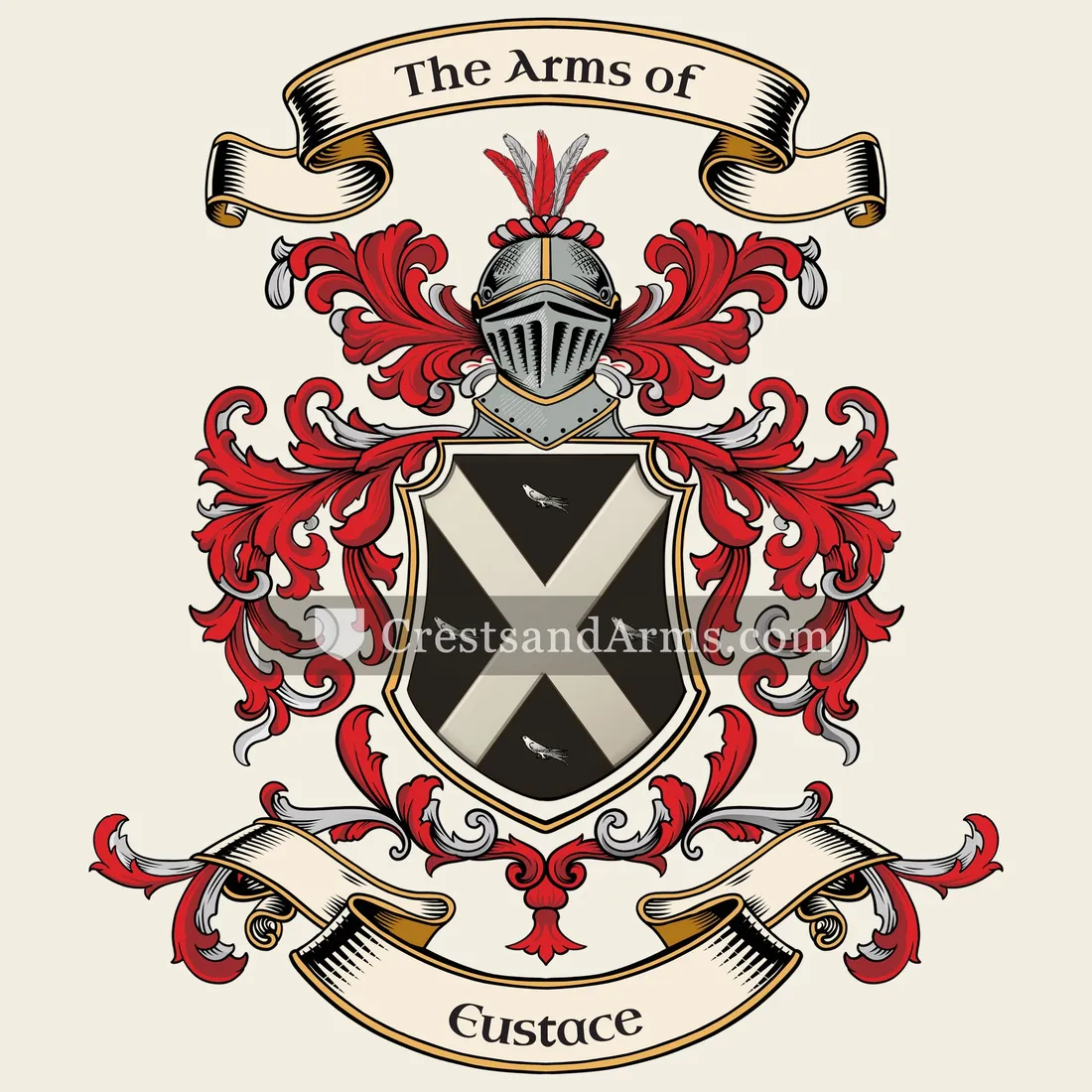
Symbols on this shield
saltireResolution, and St Andrew's cross
martletA younger son, who must win his own land
Colours
Black (Sable)Means: Constancy
Silver (Argent)Means: Peace and sincerity
Historical info
Source
Sir Bernard Burke, The General Armory of England, Scotland, Ireland and Wales, London: Harrison & Sons, 1884
Blazon (the actual original written record)
“Sa. a saltire betw. four martlets ar”
Irelandc. 1645
Digital archive packCoat of arms PNG, gold border print PDF, vector SVG and the certificate of authenticity. Sent to your email in minutes.
Map of Ireland showing where the Eustace arms are recorded
The Eustace arms were recorded in Ireland, c. 1645.
Arms such as these were typically recorded in Dublin.
Dublin was the seat of government in Ireland and the place where grants were sought and recorded. Families with business at the castle or the courts settled nearby, and settling there put their arms on record.
This is where the arms were entered in the register. Families often moved to other parts of the country, so the same name can turn up in more than one region.
The body that granted and recorded arms in Ireland in this period.
Charles I of England
Sovereign of the period
Charles I of England
1625–1649
Reigning in Britain when the Eustace arms are first recorded.
How Arms Worked in Ireland
The Ulster King of Arms granted coats of arms to individuals who proved their social standing and good character. These symbols were typically inherited by all legitimate descendants of the original holder. If a family branch wanted a unique look, they could apply for a specific change to their design through the office to ensure their identity remained distinct.
Granting authority
The Ulster King of Arms acted as the official body that regulated and issued all coats of arms throughout Ireland.
How they got arms
Families obtained their arms through formal grants issued by the office after proving their eligibility and paying the required fees.
Where arms were recorded
All official grants were recorded in the registers held by the Ulster King of Arms starting from the year 1552.
The family's standing
Recorded among the armigerous families of Ireland.
Origin & History of the Eustace Family in Ireland
The Eustace family name arrived in Ireland during the Anglo-Norman invasions of the twelfth century, quickly establishing itself as a prominent force in the social and political life of the Pale. By the time the family was well-documented in Dublin in 1645, they had already spent centuries building influence through land ownership and service to the English Crown. The name itself is derived from the Greek word for fruitful or stable, and the family often held positions of high authority within the Irish administration. During the seventeenth century, the Eustaces were deeply involved in the complex religious and political conflicts of the era, which often placed them at the center of regional power struggles. Their presence in Dublin during the mid-1600s reflects their long-standing role as members of the landed gentry who helped shape the governance and development of the city during a period of significant national transition.
Eustace Meaning & Related Branches
Root word
Eustachius
Derived from the Greek word for fruitful or productive.
This name
EustaceA name signifying one who is stable, steadfast, or fruitful in character.
also spelled
Eustas
Eustache
Eustachius
Estace
Related arms
Eustachiusvariant spelling
Costello, or McCostelioerecorded with Eustace, same area
Documented Sources
J. B. Rietstap, Armorial Général, Gouda: G. B. van Goor Zonen, 1884–87
Reaney, P.H., A Dictionary of English Surnames, 1958
Hanks, Patrick and Hodges, Flavia, A Dictionary of Surnames, 1988
Kent History and Library Centre, Parish Registers of Kent, 1700–1750
Digital archive packCoat of arms PNG, gold border print PDF, vector SVG and the certificate of authenticity. Sent to your email in minutes.


 saltireResolution, and St Andrew's cross
 saltireResolution, and St Andrew's cross
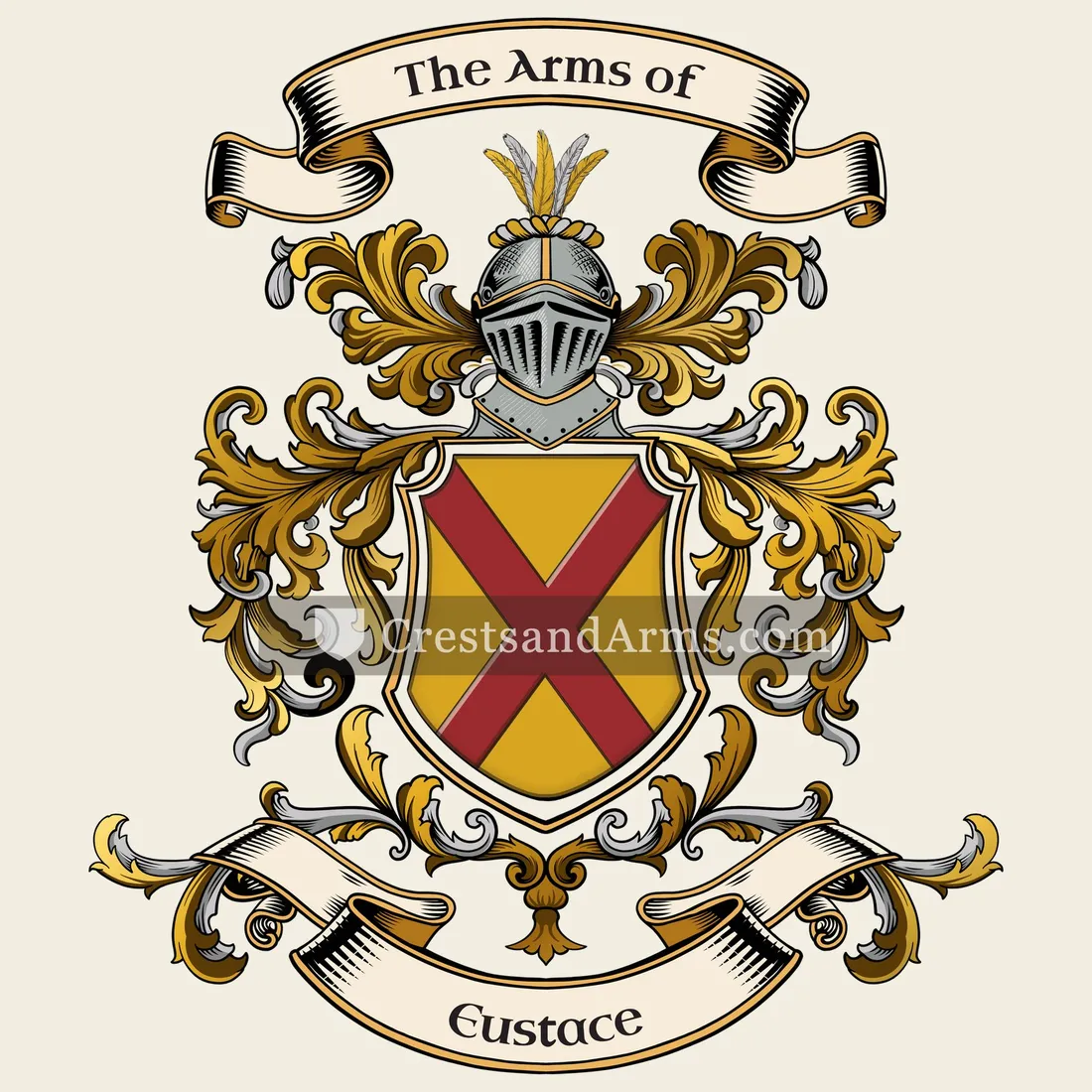


 martletA younger son, who must win his own land