Map of Netherlands showing where the Evers arms are recorded
The Evers arms were recorded in Amsterdam, c. 1815.
This is where the arms were entered in the register. Families often moved to other parts of the country, so the same name can turn up in more than one region.
Region
Amsterdam
Town
Amsterdam
First recorded
1815
Granting Authority for the Evers Arms
Hoge Raad van Adel
Photograph made by me · CC BY-SA 3.0
The body that granted and recorded arms in Netherlands in this period.
William I of the Netherlands
Sovereign of the period
William I of the Netherlands
1815–1840
Reigning in Netherlands when the Evers arms are first recorded.
How Arms Worked in Netherlands
In the Netherlands, coats of arms were often used by noble families and those who held specific public offices. These arms were passed down through the generations to legitimate descendants. Younger branches of a family usually kept the original design without needing to add special marks. This system ensured that the family identity remained clear and consistent over many years.
Granting authority
The Hoge Raad van Adel is the official body that regulates and manages noble titles and coats of arms in the Netherlands.
How they got arms
Families typically obtained their coats of arms through official royal grants or by proving their long-standing historical use of the symbols.
Where arms were recorded
Coats of arms are officially recorded in the registers held by the Hoge Raad van Adel, which began its work in 1814.
The family's standing
Recorded among the armigerous families of Netherlands.
Origin & History of the Evers Family in Netherlands
The family name Evers is a patronymic surname, which means it originated as a way to identify a person as the son of someone named Ever or Evert. This given name is a shortened form of the Germanic name Everhard, which translates to brave as a wild boar. By the early nineteenth century, the name was well-established among the urban population of the Netherlands. When records confirm the presence of the Evers family in Amsterdam in 1815, they were living in a city undergoing significant political change following the end of the Napoleonic era. During this period, the Dutch government began requiring citizens to register their surnames formally for tax and census purposes. This transition helped solidify the spelling of the name as it moved from spoken tradition into official municipal records. Families like the Evers in Amsterdam were part of a growing merchant and artisan class that helped define the city as a center of trade and culture after the French occupation ended.
Coat of Arms & Family Crest Details
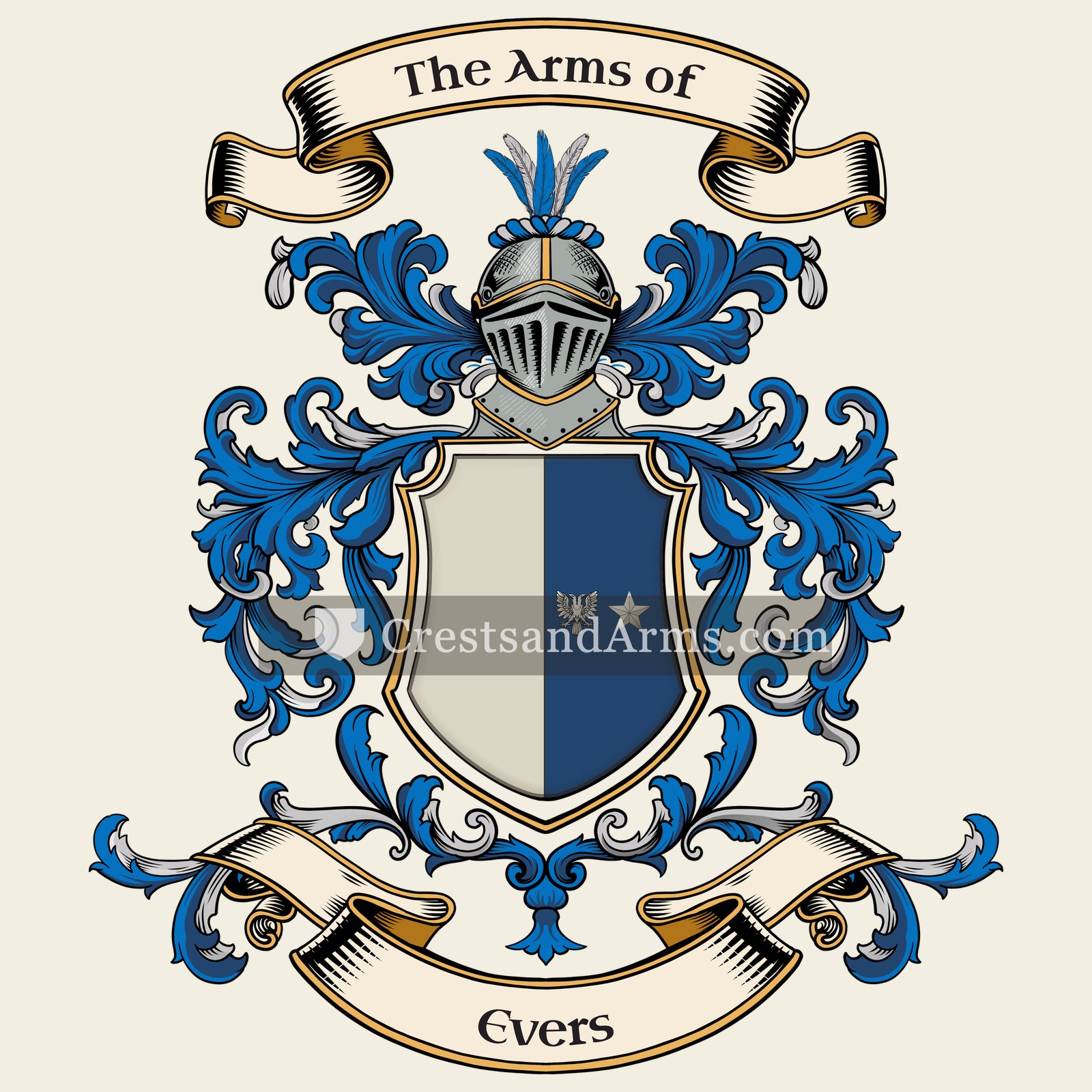
Symbols on this shield
eagleNobility, strength and a keen mind
mulletThe third son, and a divine quality from above
Colours
Silver (Argent)Means: Peace and sincerity
Blue (Azure)Means: Loyalty and truth
Historical info
Source
J. B. Rietstap, Armorial Général, Gouda: G. B. van Goor Zonen, 1884–87
Blazon (the actual original written record)
“Parti: au 1 taillé d'arg. sur gu.; au 2 d'azur à la demi-aigle d'arg., mouv. du parti, acc. en chef à sen. d'une étoile du même. C.: une couronne à l'antique d'or, entre un vol d'arg.”
Germanyc. 1765
Digital archive packCoat of arms PNG, gold border print PDF, vector SVG and the certificate of authenticity. Sent to your email in minutes.
Map of Germany showing where the Evers arms are recorded
The Evers arms were recorded in Germany, c. 1765.
Arms such as these were typically recorded in Bavaria.
Bavaria was a country of old landed families and walled market towns. Estates passed down the same line for centuries, and both the landowners and the leading townsmen kept arms, which is why so many Bavarian names sit in the registers.
This is where the arms were entered in the register. Families often moved to other parts of the country, so the same name can turn up in more than one region.
The body that granted and recorded arms in Germany in this period.
Francis I, Holy Roman Emperor
Sovereign of the period
Francis I, Holy Roman Emperor
1745–1765
Reigning in Netherlands when the Evers arms are first recorded.
How Arms Worked in Germany
In the Holy Roman Empire, coats of arms were often granted to individuals by the Emperor or his representatives. These arms were then passed down through the generations to all legitimate descendants of the original holder. Younger branches of a family usually kept the same shield design without needing to change it, as the arms belonged to the entire lineage.
Granting authority
The Holy Roman Emperor held the sole power to grant new coats of arms throughout his vast imperial territories.
How they got arms
Families typically obtained their coats of arms through a formal imperial grant or by proving their noble status to the authorities.
Where arms were recorded
These grants were officially recorded in the Imperial Chancery registers, which began keeping formal records of such honors during the Middle Ages.
The family's standing
Recorded among the armigerous families of Germany.
Origin & History of the Evers Family in Germany
The surname Evers is deeply rooted in the linguistic traditions of Northern Germany, where it originated as a patronymic name derived from the Germanic personal name Eberhard. This name translates to "brave boar," a term that reflected the cultural values of strength and resilience in early Germanic societies. While the name was most common in the northern regions, migration patterns eventually spread the family across the German states. By the year 1765, records confirm that members of the Evers family were well-established in Bavaria. During this period, families like the Evers were often tied to the land through agriculture or specialized trade guilds. As they settled into the Bavarian landscape, they became part of the local social fabric, contributing to the growth of their communities through their work and daily interactions. This transition from the northern roots to the southern regions highlights the mobility of families during the eighteenth century as they sought new opportunities within the Holy Roman Empire.
Coat of Arms & Family Crest Details
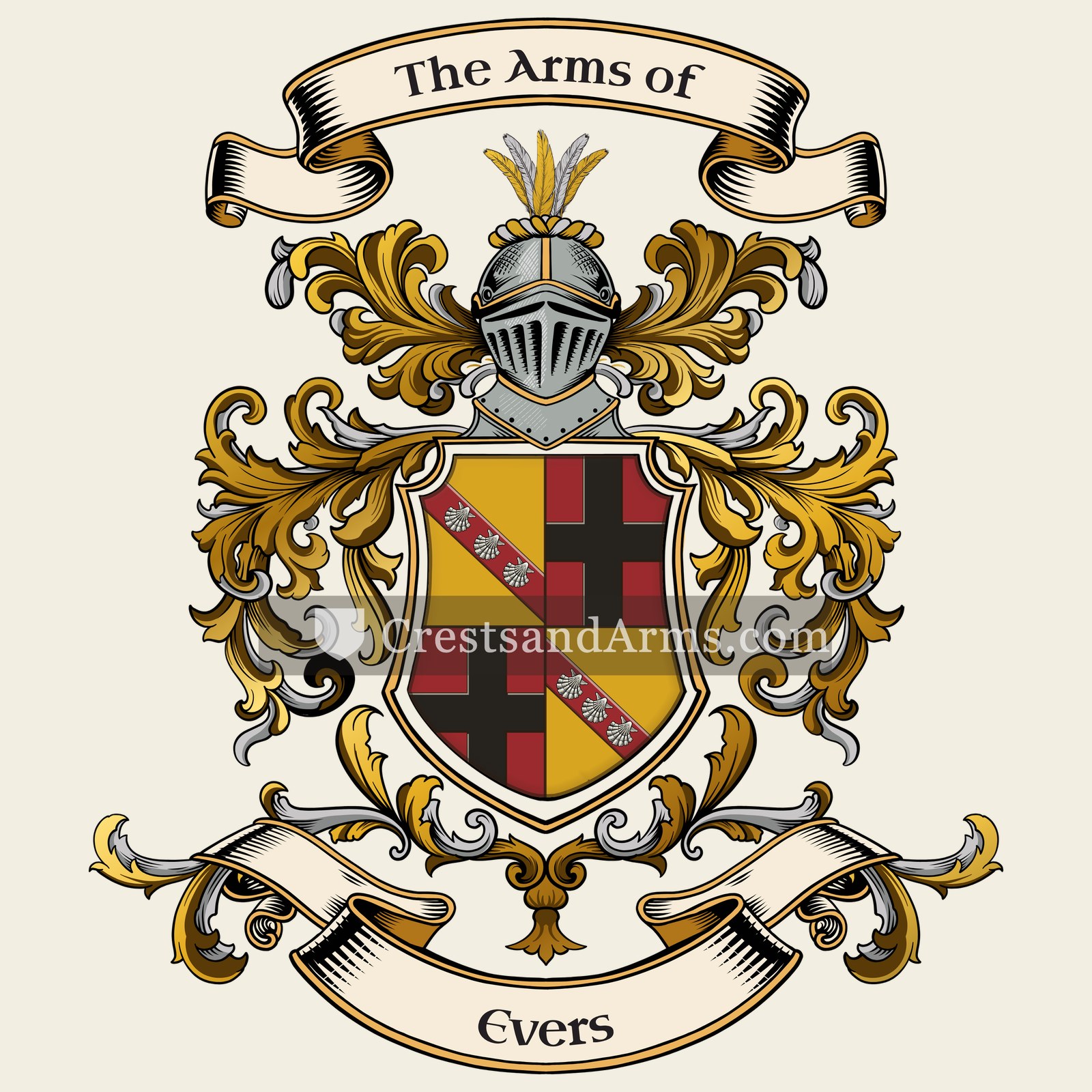
Symbols on this shield
bendDefence, and the scarf of a commander
cross symbolChristian faith and service
escallopThe pilgrim's shell, and a long journey made
Colours
Gold (Or)Means: Generosity
Red (Gules)Means: Military strength
Black (Sable)Means: Constancy
Silver (Argent)Means: Peace and sincerity
Historical info
Source
Sir Bernard Burke, The General Armory of England, Scotland, Ireland and Wales, London: Harrison & Sons, 1884
Blazon (the actual original written record)
“Quarterly, or and gu. on a bend of the second three escallops ar., quartering or, a cross sa”
Irelandc. 1645
Digital archive packCoat of arms PNG, gold border print PDF, vector SVG and the certificate of authenticity. Sent to your email in minutes.
Map of Ireland showing where the Evers arms are recorded
The Evers arms were recorded in Ireland, c. 1645.
Arms such as these were typically recorded in Dublin.
Dublin was the seat of government in Ireland and the place where grants were sought and recorded. Families with business at the castle or the courts settled nearby, and settling there put their arms on record.
This is where the arms were entered in the register. Families often moved to other parts of the country, so the same name can turn up in more than one region.
The body that granted and recorded arms in Ireland in this period.
Charles I of England
Sovereign of the period
Charles I of England
1625–1649
Reigning in Netherlands when the Evers arms are first recorded.
How Arms Worked in Ireland
The Ulster King of Arms granted coats of arms to individuals who proved their social standing and good character. These symbols were typically inherited by all legitimate descendants of the original holder. If a family branch wanted a unique look, they could apply for a specific change to their design through the office to ensure their identity remained distinct.
Granting authority
The Ulster King of Arms acted as the official body that regulated and issued all coats of arms throughout Ireland.
How they got arms
Families obtained their arms through formal grants issued by the office after proving their eligibility and paying the required fees.
Where arms were recorded
All official grants were recorded in the registers held by the Ulster King of Arms starting from the year 1552.
The family's standing
Recorded among the armigerous families of Ireland.
Origin & History of the Evers Family in Ireland
The family name Evers has a long and documented history in Ireland, particularly within the city of Dublin. By 1645, records confirm that members of the Evers family were firmly established as residents of the capital. During this period, Dublin was a bustling center of trade and political activity, and families like the Evers often played roles in the urban life of the city. While the name itself has roots that stretch back to older European naming traditions, its presence in Ireland during the mid-seventeenth century suggests that the family was part of the social fabric of the Pale. Over the following generations, the family continued to integrate into the local community, leaving traces of their lives in property deeds, legal documents, and parish registers. These early records provide a clear window into how the family navigated the changing landscape of Irish history during a time of significant transition.
Evers Meaning & Related Branches
Root word
Everhard
Derived from Germanic elements meaning brave or hardy wild boar.
This name
EversA patronymic surname signifying son of Everhard, representing strength and courage.
also spelled
Eversz
Eversen
Eversse
Evres
Evars
Related arms
Beesimilar arms
Iverssimilar arms
Documented Sources
J. B. Rietstap, Armorial Général, Gouda: G. B. van Goor Zonen, 1884–87
Meertens, P.J., Voornamen in Nederland, 1951
Van der Schaar, J., Woordenboek van voornamen, 1964
Stadsarchief Amsterdam, Bevolkingsregister 1815
Digital archive packCoat of arms PNG, gold border print PDF, vector SVG and the certificate of authenticity. Sent to your email in minutes.


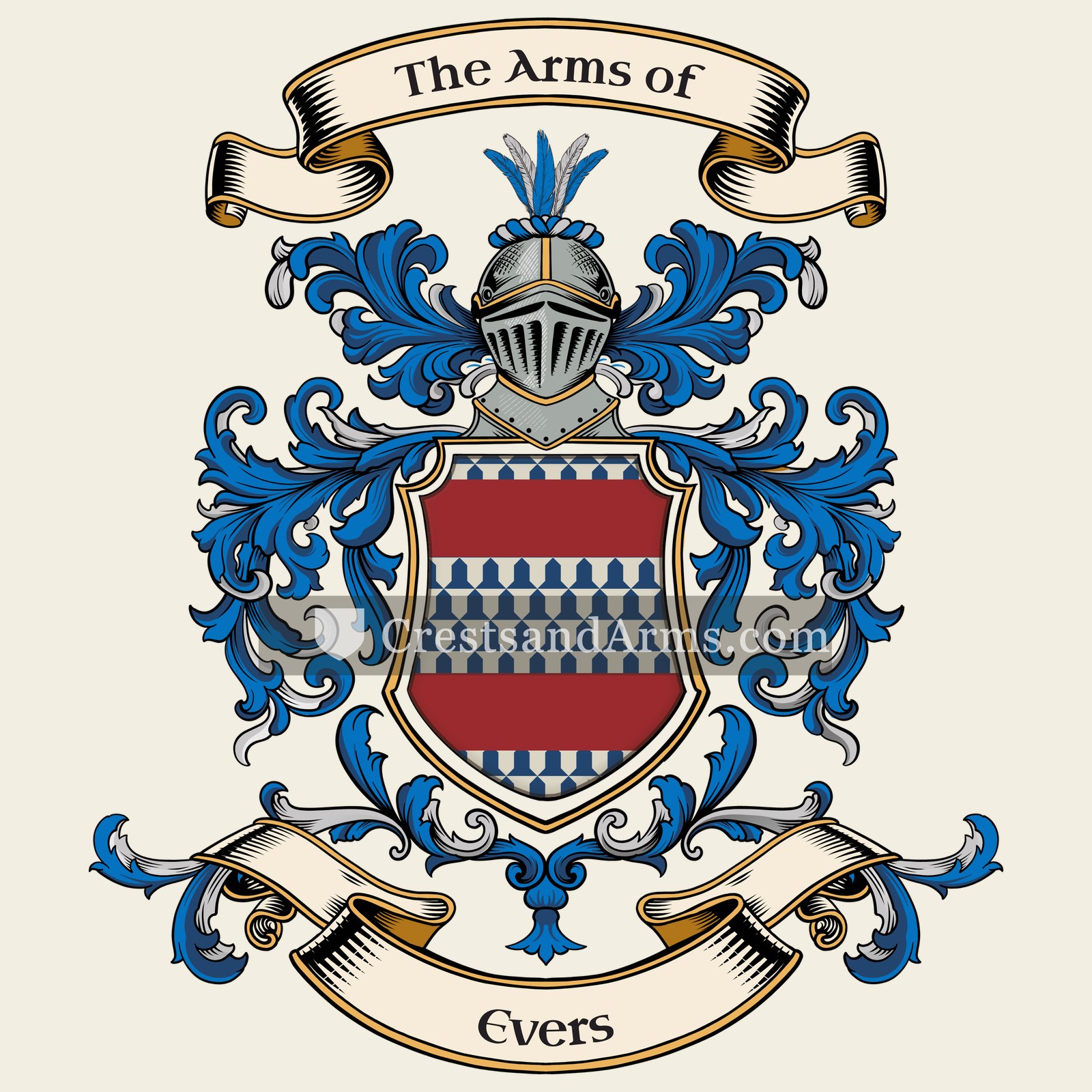
 fessThe military belt, and readiness to serve
 fessThe military belt, and readiness to serve


 eagleNobility, strength and a keen mind
 mulletThe third son, and a divine quality from above


 bendDefence, and the scarf of a commander
 cross symbolChristian faith and service
 escallopThe pilgrim's shell, and a long journey made