Map of England showing where the Evette arms are recorded
The Evette arms were recorded in Worcester, c. 1634.
Worcestershire was orchard and farming country with a scattering of old manors. Its gentry were middling rather than great, but a manor was a manor, and holding one was what brought arms.
This is where the arms were entered in the register. Families often moved to other parts of the country, so the same name can turn up in more than one region.
The body that granted and recorded arms in England in this period.
Charles I of England
Sovereign of the period
Charles I of England
1625–1649
Reigning in England when the Evette arms are first recorded.
How Arms Worked in England
English heraldry allowed arms to be shared by all legitimate descendants of the original owner. These symbols were treated as personal property that moved through the generations to all children. While the eldest son kept the original design, other family members could use the same shield without needing to change it or register their own unique versions.
Granting authority
The College of Arms in London has regulated the use of coats of arms throughout England and Wales since 1484.
How they got arms
Families typically obtained their coats of arms through a formal grant from the Crown or by proving their ancient right to them.
Where arms were recorded
All official coats of arms are recorded in the registers kept at the College of Arms, which date back to the fifteenth century.
The family's standing
Recorded among the armigerous families of Worcester.
Origin & History of the Evette Family in England
The surname Evette is a variant of the French name Yvette, which traces its roots back to the medieval period as a diminutive form of Yves. The name is derived from the Germanic word for the yew tree, a plant that held great significance in early European culture as a symbol of longevity and resilience. By the time the family arrived in Worcester in 1634, the name had already undergone several linguistic shifts as it traveled across borders. Early members of the family were part of the initial wave of settlers who helped establish the foundations of the town during the seventeenth century. These early pioneers were likely drawn to the region by the promise of agricultural stability and the growth of local trade. Living in a frontier environment, the family played a quiet but essential role in the development of the community as it transitioned from a small settlement into a more permanent colonial hub.
Evette Meaning & Related Branches
Root word
Ivo
A Germanic name derived from the yew tree.
This name
EvetteA diminutive form meaning little yew tree or archer.
also spelled
Evitt
Evatt
Evot
Documented Sources
Sir Bernard Burke, The General Armory of England, Scotland, Ireland and Wales, London: Harrison & Sons, 1884
Dauzat, Albert. Dictionnaire étymologique des noms de famille et prénoms de France. 1951
Morlet, Marie-Thérèse. Dictionnaire étymologique des noms de famille. 1991
Worcestershire Archive and Archaeology Service, Parish Registers of Worcester
Digital archive packCoat of arms PNG, gold border print PDF, vector SVG and the certificate of authenticity. Sent to your email in minutes.


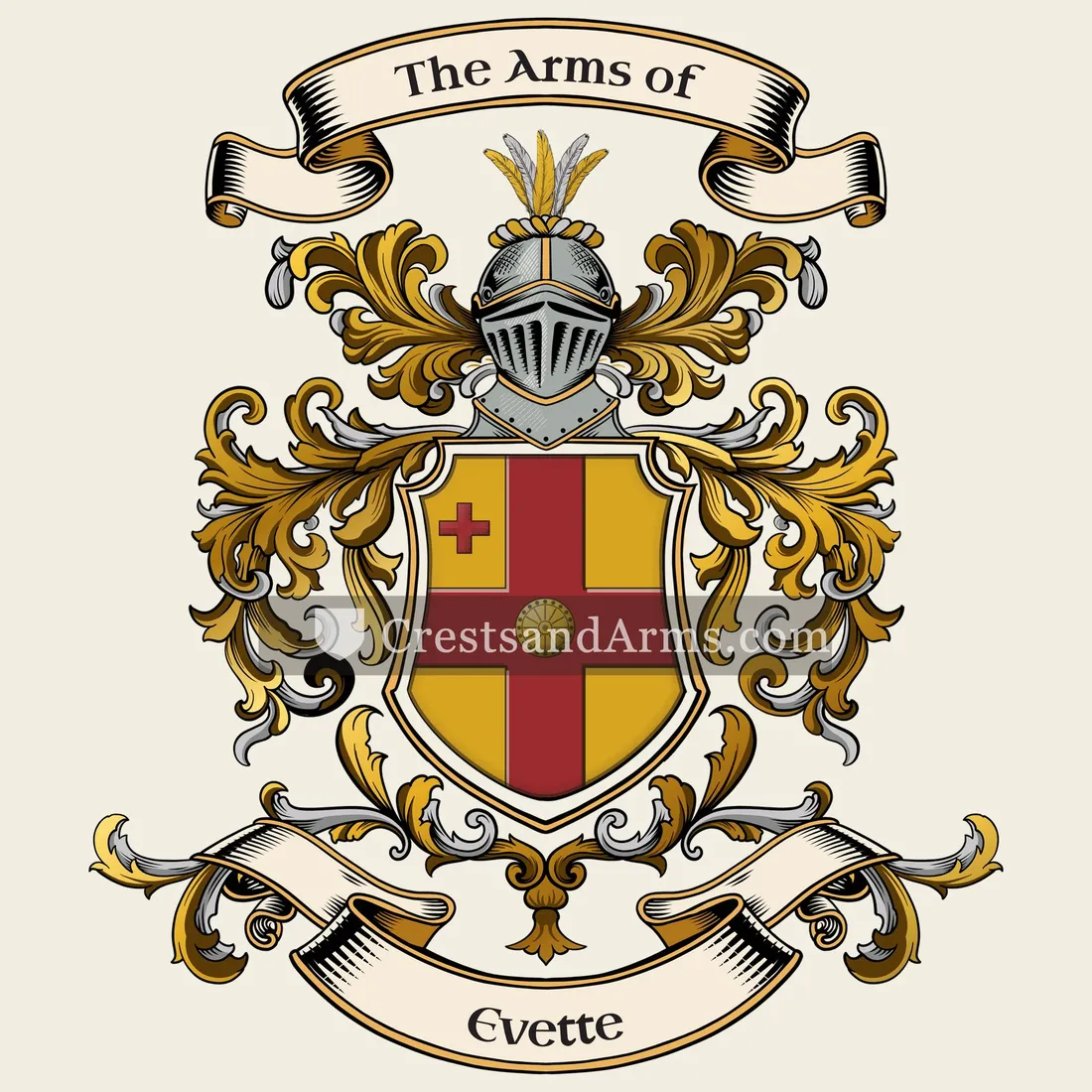
 cross symbolChristian faith and service
 roundelA coin, and one who has been to the crusades
 cross symbolChristian faith and service
 roundelA coin, and one who has been to the crusades