Map of Belgium showing where the Ewell arms are recorded
The Ewell arms were recorded in Luxemb, c. 1737.
This is where the arms were entered in the register. Families often moved to other parts of the country, so the same name can turn up in more than one region.
The body that granted and recorded arms in Belgium in this period.
Charles VI, Holy Roman Emperor
Sovereign of the period
Charles VI, Holy Roman Emperor
1711–1740
Reigning in Belgium when the Ewell arms are first recorded.
How Arms Worked in Belgium
In Belgium, a coat of arms is considered personal property that is passed down through the male line to legitimate descendants. Families often use the same shield design across generations to show their shared heritage. If a branch of the family wants to change the design, they must apply for an official update to their specific version of the arms.
Granting authority
The Conseil héraldique is the official body that regulates and approves all coats of arms in Belgium.
How they got arms
Families obtain their coats of arms through formal royal grants or by confirming their historical right to use existing designs.
Where arms were recorded
All approved coats of arms are officially recorded in the public registers of the Conseil héraldique since 1844.
The family's standing
Recorded among the armigerous families of Belgium.
Origin & History of the Ewell Family in Belgium
The Ewell family name carries a history deeply rooted in the movement of people across European borders during the eighteenth century. While the name has strong historical ties to England, records confirm that members of the family were established in the region of Luxembourg by 1737. During this period, the area was part of the Austrian Netherlands, a time characterized by significant social and economic shifts that often prompted families to settle in new territories. These early ancestors likely lived as farmers or tradespeople, contributing to the local community while maintaining the traditions associated with their surname. As they navigated the challenges of life in the Holy Roman Empire, the family began to build the foundation that would eventually lead to their migration and expansion into other parts of the world.
Ewell Meaning & Related Branches
Root word
Ew
Old English term for a yew tree or water source.
This name
EwellDerived from a topographic location near a yew tree or a stream.
also spelled
Elle
Documented Sources
J. B. Rietstap, Armorial Général, Gouda: G. B. van Goor Zonen, 1884–87
Luxembourg National Archives, État civil, Registres paroissiaux
Muller, Jean-Claude, Les familles luxembourgeoises au XVIIIe siècle, 1985
Digital archive packCoat of arms PNG, gold border print PDF, vector SVG and the certificate of authenticity. Sent to your email in minutes.


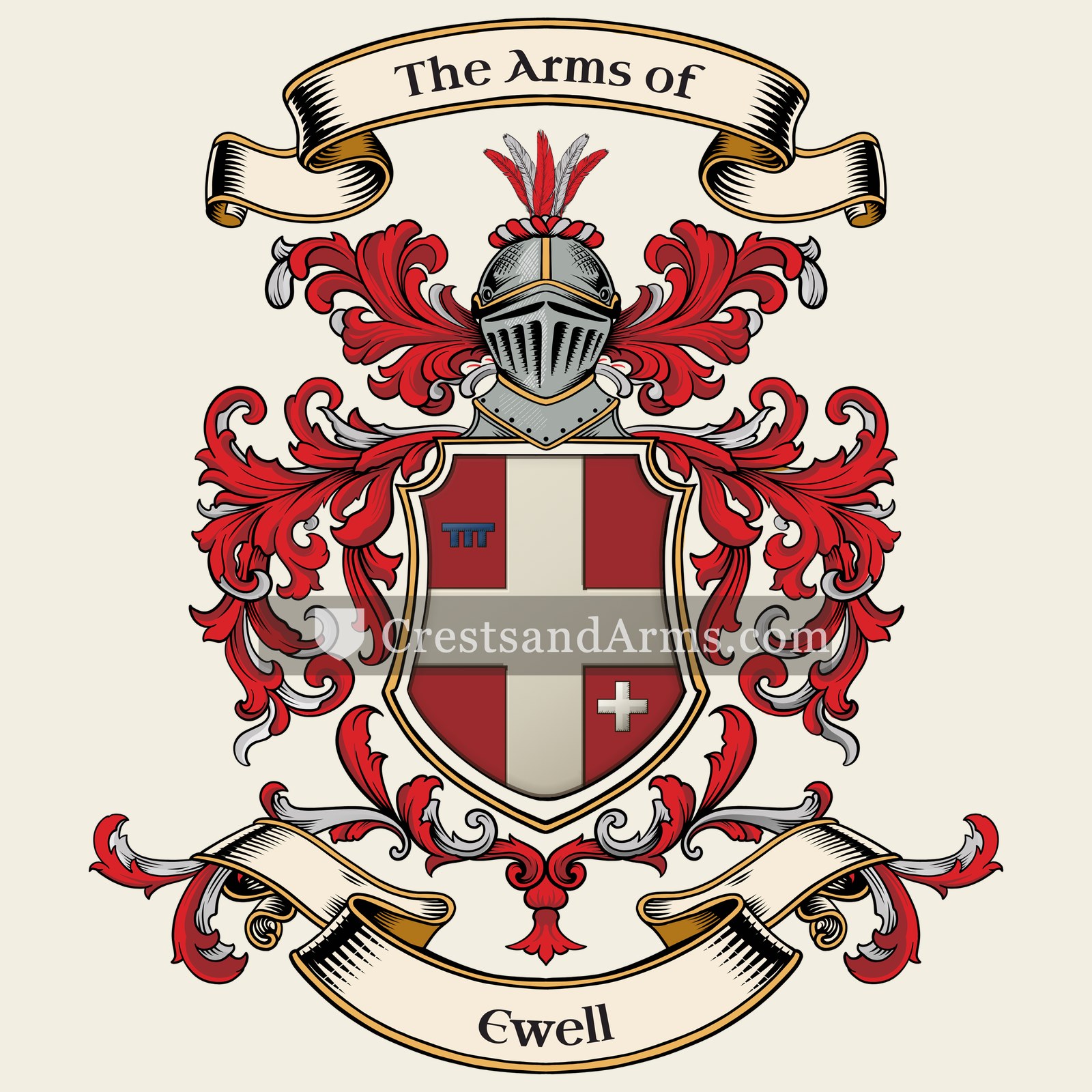
 cross symbolChristian faith and service
 labelThe eldest son, during his father's life
 cross symbolChristian faith and service
 labelThe eldest son, during his father's life