A record of documented arms, meaning and origin, researched for the Ewers family lines. Documented in 2 countries.
Reg. 2640 · Polish, D–F
Coat of Arms & Family Crest Details
Symbols on this shield
chiefAuthority, wisdom and dominion
mulletThe third son, and a divine quality from above
fleur de lisPurity, light, and the sixth son
Colours
Black (Sable)Means: Constancy
Red (Gules)Means: Military strength
Gold (Or)Means: Generosity
Historical info
Source
J. B. Rietstap, Armorial Général, Gouda: G. B. van Goor Zonen, 1884–87
Blazon (the actual original written record)
“De sa. à cinq étoiles d'or, 3 et 2; au chef de gu., ch. de trois fleurs-de-lis d'or. Cq. cour. C.: cinq plumes de paon au nat. L.: à dextre d'or et de gu., à sen. d'or et de sa.”
LivoniaLivonia, c. 1772
Digital archive packCoat of arms PNG, gold border print PDF, vector SVG and the certificate of authenticity. Sent to your email in minutes.
Map of Poland showing where the Ewers arms are recorded
The Ewers arms were recorded in Livonia, c. 1772.
Livonia was Baltic country held by a small number of landed families who kept their estates for centuries. Land there passed down whole rather than being divided, and long unbroken tenure is what fills a register.
This is where the arms were entered in the register. Families often moved to other parts of the country, so the same name can turn up in more than one region.
Region
Livonia
First recorded
1772
Granting Authority for the Ewers Arms
Ennoblement by the Sejm
Author: Olek Remesz · CC BY-SA 3.0
The body that granted and recorded arms in Poland in this period.
Stanisław August Poniatowski
Sovereign of the period
Stanisław August Poniatowski
1764–1795
Reigning in Poland when the Ewers arms are first recorded.
How Arms Worked in Poland
Polish noble families shared a single coat of arms across many different surnames, creating large clans rather than individual designs. These symbols were held collectively by all members of the clan regardless of their specific family name. When a new family joined the nobility, they were adopted into an existing clan and began using that group's established shield.
Granting authority
The Sejm, which was the Polish parliament, held the power to grant noble status and the right to bear arms.
How they got arms
Families typically received their coat of arms through a formal act of ennoblement granted by the Sejm for distinguished service.
Where arms were recorded
These grants were officially recorded in the Crown Metrica, which served as the central archive for state documents starting in the sixteenth century.
The family's standing
Recorded among the armigerous families of Livonia.
Origin & History of the Ewers Family in Poland
The family name Ewers has deep roots in the Baltic region, particularly within the historic territory of Livonia. By 1772, when the First Partition of Poland brought parts of this region under new administrative influences, the Ewers family was already established as part of the local social fabric. The name itself is of Germanic origin, likely derived from a shortened form of names like Everhard, which means brave or strong as a wild boar. As the borders of the Polish-Lithuanian Commonwealth shifted during the late 18th century, families like the Ewers often navigated a complex landscape of changing loyalties and shifting cultural identities. Because Livonia served as a crossroads for German, Baltic, and Polish influences, the family members were part of a unique group that moved between these different worlds. Their presence in the region during this time highlights how families adapted to the political upheavals that redefined Eastern Europe throughout the 1700s.
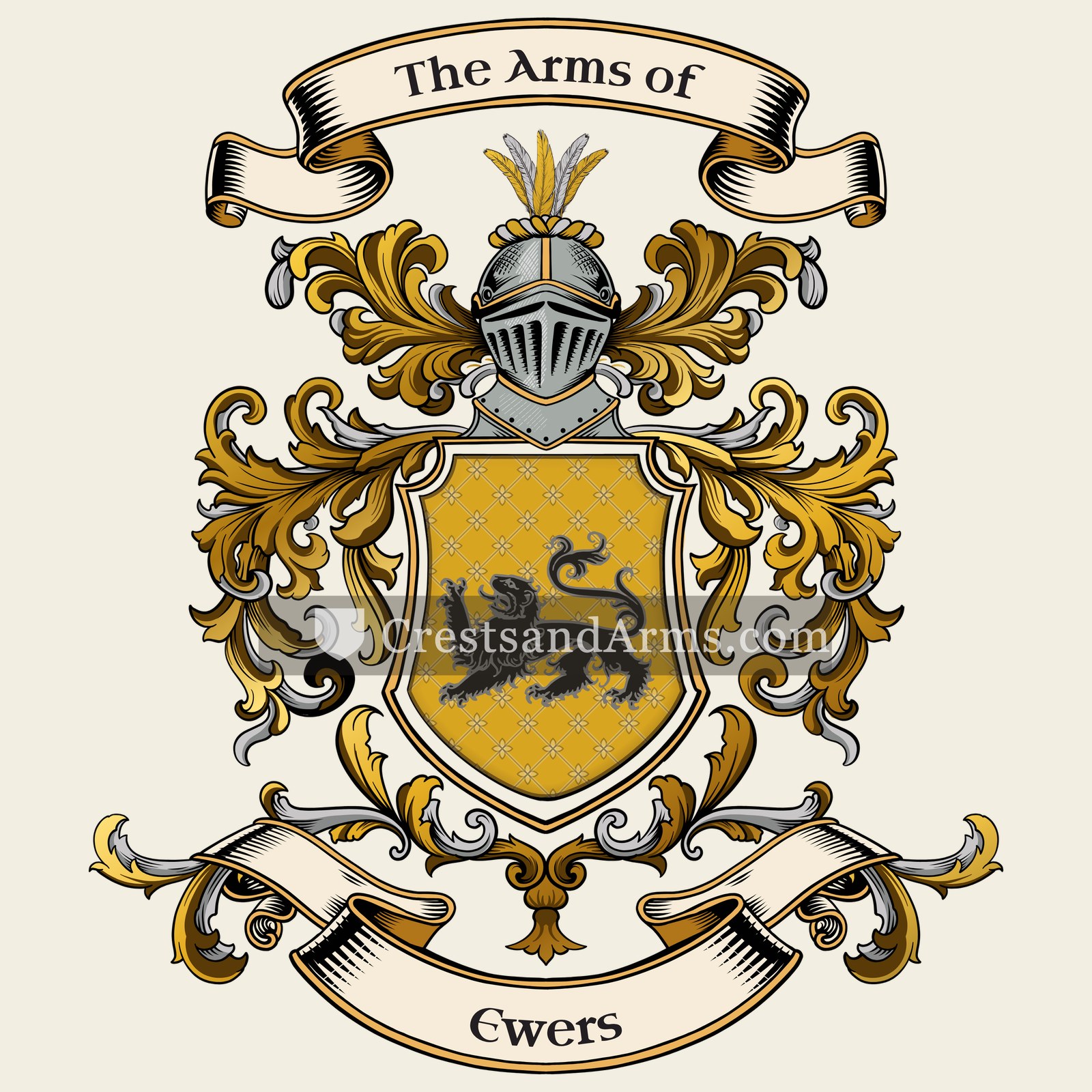
Coat of Arms & Family Crest Details
Symbols on this shield
lionCourage, strength and royalty
Colours
Gold (Or)Means: Generosity
Black (Sable)Means: Constancy
Historical info
Source
Sir Bernard Burke, The General Armory of England, Scotland, Ireland and Wales, London: Harrison & Sons, 1884
Blazon (the actual original written record)
“Or, an heraldic tiger pass. sa”
Irelandc. 1645
Digital archive packCoat of arms PNG, gold border print PDF, vector SVG and the certificate of authenticity. Sent to your email in minutes.
Map of Ireland showing where the Ewers arms are recorded
The Ewers arms were recorded in Ireland, c. 1645.
Arms such as these were typically recorded in Dublin.
Dublin was the seat of government in Ireland and the place where grants were sought and recorded. Families with business at the castle or the courts settled nearby, and settling there put their arms on record.
This is where the arms were entered in the register. Families often moved to other parts of the country, so the same name can turn up in more than one region.
The body that granted and recorded arms in Ireland in this period.
Charles I of England
Sovereign of the period
Charles I of England
1625–1649
Reigning in Poland when the Ewers arms are first recorded.
How Arms Worked in Ireland
The Ulster King of Arms granted coats of arms to individuals who proved their social standing and good character. These symbols were typically inherited by all legitimate descendants of the original holder. If a family branch wanted a unique look, they could apply for a specific change to their design through the office to ensure their identity remained distinct.
Granting authority
The Ulster King of Arms acted as the official body that regulated and issued all coats of arms throughout Ireland.
How they got arms
Families obtained their arms through formal grants issued by the office after proving their eligibility and paying the required fees.
Where arms were recorded
All official grants were recorded in the registers held by the Ulster King of Arms starting from the year 1552.
The family's standing
Recorded among the armigerous families of Ireland.
Origin & History of the Ewers Family in Ireland
The history of the Ewers family in Ireland is deeply connected to the turbulent political landscape of the seventeenth century. While the name itself has roots in England as a term for a servant who provided water for washing, the family established a notable presence in Dublin by 1645. During this period, Ireland was caught in the midst of the Irish Confederate Wars, a time when many families moved across the Irish Sea due to shifting military and economic alliances. Members of the Ewers family who settled in Dublin during this era likely integrated into the urban merchant or administrative classes that defined the city at the time. Their presence in the capital suggests they were part of the growing population of settlers and tradespeople who navigated the complex social changes following the Cromwellian conquest. By establishing themselves in Dublin during the mid-1600s, the early Ewers family became part of the long history of migration that shaped the modern demographic of the city.
Ewers Meaning & Related Branches
Root word
Eberhard
Derived from the Germanic elements for wild boar and brave or hardy.
This name
EwersA patronymic surname indicating descent from a person whose name was a variant of Eberhard.
also spelled
Ewersz
Ewersen
Ewersse
Eweres
Documented Sources
J. B. Rietstap, Armorial Général, Gouda: G. B. van Goor Zonen, 1884–87


 chiefAuthority, wisdom and dominion
 mulletThe third son, and a divine quality from above
 fleur de lisPurity, light, and the sixth son
 chiefAuthority, wisdom and dominion
 mulletThe third son, and a divine quality from above
 fleur de lisPurity, light, and the sixth son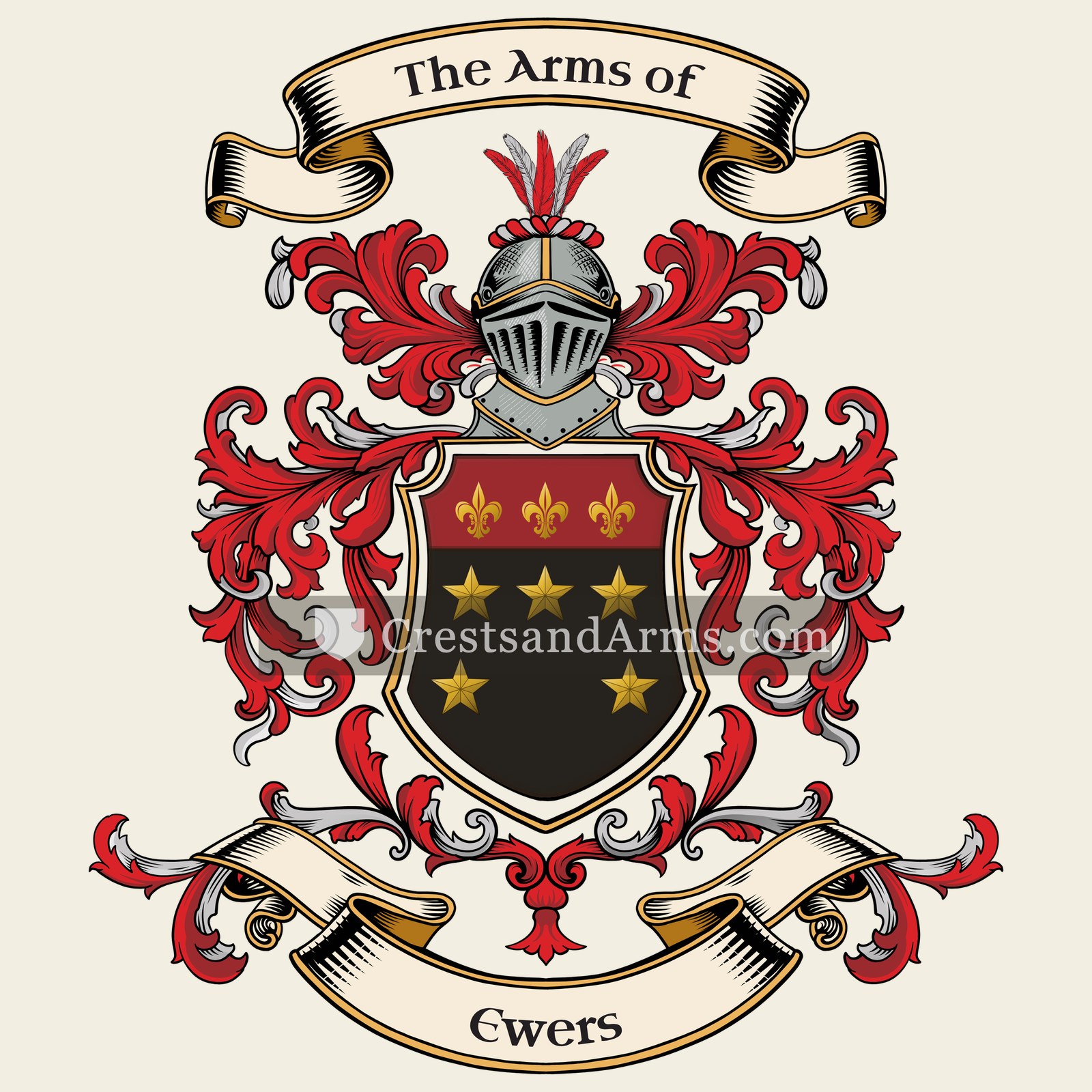


 lionCourage, strength and royalty